Matt Reynolds (00:02):
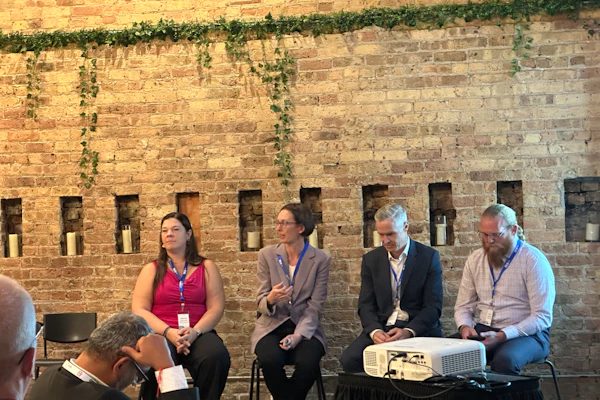
Hi, I'm Matt Reynolds. I'm the chief editor of Packaging World Magazine and I'm here in Phoenix this week at the ista. That's the International Safe Transit Association. And we listened to quite a few interesting conversations, presentations. One that really jumped off the page for me was with Google, with Ken L. So Ken, why don't you introduce yourself first and what it is you do, and then we'll get into the details of the presentation.
Ken Leung, Google (00:41):
My name is Ken. I've been doing shock and vibration testing at Google for 15 years now, and that means preparing all the Google's data center hardware, the racks, the servers, the line cars, the switches already for the transportation and handling around the world.
Matt Reynolds (00:58):
Right, because they're not building these racks at these data center sites, right? That's right. They build them at one place and then you've got a complete rack that can basically be plugged in.
Ken Leung, Google (01:09):
The supply chain is completely complicated. It's really, really complicated. You may have servers that are built in Asia. You may have racks that are built in America and then they have to integrate together somewhere else in the world, wherever it is maybe closer to where the data center is going to be, integrated there as a fully populated rack full of machines. And this goes on an air ride truck or your normal typical trucks and it goes to the data center and you want to be able to wheel this off the truck, go directly inside and plug it in and turn it on.
Matt Reynolds (01:43):
That's
Ken Leung, Google (01:43):
The goal.
Matt Reynolds (01:44):
Okay. So I think it stands to reason, but why is vibration and movement, I mean it's vibration and what's your specialty? Vibration and shock, shock and vibration. Why is it such a big issue for today's hardware? And this isn't just the biggest and heaviest pieces of equipment. This is down to, you can imagine this being an issue for let's say cell phones or computer equipment that's on the consumer side. Why is shock and vibration such a big issue?
Ken Leung, Google (02:15):
Anytime you have a physical hardware where you're building it somewhere else than the place is going to be used at, you're going to be introducing this movement to your product. Depending on how you package it and depending on what kind of truck you use, that vibration could go inside the product and cause damages that you might even never imagine. So fractures down to the material layer and start cracking. And once things start cracking, it's going to fall apart. And you don't want to want damaged product getting to your customers. You don't want damaged packaging actually to get to your customer. So they're important in both sides.
Matt Reynolds (02:55):
So this would translate to the consumer side to anything that's got a lot of componentry in it. Anything that's say a solid state is probably less susceptible to this. But when you've got components that are joined together, soldering, soldered, for instance, together or wired together, all of this vibration, any one of these points where the two pieces interact can be a problem, but it's also the physical solid structures too, that bend, break, they undergo tension and compression are issues. So these are all things that you're trying to solve for good. You said that failures can show up later and it's almost better when you roll this large rack off the truck and plug it in, that it doesn't work. Explain that because you'd want it to work, but why is it more important to know right away?
Ken Leung, Google (03:43):
Yeah, because when you turn it on and it doesn't work, it's very easy to diagnose that you have a problem. Immediately, you know. Maybe it's the power supplier, there's somewhere in the circuit box. You have a lot of evidence and the most important evidence is that it doesn't work. That's the first thing. What happens is when these machine goes into a data center, when you have some partial damage or partial connection of materials. Over time it's going to wear. The data center environment, it's cool, but the machine gets hot when it's used and then it chills back down when it's not used. So it's flattening out and expanding. Whatever it is, it's really complex. So over time, these are supposed to be rated for five years life, 10 years life. Suddenly it's three years life, and that's three years after your product development cycle. Nobody cares anymore. Nobody knows how to look at it. Machine come back and you say, what happened? How do we fix it? So this becomes a really drawn out process that costs companies millions of dollars
Matt Reynolds (04:47):
Because
Ken Leung, Google (04:48):
The failure can be complex, could be any one of those components, costs a lot of money to take it all apart to figure out what's going on. So in the long run, five years, 10 years later, you're going to lose a lot of money. And the more important part, it's not three months later, but next week or two weeks, and they are betting on it to work for this important project. The large models now take two weeks to train, spend millions of power to power this thing, and halfway through it machine goes down, you have to retrain it, so you just lost millions of dollars.
Matt Reynolds (05:20):
And then if it were to go down during your example was let's say Black Friday or something like that, then the company is, it's equivalent to unplanned downtime, but the capital is much greater. So much goes into it. To have it fail at the two yard lines, so to speak, is important. So as a packaging engineer, what is something that we can more broadly discuss for all sorts of different packaging engineers, even on the CPG side, that packaging engineers get wrong about shock and vibration, different ways they think about it?
Ken Leung, Google (05:55):
Yeah, the traditional methods, the accelerometer and shaker tables has pretty much been unchanged for the past 50 years. Same test, same test profile. It's little different weights and different flavors of it. It's still a drop test, which is an impact. And on shaker table, which is the vibration. Most people don't really know physically what's happening to the real product. And so they're just making guesses more so at the time they say put more foam in it and put more materials in it. And actually sometimes that makes it worse because inside, for my world anyway, you have a server, you got a giant heat sink, it's like a bobble head, it'll go off. You try to put the soft foam around it, it makes the wobbling even worse. It actually damage things more. So putting more foam in it, that it made it worse. But that's not something that's immediately intuitive to people. So we want to spend more time understanding the physics of what actually happens inside the product. So you're not just looking at the box from the outside anymore. You do a test of a cardboard box, you're not going to get any information from it. And this is why we spent 50 years of testing on all these things that we're still starting from scratch for a new prpdiuct. So the most important part is to open it up and see what's inside. And that's what I spent a lot of my time on,
Matt Reynolds (07:08):
Diagnosing the actual problem as opposed to just trying to put band-aids around it enough so that it's not bleeding. I understand. So are current testing methods missing what really happens down to the actual stresses and the fractures and stuff like that because just applying this band-aid as opposed to using an x-ray to see what's inside and using sensors and all the new equipment that we have available, is that fair to say?
Ken Leung, Google (07:32):
Yeah, it's not that easy to see inside. A lot of it is deep inside. So in the semiconductor world, what they would do, something called "Dye and Pry" where you soak a product in a chemical, the chemical is red, and it seeps inside the cracks. You pull it open, or pry it, and you can see how far the chemical goes to, then you can see how far the extent of damage. But like I said, that's hard to do for everything. You can cut it open to a cross-section and look at it in microscope, same thing, but it's deep inside it. So we're trying to figure out how to deal with that and people don't really have a solution, especially when they don't know how the things move and behave.
Matt Reynolds (08:09):
Okay. So that kind of brings us to your project. Why don't you tell our audience, again, our audience, brand owners, CPGs, what your project is, is an open source or will be an open source that you're kind of individually building over time to create tools and methodologies and standards, these sorts of things. Standards might not be the right word, but a way of thinking about the product protection itself in packaging as opposed to just putting more dunnage on it or
Ken Leung, Google (08:33):
Something
Matt Reynolds (08:33):
Like that. Yeah,
Ken Leung, Google (08:33):
We're basically open sourcing that research and the tools that we use to investigate all this stuff, even well before the standards are developed, right? The real world is complicated. So one standard doesn't mean you can cover the same vehicle vibration in Asia versus US. Or North America versus Europe and all that stuff. So you really need that science behind it and other tools to support that work. A couple years ago I just said, "okay, the world is getting complex. Everything is crazy. There's all these different designs and different structures and all this stuff. What can I do to make it a little bit better?" I just started writing up everything that I know about all this, just fundamentally how I think about it, what kind of sensors I use to measure, including the brand, the price, and how you use it. And then starting to go into from traditional sensors toward high-speed cameras and using computer vision and 3D measurements to really change the way people look at things. Because with all these tools, you can't support the development, the scientific endeavor to make these things better. Packaging hardware products, or whatever you need to do to make the supply chain better and all that stuff. So my thought is to get the tools to the people who need it as quickly as possible and then to make it as cheap and easily available around the world as it can, so that everybody can use it. Students, researchers, packaging engineers, hardware developer, whoever it is.
Matt Reynolds (10:04):
Okay, good. Now you're dealing with a very specific set of products that have extremely tight tolerances, tolerances that might not exist amongst the wider consumer packaged goods, CPG world. But I have to think that this kind of science, this kind of knowledge and body of knowledge is going to translate in some way. So why don't you expand on that. What are ways that this extremely detailed test (and you're talking about terabytes of data for two or three seconds of testing or I don't know what the translation is). But that's going to impact downstream in all of packaging. So how do you think that translates?
Ken Leung, Google (10:43):
Materials and stress is universal and that's why mechanical engineering is such a broad field is that it's universal for all platform and all kind of products. So we're really just looking at how materials behave under stress. So whether it's something complicated like a computer server or nuts and bolts for consumer products or whatever it is, it's all going to translate to it in the way that it's the environment creating stress and the durability of structures against it. You want more strength than the stress you can get. And when you're really far above it, then you're not that worried. Nuts and bolts for the most part are not going to break apart unless you really put thousands of Newtons of loads on it. But it's that pipeline of how you look at it and measure and understand the materials to get to and look at your risks and see how far you're above.
(11:38):
That's the really important one. It may not matter. And if you have data for that, everyone is going to benefit from that, and you don't have to do the research and testing anymore. They can just say, "oh, there's data that says it was good, so we can move on and do other stuff." Because there's so much out there. But we don't have that pipeline right now because the accelerometers, you got pages and pages of data and you don't really know what you're looking at. Where [the acceleromter] was [placed] really matters. Is it on the top? Is it on the side? So computer vision and the 3D measurements of its a video that you can see right away what it looks like, what was actually done. Was it a drop? Was it a vibe? And how did it break? Or if it's boring, another thing happened, then that's even better. You have this record of it, anybody over a degree can look at it and almost agree what happened. And then you have this, have your lesson learned and you move on from that. You build on top of it.
Matt Reynolds (12:32):
Body of knowledge. Some of your slides today were basic compression and tension strength calculations from a 1960s textbook. Once you build the body of knowledge and the library is there for everybody and that's what you're working on. So why don't you explain before, we'll kind of have one last advice to packaging engineers question, but before I forget, please, if there are any contact information about your project or anything that you'd like to invite our packaging engineers from across the CPG space to learn more about this project, give us the details.
Ken Leung, Google (13:06):
Go on Google. Just imagine that search for Google open source vibration project and GitHub, because that's where all the papers and the data are released that almost come up really quickly. And then on LinkedIn we try to connect the people. I'm not sure I can give up my Google email address to people, but that's why in the slides you have that OCP address that will eventually get to me,
Matt Reynolds (13:33):
But
Ken Leung, Google (13:33):
Really look me up on LinkedIn.
Matt Reynolds (13:35):
Okay, LinkedIn, I found you on LinkedIn. If I can do it, anybody can do it. Alright, before we go, the audience today was mostly packaging engineers. Everybody was listening in rapt attention. So clearly there's a translation here between what Rodney at SC Johnson is doing, and what you're doing. So if you had any advice or what the next 10 years looks like for packaging engineering, how do you see that? What kind of words of wisdom would you impart to packaging engineers in our audience?
Ken Leung, Google (14:02):
Yeah, so physics is universal, and the ultimate limiter to all this stuff. Even the Elon Musk says physics are the only rules that you can really be bounded by. So understanding that, first of all, learn your craft, learn the science, you go to school and all that, they're really important because very quickly you can throw all that out and you've got the real world and you've got projects and stuff. Spend more time understanding the physical part of it. And on the side, we're going to give you all the tools and what you need to help you to do this because nobody can do this by themselves. There's no silos. These things are incredibly complex. Electronics, medical devices, food packaging--everything is becoming incredibly complex. So learning to work together, connect and how to come together to build on top of what we now, I think that's what we need to do.
Matt Reynolds (14:56):
I think that really puts a bow in it. So we've got a few more sessions to head down to, but I really appreciate your time today. I sure our audience appreciates hearing from you. So thanks again to Ken from Google and let's get back at it and get a few more sessions down.
Ken Leung, Google (15:08):
Okay. Sounds good.
(15:08):