A federal judge upheld Oregon's Extended Producer Responsibility law, rejecting constitutional challenges from the National Association of Wholesaler-Distributors regarding dormant commerce clause violations and due process concerns. The ruling validates Oregon's authority to require producers selling in the state to comply with its plastic pollution and recycling modernization requirements through approved producer responsibility organizations.
- Judge Michael Simon ruled that Oregon's Plastic Pollution and Recycling Modernization Act is constitutional in a 71-page decision after a five-day trial in July 2025.
- The court rejected NAW's dormant commerce clause argument, finding the association failed to prove the law imposes a significant burden on interstate commerce.
- The judge upheld the law's due process requirements, ruling that CAA membership is optional since producers can form their own PRO or privately recycle their products.
- Oregon's EPR program generated $30 million for local processing facilities, funded 70,000+ new curbside recycling carts, and protected ratepayers from commodity market volatility in its first year.
- Appeals to the Ninth Circuit are expected, and the case could reach the Supreme Court, while similar EPR challenges continue in California and Colorado.
In what Packaging World legal columnist Eric Greenberg calls "the first chapter in what’s likely to be a long saga," one state’s EPR law has been upheld by a court despite arguments that it was too burdensome or unlawfully delegated power to a private company.
Judge Michael Simon found that Oregon's Plastic Pollution and Recycling Modernization Act survives both challenges that the National Association of Wholesaler-Distributors (NAW) brought. One was under the Dormant Commerce Clause, the other under the Fourteenth Amendment's guarantee of due process. It took him 71 pages. He heard the case himself (no jury) over five days in Portland in July, and ruled about five weeks later, last week.
Packaging World covered that trial, read more about it.
The NAW sued in 2025, and the defendant is Leah Feldon, who directs Oregon's Department of Environmental Quality (DEQ). NAW lost on every point.
Judge Simon framed the decision as an act of restraint from the bench, opening with the same U.S. Supreme Court language that recycling advocates had pressed on him.
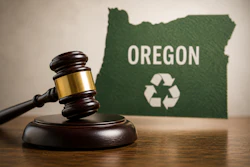
“Companies that choose to sell products in various States must normally comply with the laws of those various States,” the Supreme Court has said, which was quoted by Judge Simon in the ruling.. He used Louis Brandeis’ 1932 description of states as laboratories for “novel social and economic experiments,” and noted that Congress retains the power to impose national uniformity. “Judicial intervention, however, is not needed in this case,” he said. A federal judge in Portland upheld Oregon's packaging EPR law last week, rejecting both constitutional claims brought against it.ChatGPT prompted image
Membership as a choice
“Companies that choose to sell products in various States must normally comply with the laws of those various States,” the Supreme Court held in National Pork Producers Council v. Ross, quoted by Judge Simon in the ruling.
NAW’s due process claim argued that Oregon unconstitutionally handed governmental power (like fee setting, material classification, auditing, and dispute resolution) to Circular Action Alliance (CAA), an un-elected, private nonprofit Producer Responsibility Organization (PRO) whose founding board includes many of the largest consumer packaged goods companies in the world, and many of NAW members’ own competitors (NAW members often have their own private label brands that compete against the CPGs on the board).
Simon rejected that argument, saying that the RMA doesn't force producers to join CAA: as unlikely as it would be, a producer can form its own PRO. Or even more unlikely, it can privately recycle all of the covered products it is responsible for, such that it no longer is an obligated producer and owes nothing.
The court noted what NAW’s witnesses said about the impracticality of that alternative. It would entail $150,000 DEQ plan-review fee, a lengthy approval process, millions in annual operating fees, and a window of non-compliance while a producer leaves one PRO for another. Still, Simon said the program is not unduly burdensome as DEQ has never denied a PRO application. In fact only CAA has ever applied to be one.
On DEQ’s oversight of CAA’s fees, a transparency question NAW pressed on, Simon leaned on the Supreme Court’s 2025 decision in FCC v. Consumers’ Research. Even though DEQ never reviewed the specific formula or the thousands of data points about the cost for CAA to manage the program, the agency ordered substantive changes to the fee methodology, ran its own calculations to check the law’s prohibition on cross-subsidization, and approved the plan. What matters constitutionally is that nothing takes effect without the agency’s say-so, “regardless of how freely given.”
The Commerce Clause claim never cleared the threshold
NAW’s dormant Commerce Clause argument, which its litigation director had called “the poster child for a Commerce Clause violation,” failed at an earlier stage than the merits. Simon found the association had not sufficiently showed that the RMA imposes a significant burden on interstate commerce.
NAW presented what the court called "anecdotal evidence" that its members face substantial compliance costs. Simon said that wouldn't do the trick, since courts will try to protect "the interstate market, not particular interstate firms.” Increased costs to producers and higher prices to consumers do not qualify as a burden on interstate commerce in this case. NAW’s experts did not quantify any interstate effect, rather they testified that wholesalers and distributors may need to reroute operations or raise prices. Also, NAW's experts didn't quantify what the exact effect would be.
The court also rejected NAW’s discrimination arguments. It found no protectionist purpose behind the 2021 law, no discrimination in the exemption for Oregon public bodies (Oregon public bodies pay taxes supporting Oregon’s waste infrastructure and so are not “similarly situated” to out-of-state ones), and no proof of discriminatory effect from the $5 million small-producer or immediate-consumption exemptions, which NAW argued only in the hypothetical.
NAW’s user-fee theory turned on CAA’s own numbers: $145.5 million collected against $56.5 million spent in 2025, leaving roughly $90 million. One of NAW’s experts testified producers “were charged a substantial amount more than the amount that was actually necessary.” Simon accepted CAA’s explanation from its annual report — that the underspend reflected program-development uncertainty, accelerated reserve accumulation, and surplus that could reduce 2026 and 2027 producer fees — and found no evidence the fees are clearly excessive relative to the program’s needs.
Reactions
“District courts are generally reluctant to overturn laws enacted by state legislatures, and we have always understood that this is part of a bigger fight,” NAW said in a statement provided to PW last week. It stopped short of committing to an appeal, saying only that it “is reviewing its options for next steps.”
CAA, which declined to comment while the case was pending, welcomed the outcome in a statement to Packaging World. The ruling “provides important clarity as Oregon’s producer-funded recycling system continues to take shape,” the organization said.
“We remain committed to supporting producers every step of the way as they meet their obligations under the law, while continuing to work closely with local governments, recycling partners and state agencies to implement the program,” CAA said. “Together, we are building on years of meaningful progress and laying the foundation for a stronger, more accessible and more consistent recycling system for Oregonians through 2027 and beyond.”
For its part, NAW said it “strongly disagrees” with the decision but was not surprised by it. “District courts are generally reluctant to overturn laws enacted by state legislatures, and we have always understood that this is part of a bigger fight,” the association said in a statement. It stopped short of committing to an appeal, saying only that it “is reviewing its options for next steps.”
In its reaction to the ruling, the association restated its main objection--that Oregon “forces businesses to join a state-approved Producer Responsibility Organization and pay mandatory packaging fees as a condition of doing business in the state,” and that the law hands “a private, self-interested organization extraordinary fee-setting authority without meaningful oversight or an effective avenue for businesses to challenge its decisions.”
But, the case turned on that characterization, and the court disagreed. Judge Simon held that the RMA does not compel membership in CAA because a producer may form its own PRO or privately recycle its covered products and thereby fall outside the statute altogether.
NAW also pointed to two findings from the trial record. Its members testified they received invoices months after the underlying sales, at rates they could not predict or verify. And DEQ’s program lead confirmed under oath that the agency had never seen the algorithm CAA uses to calculate its cost-to-manage values. Both points appear in Simon’s findings, and on both he agreed with the facts while rejecting their constitutional significance — the fee cadence is a rational means of funding the system, he wrote, and DEQ approved the methodology, whether or not it reviewed every calculation behind it. What he wrote boils down to this--DEQ is the government, and it exercises oversight over CAA.
“The district court’s ruling is not the final word,” NAW said, adding that it will continue pressing its challenges to the California and Colorado EPR laws.
The Recycling Partnership (TRP), which filed a brief supporting the law and had called the dormant Commerce Clause questions “existential to EPR across the different states,” read the decision as a broad validation. “Judge Simon’s decision demonstrates the legality of Extended Producer Responsibility in Oregon,” said Kate Davenport, TRP’s chief impact officer. “The judge also took care to explain the many benefits the Recycling Modernization Act will have for Oregonians.”
Davenport said the ruling “sets a strong tone for litigation against programs in other states, and further solidifies EPR as a policy driving generational change in how recycling operates in the U.S.” A federal district court decision interpreting a state law is not binding on courts in other states, but it is likely to be influential, since it's the first merits ruling anyone in these cases has to work with, rather than a preliminary decision.
Davenport also offered TRP’s accounting of the program’s first year, saying paper and packaging EPR in Oregon injected $30 million into local processing facilities, funded more than 70,000 new curbside recycling carts in local communities, and helped protect local ratepayers from volatile global commodity markets.
Scott Cassel, chief executive officer and founder of the Product Stewardship Institute, who testified as an expert witness for Oregon at trial, called the outcome decisive. “We are thrilled with the judge’s ruling in this monumental case,” Cassel said. “The plaintiff tried every conceivable angle to derail the implementation of the Oregon EPR law, but nothing stuck.” He added that it was “an honor to provide expert testimony at the trial and support the Oregon team defending this first-in-the-nation packaging EPR law.”
What none of the parties addressed is the part of the ruling most likely to be contested next. Simon’s rejection of the due process claim rests almost entirely on the finding that CAA membership is optional — that a producer can stand up its own PRO or recycle its way out of the statute. Strip that finding away and the rest of the analysis has to be rebuilt, because the judge treated CAA’s self-interest and the limits of DEQ’s review as legally irrelevant only because the alternative exists. It is the narrowest point in a 71-page opinion and the one an appellate brief would aim at first.
Packaging World's long-time contributor and Legal Side columnist, Eric Greenberg, spoke to editors about the ongoing case in July, and more recently, the ruling (with the caveat that he has not yet read the full 71 pages himself). Here's how he summarizes the wider scope of this and other cases.
"EPR laws propose a significant shift in commercial markets, placing significant new obligations on packaging makers and users. They certainly should be carefully evaluated by courts and invalidated if they are too burdensome or unfair," he said. "This is especially true given that most packagers operate in a national market, and yet different states are imposing different EPR programs. In my view, regardless of the subject matter, few things are as fundamentally burdensome to national companies as state-law-based obligations that are not uniform from state to state," Greenberg concluded.
What happens next
Appeals to the Ninth Circuit are widely expected, and a Supreme Court endgame could stretch years. The status of the preliminary injunction Simon granted in February — the first time any court blocked enforcement of a state packaging EPR law, and relief that ran only to NAW’s members — was not addressed in the findings and would ordinarily dissolve on entry of final judgment.
The litigation map keeps widening regardless. NAW and 17 state attorneys general are challenging California’s SB 54 in federal court. NAW filed suit July 30 against Colorado’s EPR law, adding three First Amendment claims to the due process theory that just failed in Oregon. The Independent Lubricant Manufacturers Association is challenging the Colorado law in state court. And a producer class action, Lollicup USA v. Feldon, seeks to extend Oregon relief to producers outside NAW’s membership.
For now, Oregon’s program and producers’ reporting and fee obligations continue.