Portion packaging automates the manual process of filling and lidding individual sauce cups, freeing restaurant staff for more productive tasks while maintaining product quality and shelf life.
- Labor reduction: Eliminated up to 3,000 manual cups filled per store daily
- Production capacity: New machine produces 540 one-ounce pouches per minute across nine lanes
- Shelf life: Hot-fill packaging at 190°F provides four-week shelf life without preservatives
- Scalability: High-capacity system enables future contract manufacturing opportunities
- Quality preservation: Clear film packaging maintains consumer familiarity with original product presentation
Based in Corona, Calif., Miguel’s Junior now operates 23 restaurants in Southern California. Predictably enough, green and red salsas are as popular at Miguel’s as they are in any restaurant serving Mexican food. For the first 15 years of the company’s existence, these salsas were prepared at a central commissary and hot filled into 7-lb pouches that went straight to the stores under refrigeration. There the salsas were manually dosed from the pouches into 1-oz plastic cups that were closed with snap fit lids and served to customers.
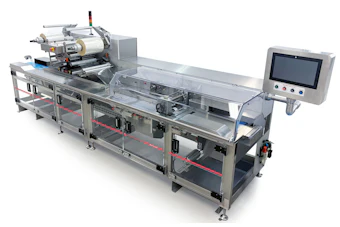
With each new store that opened, the shortcomings of this approach became increasingly apparent. Most obvious, of course, was that store personnel could be deployed far more effectively if they weren’t saddled with the task of manually filling and lidding salsa cups, sometimes as many as 3,000 per day per store. Javier Vasquez, president and CEO of the family-owned business, started looking into some kind of portion packaging solution. The search led eventually to the installation of a Winpak Phoenix nine-lane vertical form/fill/seal pouch packaging machine.
“We tried a few machines from other manufacturers, but they just didn’t work out,” says Vasquez. Running commercially since January of 2026, the nine-across system produces up to 540 1-oz pouches/min. The 1-oz pouches are hot-filled at 540/min and then placed in an ice bath.Miguel's Junior, Winpak
“Two things that stood out about this machine is that it’s a high-capacity system and it’s easy to change from one sauce to another,” says Vasquez. “That’s important to us because in the near future we want to begin contract manufacturing and packaging for other firms. Doing that would be very difficult if the machine were anything but high-capacity or if it was time-consuming or complicated to move to a different sauce.”
What hasn’t changed is the filling temperature of 190 deg F. This helps give the pouches the four-week shelf life they need to make it out to Miguel’s stores without needing to add any preservatives. “Hot-fill adds another layer of complexity to the process,” says Vasquez. “Winpak demonstrated that their machinery is routinely used in hot-fill applications, so that became another reason we selected them.” Upon discharge from the Winpak machine, the pouches drop into totes that operators dump into an ice bath. This lowers the temperature quickly and prevents overcooking. Chilled pouches exit the ice bath by way of an incline conveyor and drop into plastic crates that the firm’s store-door delivery system takes to all 23 restaurants. As was the case with the previous packaging format, the pouches are kept under refrigeration during transport and storage at the restaurants.
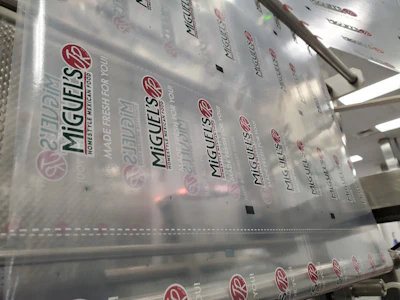
The roll-fed packaging film used at Miguel’s, also supplied by Winpak, is a reverse-printed polyester laminated to an extrusion of EVOH and linear low-density polytheylene. Described by Winpak as a high-barrier film, it includes a sealant layer that provides good hot tack and high slip for machineability.  Hot-filling and barrier film help provide the four-week refrigerated shelf life that the restaurant depends on.Miguel's Junior, Winpak
Vasquez says pouch clarity was essential because he and his team wanted the new presentation to be as similar as possible to what consumers were used to seeing in the past. One additional piece of information printed on the pouch during production is the lot and date code that gets printed by a Videojet ink-jet printer integrated with the Winpak machine.