Scott Shannon, Intralox (00:03):
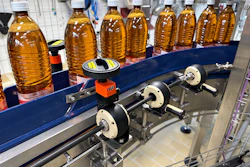
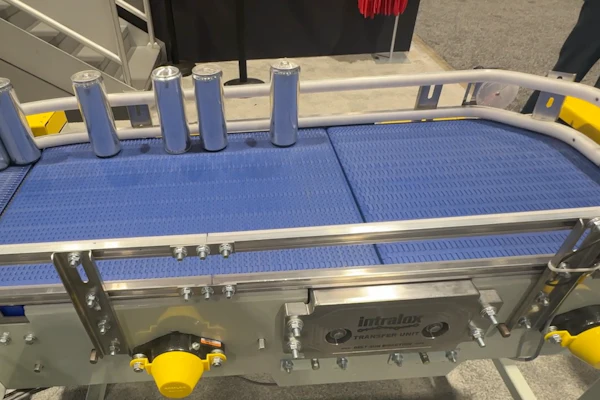
Hi, my name is Scott Shannon with Intralocks. I wanted to share what I believe is somewhat of a innovative approach to mass handling. We'll talk a little bit in a few minutes specifically to a brewery. However, it's applicable to Procter & Gamble. It's applicable to a lot of different industries handling containers. And what it is, it's a micro pitch belt. And this micro pitch belt has the ability to eliminate dead plates, eliminate side-on, side-off transfers, which Ajoy will tell you a little bit more about in a moment. It allows you to build conveyors, say floor space. There's a lot of additional benefits to it, but let me have Ajoy explain, because he has practical plant experience employing this.
Ajoy Kapila, Molson Coors (01:03):
Good afternoon. Ajoy Kapila from Molson Coors. And yeah, everything that's being talked about this is spot on. So when Interlocks came to us and said, "We have a way to convey containers." And it's a departure from the legacy, what we call parallel transfers, side on, side off. And they backed up their performance claims by real forensic scientific data. And so what you have here, when you just study the arrangement here, it's put together with some very high precision. It's the tolerances, placement of the belts, nose overs. But what this does is it allows you to put in a system that performs equally well as a side-on-side-off system, the legacy side-on-side-off, but you're using every square inch of the belt to convey your containers. And for us, and I'm sure for others, that becomes very important because when you're starting to tune a line and starting to maintain a line, your center lines become very, very obvious.
(02:18):
I need to have a conveyor running X containers per minute because I know that's exactly how many containers I have. That is attributed to this side-on, side-off. So it's basically a box, right? So you're concatenating boxes and you're having a system. We have these in our breweries now and we're wanting to propagate the design to new line modifications that are coming in. Furthermore, when you look at the way the system is set up, it's end-to-end and it's linear. When you step back and you look at a side-on-side-off, there is necessary real estate that has to be freed up somehow to create that parallel transfer. More often than not, real estate is expensive. Breweries, plants, they're not willing to give up floor space because they want to put other things in there. So this design lends itself to a very streamlined conveying system, still meeting rate, improving efficiencies, reducing down containers.
(03:20):
There are some very impactful metrics that can be exacted from this layout.
Scott Shannon, Intralox (03:28):
Wow. Thank you so much for that. I really appreciate it. Yeah, we really believe we're bringing extraordinary innovation to the mass handling space throughout the brewery and beverage world, as we just got a great testimony, and we're very excited to share that and make that the new standard going forward.