
But every time Rivella AG switched bottle sizes on one of the packaging lines at that plant, an operator had to walk the length of the transport lane, loosening and resetting clamping screws. And there were a lot of them.
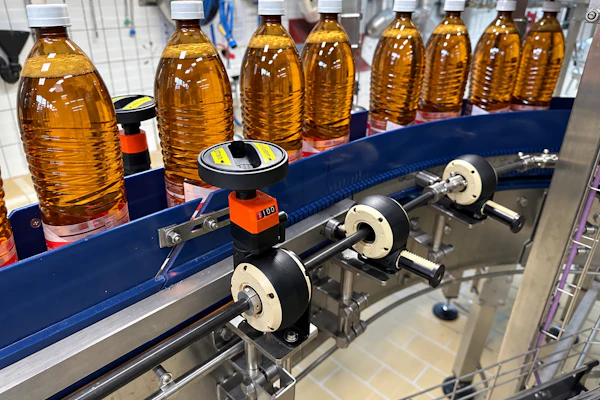
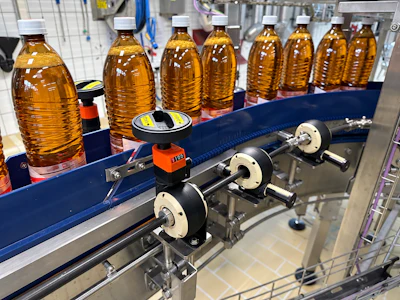
"In our plant for Rivella products, we have to adjust the transport lanes from the filling system to the packaging line several times a day due to the different bottle sizes, from 0.2 to 1.5 liters, so that the bottles are centered on the belt and transported safely from A to B," says Ismail Ibraimi, maintenance project manager at Rivella. "This was always very time-consuming, as the operator had to manually adjust the width of the aisle every 50 cm using a clamping screw. With a lane length of 12 m plus a 90-degree bend at the end, we're talking about 48 adjustments (24 stations, left and right), and some of them overhead."
Line speeds can range from 500 to 1,000 bottles/min., so time spent on changeover made a big dent in total bottles produced. Rivella's maintenance team eventually got that lane down to two adjustment points, using modular gearboxes from igus to tie all 24 stations into a single synchronized run. But the lane wasn't where they started.
Starting small with the date coder
The first project was at the coding/marking station, where three inkjet print heads apply date codes.
"The operators at the packaging station approached me with a request to simplify the process for printing the date," Ibraimi says. The three inkjet print heads for the date are now positioned precisely in height using the Apiro gearbox, the drylin SLW linear system and a motor. igus GmbH
Changing product meant repositioning the print heads by hand with adjusting screws, a job that ran up to an hour depending on the product and number of packages, and one that came up about three times a day.
Rivella brought the problem to igus Switzerland, which supplies lubrication-free plain bearing and linear components. The resulting system pairs two drylin SLW lead screw units, each driven through an Apiro modular gearbox, with a motor and igus's D1 dryve motor controller.
"With the Apiro gearboxes, we can create a strong connection between the two drylin lead screw units and thus ensure synchronised parallel adjustment of both axes," says André Kirchhofer, product manager, low-cost automation at igus Switzerland.
Three positions were programmed, one each for the 0.2-L, 0.5-L and 1-L packs.
"All the operator has to do now is select the program, press a button and the system automatically adjusts the print heads to the desired height and position. We now need less than a minute to change the product date compared to up to an hour previously," Ibraimi says.
Scaling the same approach across 12 m of lane
With the coder proven, Ibraimi turned to the bottle lane bottleneck. Coupling two axes on a print head carriage became a matter of coupling two dozen stations spread over 12 m and around a 90-deg bend.
Forty Apiro gearboxes were installed along the transport lane at 1-m intervals, with spacing tightened to 50 cm through the bends. The gearboxes tie the guide rails into a single synchronized run, so turning one input drives every station at once. Operators now set lane width at two hand-crank points and finish in a few minutes.
Space was the limiting factor. The gap between the lane and the machine left little room for adjustment hardware, and the whole installation was a retrofit onto equipment already in production.
"The Apiro system proved its worth in the date changeover and I think the product is really sensational. It is easy to install, very interesting in terms of price and the ideal solution due to the limited space between the lane and the machine," Ibraimi says. Space was restricted, but Rivella employees say it was no problem for the igus solution with Apiro gearboxes. igus GmbH
Nate Guadagni, Apiro gearbox product manager at igus, tells Packaging World that engineering ran a few weeks from specification through fabrication, with the physical installation completed inside a single day of downtime. The inputs that drive the specification are ones a plant team can gather before requesting a quote, chiefly guide rail weight, conveyor dimensions, and the travel required across the format range. Operators did need some training on the two new adjustment points, though Guadagni characterizes the learning curve as minor next to the 48-screw routine it replaced.
Hygiene and what comes next
The guide elements, plain bearings, linear guides and Apiro gearboxes are polymer and run without lubrication or scheduled maintenance, which is the reason the technology reached a beverage line in the first place. Stainless fasteners and PTFE/PFAS-tested material options are available for wash-down environments.
Rivella is treating the hand cranks as an interim step.
"The adjustment with the hand crank works great and saves an enormous amount of time. However, this is only temporary because another advantage of this system is the modular principle, which means we can replace the hand crank with a motor relatively easily at a later date. We already have the necessary products in-house and I'm waiting until our control technician has free capacity for the changeover," Ibraimi says. "The lane adjustment will then work simply, safely and quickly at the touch of a button, just like the date changeover." All igus guide elements, plain bearings, linear guides and Apiro gearboxes are completely free from lubrication and maintenance. igus GmbH
The motorized version would use the same D1 controller already running the print head positioning, with stored positions per format.
For packaging engineers weighing a similar retrofit, igus says payback is calculated per application and turns on labor cost, changeover frequency and line throughput, and that it has seen projects pay for themselves in as little as three months. Rivella has not disclosed its own labor-hour savings, but given the volume of product it moves, at the speeds it runs, it is likely substantial.
Operators in other parts of the plant have taken notice.
"The system has been so well-received by the machine operators that I have already received enquiries from several departments asking when they too will finally get such a great system," Ibraimi says.