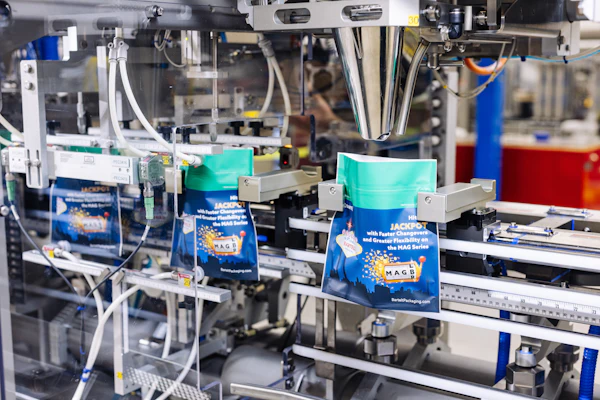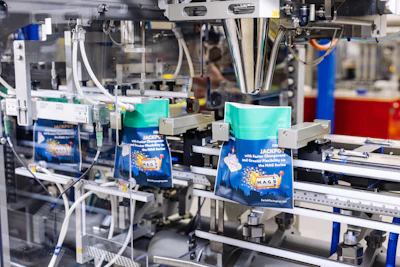
Bartelt Packaging developed its MAG Series of form-fill-seal pouch machines using Beckhoff's XTS magnetic transport system to meet strict washdown and sanitation requirements in food packaging while enabling flexible format changes and reducing labor dependency.
- Washdown capability: IP69K-rated construction allows thorough washdown in high-sanitary food environments like cheese packaging
- Flexible configurations: Three layouts (linear, compact, rotary) on one transport platform handle rollstock, pre-made pouches, and variable pouch sizes
- Dynamic indexing: Pitchless XTS movers enable independent control and on-the-fly adjustments based on product being run
- Reduced maintenance: Self-cleaning rail design with lower wheel and track wear compared to competing systems after months of operation
- Labor efficiency: Automated format changes and digital controls reduce setup time and reliance on skilled labor
Pouch lines have to form, fill, and seal film at high speed while handling more formats and smaller batches, all amid an ongoing shortage of skilled labor. Meanwhile, for CPGs packaging powders, snacks, and cheese, hygiene standards are also getting stricter, and some food applications require full washdown capability instead of dry operation.
Traditional chain-driven systems with fixed speeds and formats often require multiple dedicated machines or extended downtime to change over pouch widths and motion profiles.
Bartelt Packaging, part of ProMach, ran into those limits when a customer application requiring high-level sanitation exposed the shortcomings of the track and control systems it had been using in washdown environments. The company began evaluating alternatives in 2023 and ultimately built its MAG Series of hf/f/fs (horizontal form, fill, and seal) machines around Beckhoff’s XTS magnetic transport and PC-based controls. The MAG-B from Bartelt is a compact horizontal form fill seal (HF/F/S) machine that features the stainless steel XTS Hygienic and runs in simplex or duplex configurations.Beckhoff/Bartelt/ProMach
Stress-testing a hygienic track
Bartelt wanted a hygienic system with push-button changeovers that could run a broad range of pouch sizes and products on one machine. The company tested a Beckhoff demo system of the stainless steel, IP69K-rated XTS Hygienic in-house before committing.
“We beat up that demo system with days of continuous testing, including the addition of weights to each carrier to simulate maximum product weight,” says Tom Tomac, vice president and general manager at Bartelt. “We put everything on it that we possibly could and put the XTS through its paces. We provided Beckhoff our detailed feedback and their dedicated engineers reworked and refined the solution for Bartelt and shipped another XTS Hygienic that took all the team’s testing feedback into account. More testing ensued, which we upped to another level with sticky, sugary gummy bears and more, but the new and improved system could not be beat.”
“That made a big impact on us,” says Tom Brooker, vice president of engineering at Bartelt. “Beckhoff was willing to listen to our feedback and actually act on it.”
Bartelt commercialized the Beckhoff-based solution in the MAG-B, which launched in 2025. Bartelt’s MAG-B compact, MAG-L linear, and MAG-R rotary HFFS packaging machines rely on IP65 and IP69K XTS linear transport technologies from Beckhoff (rotary XTS track for MAG-R shown prior to installation).Beckhoff/Bartelt/ProMach
Three layouts on one transport platform
The MAG Series includes the MAG-L linear, MAG-B compact, and MAG-R rotary machines. Because XTS serves as the transport foundation, the platforms can be configured in straight-line, rotary, or dual-lane layouts to suit a customer’s production goals and facility. Each machine uses the GFX Guidance System from HepcoMotion to support higher payloads and duty cycles.
“The advent of the magnetic track systems has allowed us to up our game in terms of providing our customers with the best possible packaging solutions,” says Brooker.
The MAG-L fills pouches along the length of the machine at up to 150 pouches/min. The MAG-B fills on both the front and back of the machine to maintain the same output in a more compact design. The MAG-R is the smallest of the three and uses XTS in a rotary process to save floor space.
Every configuration handles rollstock, pre-made pouches, or both. The MAG-B scales from simplex to triplex pouch indexing, and the machine architecture also allows variable timing between stations and features such as on-the-fly clamping, controlled shaking for product settling, and optimized nitrogen filling.
Traditional mechanically indexed machines have a fixed pitch. On the MAG Series, the XTS movers are pitchless and independently controlled, so pouch indexing can be adjusted dynamically based on the product being run.
According to Beckhoff, the XTS uses a v-profiled rail design that is self-cleaning, self-aligning, and quiet. Bartelt says it has seen reduced wheel and track wear compared with competing systems after months of operation, along with simpler diagnostics from integrated LED status indicators. Closeup of the XTS Hygienic, which permits washdown in environments with rigorous sanitary and cleaning requirements.Beckhoff/Bartelt/ProMach
Washdown and format changes
Bartelt offers IP69K-rated construction for key components, which allows thorough washdown in high-sanitary environments. The company says this is especially important in highly regulated food applications such as cheese packaging.
Format changes rely on digitally controlled machine adjustments. Automated repositioning of axes and tooling streamlines setup, which Bartelt says also reduces reliance on skilled labor.
An in-house-designed auto-splicer, a semi-automatic zipper splicer, and an unwinder allow continuous operation during film roll changes. According to the company, the design lets the machine use film rolls down to the core and reduces floor space by eliminating third-party equipment. TwinCAT includes built-in XTS track simulation and supports a remote connection to the controller for commissioning and support.Beckhoff/Bartelt/ProMach
Controls and networking
Beckhoff PC-based control hardware and software run automation and motion control on the MAG-B, MAG-L, and MAG-R. A C6032 industrial PC handles control and computing tasks while occupying minimal cabinet space. EtherCAT ties the system together, providing real-time motion control and I/O performance, automatic device recognition, and faster configuration and commissioning.
“I really like their programming software – it is intuitive to use, simplifies programming and saves me engineering time,” says Chris Conley, electrical engineering manager at Bartelt.
TwinCAT includes built-in XTS track simulation and Open from Source functionality, which allows code to be verified, updated, and debugged directly on the machine. Engineers can also run applications through a remote Windows connection to the controller, which streamlines commissioning and support. An ultra-compact C6032 industrial PC provides significant processing power while occupying minimal cabinet space.Beckhoff/Bartelt/ProMach
Looking ahead
Bartelt expects pressure on machine builders for higher throughput, greater product variety, tighter quality expectations, and added features to keep growing, and says it designed the MAG Series with that in mind. The company also sees digitalization and artificial intelligence moving machines toward self-correcting, self-optimizing operation with minimal operator intervention.
Bartelt is also exploring Beckhoff’s MX-System, which allows cabinet-free automation mounted directly onto machines, to reduce footprints further and speed installation.
For Bartelt, the MAG Series represents an effort to run a wider range of pouch formats on one platform while meeting washdown requirements. PW