General Mills developed a comprehensive system to identify, track, and manage thousands of obsolete control components across its manufacturing plants by creating a hierarchical asset database that links legacy hardware to specific production lines, enabling the company to prioritize replacements and prevent unexpected production shutdowns from discontinued equipment.
- General Mills uses a 10-year discontinuation threshold to prioritize which obsolete controls to replace, focusing on parts discontinued for a decade or longer
- The company combines weekly automated network scans with one-time panel walkdowns to track both networked and non-networked legacy equipment across all plants
- General Mills manages obsolete controls through four strategies: salvaging parts from decommissioned machines, recertifying failed components, making last-time bulk purchases before discontinuation, and repairing cores to maintain spare inventory
- The asset management system organizes data by business, production line, and machine rather than individual parts, enabling better communication between engineering and business leaders about production risks
- Annual capital reviews rank machines by obsolescence risk and align replacements with business plans, preventing unnecessary upgrades to lines scheduled for replacement
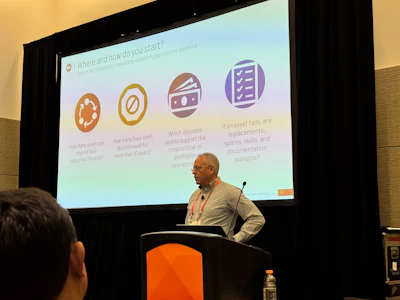
One of the first projects Daniel Migliori handled as a young controls engineer was converting a PLC-2 to a brand-new PLC-5. The PLC-5 has since been discontinued.
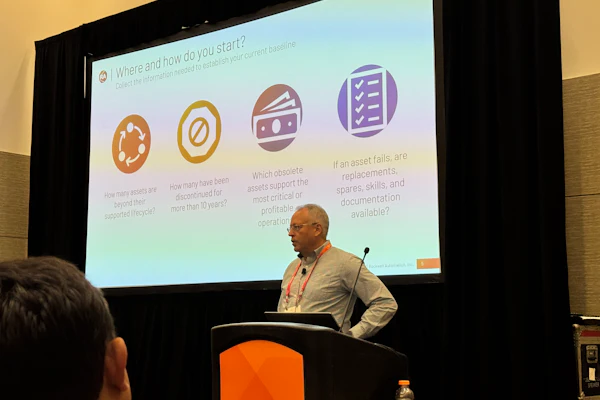
“I think PLC-5s and I have pretty much the same career path,” Migliori, now a controls engineer at General Mills, said wryly at Rockwell's Automation Fair today. “We're probably at the time of obsolescence.”
But his joke is rooted in reality, and points to a real issue. Like all large food manufacturers with sprawling automation footprints, General Mills runs packaging and processing lines on control hardware that its OEMs stopped making years ago, and a single unsupported drive or controller can take down a whole line. Migliori helps lead the corporate effort to find that risk before it finds the plants.
It Started with the Servos
The first worry was motion control, the most complex systems in General Mills' plants. The company had a large installed base of servos dating to the early 1990s, first-generation analog systems followed by second-generation SERCOS networks. By 2012 to 2014, SERCOS motion was fading from the market, and the controls group had no reliable picture of how much of it was still running.
In 2014 the group sent a spreadsheet to the controls teams at every facility and asked each to self-assess its systems, seeking to find out what they had, how many, and on which machines.
“We kind of got mixed results,” Migliori said. “Some sites were very good about getting back to us, some were not so good.”
So General Mills brought in Rockwell Automation to perform Installed Base Evaluations (IBEs) at several sites. Rockwell technicians opened every control panel and recorded what was inside and where the panel sat. The resulting reports were thorough, but when the controls group loaded them into Excel, the data wouldn't line up. Different plant employees had escorted the technicians, and each used his or her own name for the equipment.
“Whatever that escort called that piece of equipment was what ended up in our asset tracking,” Migliori said. “So there was not really good continuity to find out which systems were where.” General Mills began with Rockwell Installed Base Evaluations of its control panels, then tied each device to a business, line, and machine hierarchy so risk could be pinned to specific products.Rockwell, Automation Fair
Packaging was the Easy Part
The next step was to give the data a consistent structure, and that is where General Mills' packaging and processing operations parted ways.
“The packaging area was pretty simple,” Migliori said. “You have one processor, one machine, you have one HMI, pretty straightforward. But when you look at our process side of things, it became very difficult. With multiple unit operations, multiple units in our processing area, you just couldn't define a clean area.”
Processing needed a different map. Migliori said General Mills’ P&IDs (piping and instrumentation diagrams) are generally good across the company, so the team gave each plant’s P&IDs to the Rockwell technicians before their site visits and had them record assets against the diagrams, giving every walkdown the same frame of reference. The data still came back disjointed.
Meanwhile, General Mills had developed an in-house tool that scanned plant networks, polled the processors, and pulled back each device's ODVA identity data, which catalogs the hardware. Now the company had two data sets, the IBE panel walkdowns and the network scans, and they didn't match.
“Hindsight's always better, right?” Migliori said. “Maybe we should gather this information based off the IP address, so we can go out there and hit our processors with our scanning tool and interrogate all the child processors and the drives or remote racks.”
Keying the inventory to each processor's IP address exposed one more flaw in the walkdown data. A single processor might control five or six panels, and escorts hadn't always matched panels to the right processor. “So our data was not healthy data at that point,” he said.
The scans also had limits. EtherNet/IP, ControlNet, and DeviceNet devices answer a scan. But Blue Hose (Data Highway Plus and Remote I/O) devices don’t, because they carry no ODVA information. Some machines had only scannable devices, some had none, and some had both.
“So we have these islands of data now,” Migliori said. “How do you go out there and combine the scannable and non-scannable?”
The answer was a long stretch of data cleanup, so that every device, scanned or recorded by hand, could be attributed to the machine it belonged to. A flat list of obsolete parts showed General Mills what it owned but not which machines were exposed, so each machine now carries one lifecycle status covering 20 to 100 tracked parts.Rockwell, Automation Fair
Talk in Machines, Not Parts
The IBEs gave General Mills a good list of its legacy hardware, from 1336 and 1333 drives to PLC-5s. What the list couldn't show was which machine each part served, or whether several machines on one line shared the same aging platform. Migliori said the team decided to stop chasing parts.
Instead, the controls group built a hierarchy that runs from business to line to machine and ties each processor's IP address to the names plant operations people already use. That let the team pinpoint the risk to a specific product made on a specific line, and it gave the controls group a way to talk to people outside engineering.
“Before, we'd have our controls engineers say, ‘Hey, we have these issues with these lines,’ but we would not have any way to talk to the business,” Migliori said. “Now we can start talking to the business and saying, ‘Hey, these lines are at risk based on these levels of obsolescence.’ We don't want to take all the risk on within our controls group. We want to make sure that the whole business, and those leaders that are driving those businesses, understand the risks that we're facing.”
The panel walkdowns had captured every control component, not just Rockwell's. Migliori said the team cared most about VFDs, HMIs, servos, and anything with firmware or a program that would need re-engineering to put back in service. Lifecycle status for Rockwell parts comes from Rockwell's Product Compatibility and Download Center (PCDC), though not every legacy Rockwell part is listed there, and the team had to track lifecycle data for other manufacturers' components as well.
All of that rolls up to one number per machine. A machine might carry 20, 50, or 100 tracked parts, and General Mills assesses them together and assigns the machine a single lifecycle status.
“When you go for money, you're not going to go for money to pull out individual components,” Migliori said. “You typically would go after the whole machine. And when we talk to the business, they don't care about the parts. They care about how they can get production out of that line.” A flat list of obsolete parts showed General Mills what it owned but not which machines were exposed, so each machine now carries one lifecycle status covering 20 to 100 tracked parts.Rockwell, Automation Fiar
A 10-Year Line in the Sand
Once the data was organized, it showed thousands of discontinued parts across the company, far more than any capital budget could replace. The controls group needed a cutoff.
“We're going to go after parts that have been discontinued for 10 years,” Migliori said. “You think, that's crazy. We haven't been able to buy that part for 10 years. But that's the line in the sand that we drew.”
The plan is to work the threshold down over time and bring the installed base closer to current. The catch, he notes, is that more parts go obsolete every year. “But you've got to start somewhere, right?”
Replacement isn't always an easy sell, either, and Migliori's example came straight from the packaging floor. Upgrading a typical bagger runs about $90,000, he said. “And so who wants to spend $90,000 on a machine? And when you upgrade that machine, you hope to have the same performance as it had before. So really hard to sell.”
So General Mills built a set of options for keeping older machines running.
- Salvage. When a machine is decommissioned, the team harvests its control parts, provided enough similar machines across the enterprise could use them. Inventory views at both the site and enterprise level show what's available where. Parts go into stock as-is.
- Recertification. Salvaged and failed parts go to Rockwell's recertification service, which tests and cleans them. Migliori said it doesn't cost much and gives the team high confidence the part will run as expected.
- Last-time buys. Rockwell notifies General Mills before a part is discontinued, six months out in Migliori's example, so the team can check usage rates and pad its spares to cover the next several years.
“We're kind of doing our own eBay,” Migliori said. “And we have kind of control of our own fate, right? We're not out there pulling parts from other places. We know it's an accountable part that comes from inside sources.”
Getting used parts into the storeroom took some work. General Mills' business systems wouldn't let the team simply add salvaged spares to the maintenance inventory, so the company created a separate storeroom for them.
“Those spare parts don't do any good sitting in somebody's toolbox under their benches,” Migliori said. “If the third shift doesn't know where that part is that you're going to put on that line, that doesn't do a whole lot of good.”
He also pushes plants to send failed parts back for repair. “Especially if it's been out there 10 years, chances are they still can be repaired,” he said. “You get those cores back,” so the spare pool doesn't deplete as fast.
Migliori sends those repairs back to Rockwell rather than to independent shops. His concern is that neither Rockwell nor Bosch supplies its spare parts to third-party repairers. “All of a sudden you think you've got a spare and you don't have a spare,” he said. “So make sure you get the parts repaired right.” Weekly scans exposed devices on the wrong network tier and RSLinx loops that listed one processor’s parts five or six times, all of which had to be cleaned out before the data went to the business.Rockwell, Automation Fair
Scanning Every Week
General Mills' asset database started in Excel, outgrew it, and moved to an in-house SQL system with a deep library of reports by machine and legacy platform. Migliori said the internal developer who maintained it was needed elsewhere, so the company moved to Rockwell's Asset Inventory Manager (AIM), a ThingWorx-based application, rather than keep supporting its own.
Today FactoryTalk AssetCentre browses General Mills' plant networks every week and feeds what it finds into AIM, which updates each part's lifecycle status from the PCDC. The one-time IBE data still covers non-scannable and standalone legacy hardware. When a machine is upgraded and keeps its IP address, the weekly scan discovers the new parts on its own.
The scans turned up problems nobody was looking for. AssetCentre gathers data through RSLinx, and browsing the networks showed that devices hadn't always been put on the right tier.
“We're finding meters and drives or even servo systems that are up on the peer network when they should be down on a local network,” Migliori said. “So it really opened our eyes to a lot of different things, and we corrected our networks.”
RSLinx also looped on some networks, so a single processor's parts could show up five or six times. The team built a routine to find and remove those duplicates, and it had to clear another set where scanned devices overlapped with the same devices recorded during the panel walkdowns.
“There's a lot of database functions you have to clean up to get good data,” Migliori said. “So when you start going back with your hierarchy to your business units, you know what you're saying. You have high confidence in your information.”
Scan timing matters in a food plant. General Mills first scheduled its scans for Friday night and Saturday morning, which turned out to be the worst window. Plants running around the clock are typically down for sanitation then, Migliori said, and a device that's powered off gets missed. AIM keeps the device on record and refreshes it the next week, but the team now works with each site to find the best window for its scans. General Mills’ yearly review weighs each machine’s control-system risk against what the line means to the business, and skips lines already slated for replacement.Rockwell, Automation Fair
An Annual Capital Review
Every year the controls group runs the reports, ranks the machines, and feeds the results into General Mills' capital planning. Legacy networks rank high. The company has nearly eliminated Blue Hose and is now phasing out ControlNet, and its 1394 servo drives and GML motion programming are gone.
“We celebrate our victories as we get rid of some of these products,” Migliori said.
The review also looks for outliers where a like-for-like swap won't work. A 100-hp 1336 drive mounted in an MCC bucket is one he cites.
“I find out that the PowerFlex 755 is deeper,” he said. “So you're not going to put that in the same MCC bucket. So if you think you're just going to go source one of those drives, it's not going to fit in your bucket.”
Form, fit, and function count as much as lifecycle status, and servo systems are the clearest case. On a SERCOS-based machine, Migliori said, migration is close to a wholesale changeout, from the motion controller out to the amplifiers and drives.
The reports start the conversation, and the plants finish it. Corporate controls engineers sit down with site controls engineers to compare the data with what's actually causing trouble on the floor.
“How comfortable are you, or what gives you grief in your life?” Migliori said of those meetings. “We come together and work together on our capital plan to decide what should be our key target areas. So it's not a wholesale changeout to get everything.”
Business plans shape the list too. If a line is slated for replacement next year, the review skips investing in its controls. “So there again, it's all about communication,” he said.
The Parts You Can't See
Migliori helps lead the corporate group that oversees the program. Operating-unit leads in that group are each assigned to businesses and work with roughly eight plants apiece, walking site teams through the AIM data and their capital plans each year.
Non-networked equipment remains the hardest piece, such as a decades-old PLC handling an interface between two OEMs' machines. General Mills handles it with the one-time panel walkdown. When that equipment is eventually upgraded, the new controller is very likely to sit on a network, so the weekly scan picks it up. At that point the controls group checks with the site, removes the old hand-recorded parts from that machine in the hierarchy, and lets the scanned data take over.
“The parts that we can see on the network are probably not your biggest concern,” he said. “The parts you can't see are a bigger concern. So it's nice to have a tool where you can bring all of those assets in and manage them in one tool, across the borders of scannable or not.”
General Mills has spent about a year giving Rockwell feedback on FactoryTalk AssetIQ, a cloud-based OT asset management tool that Rockwell said will be available in early 2027. Migliori expects it to strengthen the process General Mills has built.
The program took more than a decade to build, and Migliori said a team starting from scratch today has it easier. A plant that already runs AssetCentre has the key tool for harvesting device data, and lifecycle lookups that didn't exist in 2014 are now automated.
“If you jump in at this part of the game, a lot of the tools are already there,” he said. “We built, we built, we built, we shared information, and now we've got the system we have. It's a thankless process, let me tell you that.”