Southern Marketing Affiliates reduced packaging costs by 30-35% by integrating an on-demand corrugated case machine with its warehouse management system, which automatically calculates optimal case dimensions for each order instead of relying on manual selection from pre-stocked inventory.
- SMA achieved a 30-35% reduction in packaging material costs and freed up approximately $80,000 in annual labor through on-demand corrugated automation
- The Packsize EM7-35 machine builds custom cases in seconds based on WMS-calculated dimensions, reducing average case volume by 31.6% compared to stock cases
- The system processed 57,581 cases across 39,304 orders with a 99.998% API reliability rate since going live in December 2024
- The investment paid for itself in 6-7 months through lower material costs and reduced manual case-building labor
- SMA eliminated the need to stock and store 24+ different case sizes on warehouse floors, recovering valuable space and reducing shipping damage and customer service issues
Southern Marketing Affiliates (SMA) operates as an agricultural parts distributor supplying roughly 60,000 tractor, machinery, and farm-related parts across North America. They're not a typical CPG-style brand owner, but they still do a whole lot of packaging for a whole lot of varied SKUs and custom order combinations, not so different from the car audio distributor Crutchfield, which Packaging World covered a few years ago.
For years, packers/pickers at Southern Marketing Affiliates (SMA) chose shipping cases by eye. They looked over a tote of picked parts, guessed at a case size, built the case, and hoped everything fit.
Today, at SMA's highest-volume distribution center (DC), the warehouse management system (WMS) makes that call. PathGuide Technologies' Latitude WMS calculates the cases every order needs before picking begins and sends each case's dimensions to a Packsize EM7-35, which builds a corrugated case to match. SMA says packaging material costs are down 30% to 35%, labor equal to about $80,000 a year has been freed for other work, and the project paid for itself in six to seven months.
A packing line run on instinct
Founded in 1964, SMA supplies agricultural replacement parts, including belts, bearings, and tillage components for tractors, combines, and planters. It operates five U.S. DCs and one in Canada and has run Latitude WMS for more than 25 years. The flagship DC, a 160,000-square-foot building that opened in 2017, handles roughly 65% of the company's business, about 94,000 orders in 2025.
Pickers filled totes, and packers then chose and built a case for each order. "The packers were eyeballing every order, trying to figure out which box [case] would work best," says Richard Grantham, SMA's director of operations.
SMA's first fix was Latitude's Pre-Cartonization module, which determines how many cases an order needs and which items go in each before picking starts. Its 3D algorithm weighs item dimensions and weight, handling traits such as "crushable," "heavy," "foldable," or "must stay upright," hazardous-materials rules, carrier size limits, and the dimensions, capacity, and corrugated specs of each case style on file.
That ended the guessing but not the inventory. SMA still stocked more than two dozen case sizes, from about 10 x 10 x 10 in. to 24 x 20 x 10 in., bought in bulk and staged on racks and the warehouse floor. Oversized cases let product shift in transit, contributing to damage, missing items, claims, and customer service calls.
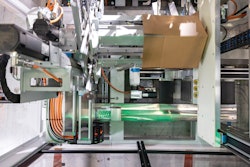
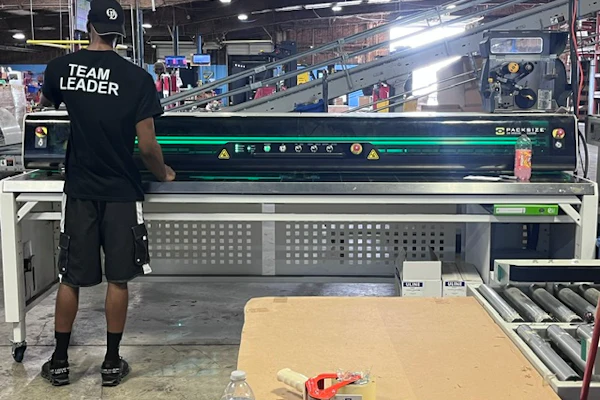
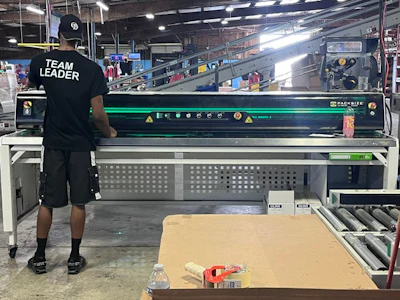
"We wanted to take as many decisions off the warehouse floor as possible," Grantham says. "The goal was to automate the process and make it as efficient as we could." A Packsize EM7-35 builds corrugated cases to order at SMA's flagship distribution center. The machine can produce up to 10 cases per minute, depending on case size and complexity.SMA
Letting the WMS design the case
The EM7-35 can produce as many as 10 cases per minute, depending on case size and complexity. At SMA it runs single- and double-wall corrugated from three fanfold widths and builds cases from about 10 x 10 x 10 in. up to 36 x 22 x 22 in. for pallet packing. The smallest size matches the minimum dimensions SMA's shipping provider bills.
Latitude talks to the machine in real time over an HTTPS REST API. When Latitude generates a label for a case, it sends one JSON message per case with its dimensions, calculated weight, sales order, pick batch, and case number, plus the shipping-label data. Latitude first calculates the minimum dimensions for the contents, then adds configured allowances and the machine's minimums. The weight includes the estimated weight of the case itself, which Packsize's control software uses to select the board grade. Latitude also adjusts cases that fall below the machine's minimum dimensions and recalculates weight when the on-demand case weighs less than the stock case it replaces, with no operator involved.
If an API call fails, Latitude falls back to a standard printed label and logs the failure in the order audit trail, so the floor rarely has to wait on the network. That happened once in 57,581 cases between Jan. 1 and Sept. 9, 2026, a failure rate of about 0.002%. Across 5,511 pick batches, Latitude averaged roughly 255 milliseconds per case to finalize dimensions and weight, print the label, and complete the round trip to Packsize. Fanfold corrugated feeds the EM7-35 from pallets beside the machine. SMA runs single- and double-wall corrugated in three fanfold widths.SMA
If an API call fails, Latitude falls back to a standard printed label and logs the failure in the order audit trail, so the floor rarely has to wait on the network. That happened once in 57,581 cases between Jan. 1 and Sept. 9, 2026, a failure rate of about 0.002%.
SMA began cleaning up item data in summer 2023, building on a multiyear effort to capture accurate dimensions across its inventory. PathGuide spent about seven weeks building the API integration in September and October 2024 and another eight weeks refining corrugated and case-weight logic through year-end, with small adjustments in February and March 2025. The system went live in December 2024. Grantham described roughly nine months of refinement before go-live. PathGuide says the Packsize integration is now part of the standard Latitude code base, configurable by warehouse without custom code, and SMA was the launch customer for the REST API version.
During testing, staff from PathGuide and Packsize joined calls as needed. "If we were getting bad data or bad boxes [cases], they'd make adjustments, we'd test again, and we'd keep refining it until everything worked the way it should," Grantham says. The EM7-35's operator screen shows Packsize's PackNet software (left), listing orders in production, beside Latitude's Review Pick Cartons By Status screen (right).SMA
From cart to conveyor
Orders are released in batches sized to the cubic capacity of SMA's picking carts, and the EM7-35 builds the cases for each batch. They are loaded onto the cart before the picker leaves. The machine's operator screen shows Packsize's PackNet software next to Latitude's Review Pick Cartons By Status screen, with PackNet listing the orders in production.
When a case comes off the machine, an employee typically finishes it on a glue machine and then a tape machine to prepare the bottom for picking. After picking, the case rides a conveyor through a scale that compares actual weight with expected parameters, and orders outside the range are diverted for a manual audit. Final case sealing, labeling, and shipping happen at pack stations on PathGuide's Latitude Manifest System. Orders for a full case of an item bypass the machine, since no custom case is needed. A corrugated shredder recommended by Packsize makes void fill, much of it from the machine's own scrap.
"It's pretty amazing to watch the machine take all that information from PathGuide and produce a box [case] in just seconds," Grantham says.
Fewer hands on case building
Before Packsize, building cases typically took three or four people. Now one person generally keeps up, even at peak, with a second pitching in occasionally when volume spikes. The other employees were redeployed elsewhere in the warehouse, and the automation did not reduce headcount. The roughly $80,000 annual labor figure was calculated from SMA's labor rate and annual hours and reflects the reduced manual case building.
"We were able to utilize people in different areas of the warehouse and improve those operations, too," Grantham says.
"As complex as it seems, it has really simplified the picking process," he says. "Once people saw it working, they really bought into it. Now all they have to do is grab the box [case], pick the products, and go."A Packsize EM7-35 builds corrugated cases to order at SMA's flagship distribution center. The machine can produce up to 10 cases per minute, depending on case size and complexity.SMA
What the data shows
SMA declined to share its baseline packaging spend or total project investment. Its ROI analysis, which counted lower material costs and reduced labor, found payback in about six to seven months.
PathGuide's figures for Jan. 1 through Sept. 9, 2026, show the system building 57,581 cases for 39,304 orders, or about 1.5 per order. The integration has handled 131,683 cases since go-live. The average on-demand case measured 1,135 cubic inches, against 1,660 cubic inches for the stock case Latitude would otherwise have assigned, a 31.6% cut in average volume. The 39,304 orders were about 57% of the 68,997 orders the DC processed in that period. The rest, less-than-truckload (LTL) and transfer orders, do not run through the machine.
SMA has no precise before-and-after damage-claim or return rate, but anecdotally says packaging-related problems have fallen significantly.
"The space on the floor is priceless to me," Grantham says. "We no longer have to buy and store all those different box [case] sizes."
"It's hard to put a price on customer experience," he says. "Our customers receive packages that look the way they're supposed to. We don't have the damaged boxes [cases], missing product, or the phone calls to customer service that we used to."
One machine, several warehouses
The EM7-35 sits only at the flagship DC, where volume supports the investment. SMA's smaller facilities do not have enough to justify their own. About six to eight months after go-live, the flagship began producing batches of commonly used case sizes for those warehouses, which let them capture some of the savings without a machine of their own.
SMA also uses Latitude's Order Consolidation feature, which automatically identifies eligible backorders headed to the same destination and combines them for packing and shipping. SMA estimates it has cut the number of shipments by about 25% and reduced the manual work of matching backorders to new orders.
What's next
SMA is evaluating print-and-apply technology that would let a packed case move on a conveyor through taping, shipment processing, and label application with less manual handling, potentially cutting labor and order cycle time. The company has also begun preliminary talks with PathGuide about AI applications. Neither project has a timeline, and no specific AI deployment has been identified, but as we know with all things AI, something's certainly brewing.