Direct-to-consumer brands like Harry's and Glossier successfully transitioned to retail by redesigning their packaging to work within retail constraints while maintaining their brand identity. Rather than abandoning their design principles, both brands adapted their packaging to grab attention in three seconds on crowded shelves, replacing the unboxing experience with shelf-ready designs that told their brand story visually.
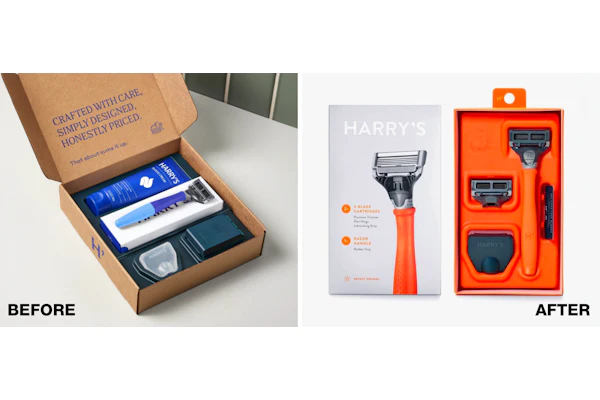
- Harry's razor packaging shifted from a gift-like corrugated box to bold, paper-based retail packaging with high-resolution product imagery, capturing nearly 50% of Target's razor-handle sales within weeks.
- Glossier replaced its iconic pink bubble-wrap pouch with retail-ready primary packs when entering Sephora, transforming pink into a fixture backdrop and merchandising system rather than losing their brand identity.
- The three-second rule governs retail shelf success—shoppers decide whether to engage with a product in approximately three seconds, requiring clear visual hierarchy, one core message, ownable color, and distinctive shape.
- Five omnichannel design moves separate successful retail transitions: calculate margins first, find elegance in structure, tell stories on the exterior, design shelf-ready trays as pedestals, and work from one brief from day one.
- Compliance and regulatory requirements should be integrated as design inputs from the start, not treated as afterthoughts, to avoid costly redesigns when entering new retail channels or markets.
When Harry's brought its razors to Target and Walmart, it soon became clear that the corrugated shipper that had turned the brand into a direct-to-consumer favorite wasn't going to cut it. It couldn't hang on a peg, and shoppers couldn't see the razor inside. And when cosmetics brand Glossier reached Sephora, the pink bubble-wrap pouch that was the brand online vanished, because there is no unboxing moment on a shelf. Both brands won their aisles eventually, but only after rebuilding the package, an asset they hoped would travel with them intact from D2C to a retail aisle. For a D2C brand now eyeing bricks-and-mortar, those two case studies are lessons, and a packaging supplier who has watched dozens of brands make the leap has a framework for getting it right the first time.
How Harry's remade its razor carton for the shelf
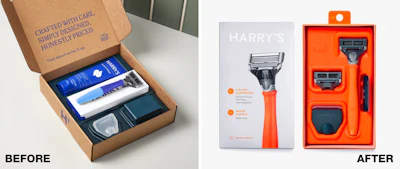
Harry's built its name on a direct-to-consumer ritual, not unlike men's own shaving ritual. Launched online in 2013, the brand shipped its razors in a low-profile corrugated carton engineered to open like a gift, with a fitted tray, restrained graphics, and a printed message under the lid. It was made for a doorstep, not a store shelf, and carried none of the peg hooks, clamshells, or packaging rules that a retailer imposes. The carton was the consumer's first physical encounter with the brand, and the experience remained entirely between the consumer and the brand (and maybe the carrier).
That carton stopped working its magic when it reached a store. Harry's made its first mass-retail move in August 2016, an exclusive with Target that reached nearly 1,800 stores, later expanding to Walmart, and the D2C shipper wasn't going to work. It had no way to hang on a standard grooming-aisle peg, and the razor itself sat hidden inside corrugated, invisible to a shopper scanning a wall of rivals. In a category then dominated by locked-up PET clamshells, a handsome brown box went unnoticed.
Nathan Peters, chief marketing officer of packaging firm Jansy, now owned by Berlin Packaging, walked an audience of e-commerce brands through the story at the E-commerce, Packaging & Labeling Expo yesterday in New York City. He uses Harry's as his lead example of the right response, because the brand did not simply surrender to category convention. Harry's rebuilt the pack for the shelf around paper-based materials and bold product photography, with high-resolution imagery of the handle, a forward-facing five-blade cartridge, and a molded tray inside color-matched to the handle. The result looked nothing like the clamshell packaging around it. On a planogram, the eye goes straight to the one pack that isn't shrink-wrapped plastic.
The payoff was fast. Within weeks of the Target launch, Harry's took close to half of the retailer's razor-handle sales and roughly 10% of cartridges, according to Nielsen data cited by the brand in a Design Awards submission. And according to Peters, the win came from continuation rather than reinvention. Harry's, he said, "didn't just default to what happened in retail. They looked at retail, they considered their brand and they came up with something that was so disruptive."
The retail pack carries the same clean graphics, the same succinct product story, and the same material restraint as the D2C box. It simply moves the message to the outside and makes the product visible, because a shopper at the shelf gets no inside-the-lid reveal and no product page. In a mature, visually uniform aisle, the pack built to look deliberately unlike its neighbors, what Peters calls disruptive packaging, is the one that catches the eye in the three seconds a brand has to get noticed, and actually gets picked up.
How Glossier turned pink into a fixture at Sephora
Glossier's packaging served as a primary marketing channel. The brand reached its community through a pink bubble-wrap pouch and a sheet of stickers tucked into every order, an unboxing photogenic enough (it was 'insta-worthy') that consumers did the advertising themselves. Early product names were basically the products themselves (a milky jelly cleanser, a brow pomade, or a cloud-paint blush) with little of the regulatory and shelf freight trappings that a store would later demand. The product packaging was understated, the pink pouch carried the brand identity, and most new consumers found Glossier through others posting their unboxing videos on social media. Online, Glossier's pink bubble-wrap pouch and stickers drove an unboxing loop that brought the next consumer in. At Sephora, with no pouch and no unboxing, the pink had to move onto the shelf itself and become the fixture.Slide from Jansy / Berlin Packaging
At Sephora, that word-of-mouth growth no longer worked. When Glossier entered 600 Sephora stores across the U.S. and Canada in February 2023, its first-ever retail partnership, the pouch was gone, and with it the unboxing moment, because a store shelf offers no reveal. The brand had to relocate everything the mailer used to carry onto a shelf a shopper reads in about three seconds. Moving into Sephora, Peters said, meant "no pouch anymore, no more unboxing, they had to own something. So pink became their fixture."
Glossier translated its flagship-store identity onto the Sephora gondola, the shelf unit that held its section of the aisle, this press release at the time explained. Its signature pink became a backdrop framing the products against Sephora's black-and-white, the "wavy tray" tester system came directly from its own stores, and a "You Look Good" mirror sat among the first things a shopper notices at the stand. The brand built the trays to be moved and rearranged as the assortment changes. So beyond mere decoration, they acted as a merchandising detail that would only matter once you're maintaining a planogram across hundreds of stores.
"The brand didn't change," Peters said. "They did a great job of making the package change to carry their brand along." But stripped of the pouch, the mailer, and the product page, the package now had to do five jobs it never faced online.
• Retail-ready primary packs that stand on their own at shelf
• A shelf spotted in three seconds, with brand and benefit read instantly
• Packs that sell without a product page to explain them
• Testers, samplers, and merchandising, a whole layer D2C never needs
• Supply-chain fit across 600 stores, delivered fast and replenished cleanly
So instead of a rebrand, Glossier's existing brand re-engineered its pack format to do the work a website, a mailer, and an influencer used to do for it.
D2C vs. retail
What both case studies share is a channel that inverts the rules of packaging. Online, a brand controls the room completely. "You control the story, you control the order of the reveal of the product," Peters said. "There is no competition there. You can set the price." The unboxing then keeps the narrative going after the sale. The consumer who films it, Peters notes, effectively becomes the brand's salesperson. Reach, shareability, and a flawless first impression are the whole game. The D2C dream versus the retail reality. Online, the pack is a blank canvas built for the unboxing; at retail, the same product has to absorb regulatory panels, barcodes, routing stickers, shelf-height limits, pallet math, and a tear-away tray that hides the bottom of the design.Slide from Jansy / Berlin Packaging
The shelf takes all of that away. "You don't get to choose who visits you," Peters said. "You don't get to control the space that you're delivering that message in." A brand lands wherever the retailer thinks it belongs, usually next to incumbents who have been earning that facing for years. Every shelf is already full. Bright retailer routing stickers, sale bursts, and shelf interrupters land on or beside the pack, often in a color the brand didn't choose. Online, a brand feels new and fresh. In the aisle, it is one more option on a crowded wall.
That is why Peters reduces retail to a three-second test, the window in which a shopper who never chose to visit decides whether to engage.
The brands that pass, in his telling, win by simplifying. They rely on a clear visual hierarchy, one message, an ownable color, and a distinctive shape. "You don't have the opportunity to tell a story for 10 minutes. You've got three seconds," Peters said. "Why is your product better than everybody else's?" The underlying shift is that brands no longer start on shelf. The modern path runs from social to D2C site to marketplace to retail shelf, and retail is becoming an extension of the digital brand rather than a replacement for it. Peters' three-second shelf test: the questions a shopper answers in about three seconds, and the traits shared by the packs that pass.Slide from Jansy / Berlin Packaging
Same brand, two rulebooks
One brand, two rulebooks, and most of what wins online counts against the pack at retail. The corrugated shipper that photographs beautifully and survives the delivery truck still has to hang on a peg, fit a shelf-height slot, cube out on a pallet, and stop a stranger who never meant to stop. Peters lays the two sets of demands side by side.
 The same pack is judged against two different checklists depending on where it sells.Slide from Jansy / Berlin Packaging
The retailer's logistics layer is where D2C brands get caught. Each chain sets its own labeling and case specifications, and there are fines for mistakes. A barcode on the wrong side of a pallet is the kind of miss that costs money before a single unit sells. Treated as an afterthought, those requirements force a full redesign a growing brand can rarely afford, especially not on the retailer's timeline. But treated early, they are ordinary design inputs. At retail, the package works more like a media channel than a container, performing against a different brief in each place it appears.
Compliance is a design brief, not a redesign
Most teams treat regulation, barcodes, and case specs as constraints that ruin a good-looking pack. "Handled early, compliance is a design brief, not a redesign," Peters said. Absorb a constraint into the concept and it disappears. Bolt it on in a panic weeks before a reset, and everyone can see the seams. The five demands a retail pack has to balance at once, from brand impact to operational efficiency. Handled early, Peters argues, compliance is a design brief rather than a redesign.Slide from Jansy / Berlin Packaging
A retail pack has to carry several jobs at once. It still has to stand out on shelf, but it also has to use less material in a recyclable format, clear whatever cosmetic, alcohol, or food labeling the category demands, carry the retailer's barcodes, case packs, and drop tests, and fill, ship, and stock faster than the pack it replaced. The good ones manage all of that without trading one off against another (much), but the trouble starts when any of it is left to accomplish too late in the game. A supplement panel, a Prop 65 warning, or a bilingual legal block will eat the brand's best real estate, and by then there is often no room left to give it.
Cross a border into a new country and the pressure grows. The rules everywhere tend to move the same direction, toward less material, more recycled content, and more producer responsibility, but not at the same pace. The U.S. is still the lighter-touch market. Europe is not, and Peters says brands moving into European retail routinely get tripped up by requirements they never had to meet at home.
 How U.S. and EU packaging rules compare. Slide from Jansy / Berlin Packaging.Slide from Jansy / Berlin Packaging
The practical move for a brand with global ambitions is to design to the stricter rulebook from the start. Engineer for PPWR-style minimization and recycled content and you almost automatically clear the lighter U.S. bar (not quite, but almost). Build only for today's U.S. requirements and you may be reworking the pack the day it ships to Paris.
How to design for both
Peters's advice comes down to one rule. You cannot fix a D2C box for retail after the fact, so you brief both channels from day one. He breaks the omnichannel pack into five moves.
1. Do the margin math first. Wholesale margins, slotting fees, and distributor cuts compress the packaging budget hard. "When you were doing a beautiful influencer box, $3 was not a problem," Peters said. "All of a sudden $3 is a big problem and you need 30-cent packaging." Knowing the number up front shapes every material and structural choice that follows.
2. Find elegance in structure, not spend. With the premium setup box priced out, perceived value has to come from smarter engineering in how a pack folds, locks, and presents, rather than from thick board and specialty finishes. Harry's paper-based tray is the model, with inexpensive materials and disproportionate shelf impact.
3. Tell the story inside-out. On a D2C pack, the story lives inside the box and is revealed at opening. At retail there is no reveal, so the narrative moves to the exterior, where it also has to serve the retailer. The discipline is concision, three points of hierarchy rather than the fifty paragraphs of body copy that sank so many 1980s consumer-electronics packs.
4. Make the shelf-ready tray a pedestal, not a blindfold. Retailers reward shelf-ready packaging that drops in and stocks fast, but a poorly designed tray buries the bottom third of the product behind an inch of corrugate. Design the primary pack and the tray together so the tray frames the brand instead of hiding it, the way Glossier's wavy tester trays became part of the fixture rather than an obstacle on it.
5. Work from one brief, from day one. Omnichannel is the foundational brief, never a retrofit. A packaging template built to scale lets a brand flex into promotions, seasonal runs, and new SKUs without redesigning from scratch each time. That capability let Glossier roll across 600 Sephora doors quickly.
The work of serving both channels, Peters said, belongs at the start of a brand build, not after a shelf has already rejected the box.
Five questions to ask before you enter retail
Before a pack goes to the shelf, Peters puts five questions to the brand. They are meant to be uncomfortable. A founder who has spent years on a product can rarely see it the way a stranger in the aisle will, and these questions force that gap into the open.
1. Will shoppers notice us? Is there something about the pack that stops a hand mid-reach?
2. Is our story clear in three seconds? Can the fifty reasons the product is great collapse into one or two?
3. Does our packaging justify our price? A $70 product among $30 rivals needs a pack that signals the value, or the premium reads as a negative.
4. Can it flex for promotions, seasons, and scale? Is there a template behind it, or will every new SKU trigger another redesign?
5. Does it work online and in store? This is the omnichannel test, the one that ties the other four together.
No brand Peters has met can answer all five with a clean yes. "A 'no' isn't a failure. It's your packaging roadmap," he said. The brands that get there ask the questions early, before the retailer's timeline forces the answers. What frustrates him is when the questions come last. "Packaging takes about five minutes at the end of that two year process," Peters said, "and it really is a very complex and important part" of reaching retail. Start earlier. It does not have to be finished, but it has to be on the table.
Expand the story, don't change it
Neither Harry's nor Glossier changed when it reached the shelf. Each expanded its story into a channel with new rules. Harry's kept its clean, honest graphics and moved them outside, where a shopper could finally see the razor. Glossier kept its pink and rebuilt it as a fixture a consumer could stand in front of. In both, the package did the work a website, a mailer, and an unboxing video used to do.
At retail, packaging helps the product grow. It's the step that turns click, cart, and delivery into a shelf pickup and, in time, a repeat purchase. "The brands that win tomorrow are the ones designing for omnichannel today," Peters said, meaning retail and digital planned together as one brief rather than the shelf treated as a problem to solve after the fact.
For a growing D2C brand, it is far cheaper to design for the shelf while the D2C pack is still on the drawing board than to retrofit it for retail later.