Clean Cult launched a new line of concentrated Castile soap in October 2026 with vibrant 1970s-inspired retro packaging that educates consumers on the product's versatility for over 20 applications while reducing plastic waste through paper-based carton packaging and a bring-your-own-bottle refill approach.
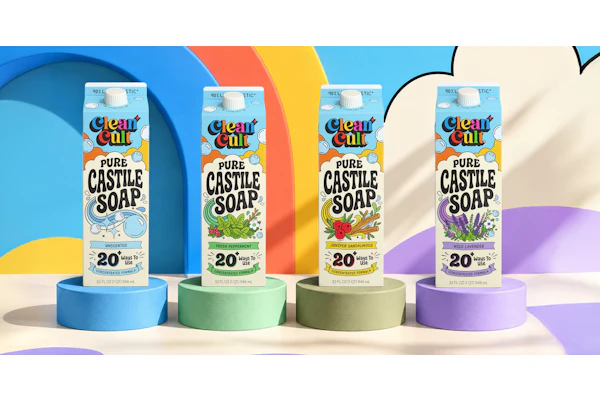
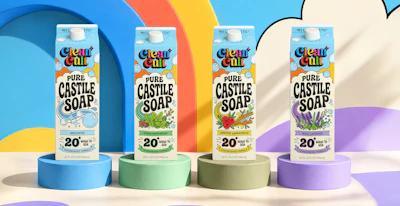
- Clean Cult's Castile soap line includes four varieties: Unscented, Fresh Peppermint, Juniper Sandalwood, and Wild Lavender, each with unique 1970s-inspired psychedelic design
- The concentrated formula can be used for more than 20 applications including dishes, laundry, floors, hair, skin, and pet washing
- Packaging uses approximately 90% paper with polyethylene lining, reducing reliance on single-use plastic bottles
- The product launched at $14.99 per 32-oz carton on Amazon and Sprouts in October 2026, priced nearly 10% lower than category leaders
- Clean Cult encourages a bring-your-own-bottle (BYOB) refill campaign for the multipurpose soap, eliminating need for multiple specialized bottles and reducing packaging SKUs
Natural cleaning products company Clean Cult has never been afraid to challenge packaging conventions. The New York-based company first made its name with a refillable packaging system that paired reusable bottles with liquid cleaning product refills packaged in paper-based gabletop cartons. The system offered an alternative to conventional single-use plastic bottles, helping reduce packaging waste. Now, with the introduction of a line of Castile soaps, Clean Cult is having some fun with the graphics, too.
Launched in October 2026, the Castile soap line includes four varieties: Unscented, Fresh Peppermint, Juniper Sandalwood, and Wild Lavender. The concentrated, plant-based soap can be used for more than 20 applications, ranging from cleaning dishes and floors to washing hair, skin, and pets.
Graphics for the new line are a colorful throwback to the 1970s, with a playful, psychedelic-inspired design that’s a dramatic departure from Clean Cult’s previous packaging. Shares Ryan Lupberger, CEO and co-founder of Clean Cult, “It was a really fun process because we’ve never just let ourselves run wild with a product.”
Expanding the Clean Cult portfolio
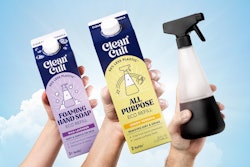
When Clean Cult launched in 2019 as a D2C brand, its refill system paired reusable, shatter-resistant glass bottles with 32-oz paper-based gabletop cartons containing ready-to-use cleaning products. Consumers could refill their bottles directly from the cartons without mixing concentrates or adding water.
As Clean Cult expanded into brick-and-mortar retail, it worked with branding agency Robot Food to update its packaging graphics, helping shoppers connect the refill cartons with their corresponding reusable bottles. In 2025, the company introduced a redesigned system at Target featuring prefilled aluminum bottles and lighter, more scent-focused graphics.
Until recently, the company’s portfolio centered on dish soap, hand soap, laundry detergent, and all-purpose cleaners. With its refill system gaining wider retail distribution, Clean Cult began considering where to go next.
“We basically said, ‘We need to tackle a category that doesn’t yet have mass market distribution, that could be fun and quirky, that could really be an all-in-one product.’ We landed on Castile,” explains Lupberger.
Castile soap is a traditional cleansing product made from plant-based oils, such as olive, coconut, or palm oil, through a chemical process called saponification. Its versatility comes from its concentrated formulation, which can be diluted with varying amounts of water depending on the task, whether that’s washing laundry, scrubbing a bathtub, cleaning outdoor surfaces, or using it for personal care, such as a body wash or shampoo.
That versatility appealed to Clean Cult, whose goal of reducing household waste extends to the products themselves. One multipurpose soap can potentially replace several specialized cleaning products and the plastic bottles they come in. “It is a super powerful all-in-one, so it saves a lot of plastic because instead of 40 products in this mass age of consumerism, you can have one,” says Lupberger.
Although Castile soap has been around for generations, it has relatively limited mainstream retail distribution today, creating an opportunity for Clean Cult to introduce the product to a broader audience. To make the soap more accessible and appealing to consumers unfamiliar with its many uses, the company decided to take a more adventurous approach to its packaging graphics.
A bold new look
Since the initial launch of its products, Clean Cult had kept its graphics relatively familiar to consumers. The paper-based carton was already an unconventional format for household cleaning products, and the company didn’t want unfamiliar graphics to create another barrier to adoption. With Castile soap, those constraints were loosened considerably.
Clean Cult’s in-house marketing and design team took advantage of that freedom to create something far more playful and unconventional than the company’s previous packaging. “We said, ‘Can we take this category and be wild, fun, explanatory, and really comical and joyful?’ So we just had a good time with it, to be honest,” Lupberger says.
The creative inspiration came from Castile soap’s past. The product enjoyed wider popularity during the 1970s, when its simple ingredients and multipurpose applications appealed to consumers interested in natural products. Clean Cult saw an opportunity to reconnect the product with that period in its history.
 Clean Cult takes advantage of all four sides of its gabletop carton for branding, colorful graphics, product information, and messaging about its ingredients and sustainability benefits.Clean Cult
On the front panel, oversized, slightly irregular, curvy black letters spell out “Pure Castile Soap” against a soft yellow background, amid bubbles and colorful, cloud-like shapes. The Clean Cult logo appears in rounded, multicolored lettering, while illustrated botanicals and bright banners distinguish the fragrances. Together, the elements give the carton its playful, psychedelic-inspired look.
Each of the four varieties has its own color palette and imagery, with sweeping, wave-like shapes in coordinating colors adding movement to the graphics. Fresh Peppermint features green leaves and accents, Wild Lavender incorporates purple flowers, and Juniper Sandalwood uses earthy green tones accented by red berries. The Unscented version relies on shades of blue and bubbly illustrations to convey freshness.
Despite the abundance of colors and illustrations however, the design retains a clear visual hierarchy. Says Lupberger, “I think retro is fun, but if no one can read the name of Castile soap and the scent, we miss the mark.”
Packaging that educates
Beyond attracting attention on shelf, the graphics have an important educational role as well. Consumers unfamiliar with Castile soap may not know how many ways they can use it, or that the concentrated formula requires different amounts of water depending on the application. Clean Cult uses the four flat panels of its gabletop carton to organize that information.
When compared with a round bottle, the additional space afforded by a square carton is particularly useful for a multipurpose product requiring instructions for different applications. “We don’t have a marketing budget like a P&G or a Unilever. We have to use our packaging to run most of our marketing and advertising on-shelf. So it has to work really, really hard for us,” says Lupberger.
The front panel identifies the soap and its scent. On one side, a colorful guide titled “Twenty+ Rituals” presents numbered applications with illustrations and playful descriptions, including “Sanctify Sticky Floors,” “Deify Your Dog,” and “Make Dishes Divine.” Another panel highlights ingredients and environmental attributes with irreverent copy, including “Some Cults Are Toxic Not Us” and “Box Out Plastic Believe in Paper.”
 A colorful illustrated guide highlights more than 20 uses for Clean Cult’s concentrated Castile soap, with humorous descriptions that make the product's versatility easy to understand.Clean Cult
A QR code directs shoppers to detailed dilution instructions for different uses. Lupberger estimates the Castile formula’s soap concentration at more than 30%, well above the levels he cites for many conventional cleaning products. That concentration helps make one carton suitable for a wide range of tasks, provided consumers follow the appropriate instructions.
Adapting the carton for Castile soap
Although the graphics are entirely new, Clean Cult uses a version of its patented 32-oz paper-based gabletop carton, the same general format that has supported its refill system since the company’s early years. However, the highly concentrated Castile soap required some modifications to both the carton and the filling process.
During early production runs, the soap generated excessive foam and placed additional demands on the carton’s side and bottom seals. Lupberger recalls foam accumulating on the production floor as the company worked through the challenges of filling the new product. “It’s a tricky, tricky product just because of how much soap is packed into a single carton,” he explains.
Clean Cult made adjustments to the carton and production line to control foaming and ensure seal integrity. Lupberger says the experience brought back some of the technical challenges the company encountered when it first began packaging liquid cleaning products in paper-based cartons.
Despite the modifications needed for the new formulation, the carton retains the characteristics that have made it central to Clean Cult’s packaging strategy. Made from approximately 90% paper, with a polyethylene lining to contain the liquid product, the carton helps reduce reliance on single-use plastic packaging while offering other environmental benefits.
One advantage is transportation efficiency. Because the cartons are shipped flat to the manufacturer and formed on the filling line, they occupy considerably less space than preformed empty plastic bottles. “We can fit 26 times the amount of cartons that a plastic bottle can because that comes empty and extruded to the manufacturer,” shares Lupberger.
The paper-based cartons are also recyclable, with access to carton recycling expanding in recent years. In 2023, approximately 60% of U.S. communities had access to carton recycling, a figure that rose to 70% in 2025. Lupberger now estimates nationwide curbside access at 73%.
Beyond the carton, Clean Cult has found another way to minimize packaging waste with its new Castile soap line. While its existing refill system typically pairs paper-based cartons with dedicated reusable bottles, the soap’s versatility called for a different approach. Offering a separate refillable bottle for hand soap, dish soap, household cleaning, and other applications would mean introducing additional packaging and SKUs.
Instead, Clean Cult encourages consumers to refill containers they already have at home, using the appropriate bottle and dilution for each application. “We’re leaning in to a BYOB campaign, so not beer, but bottle,” Lupberger says.
Expanding the Cult of Clean
Clean Cult’s Castile soap launched on Amazon and at Sprouts in October, priced at $14.99 per 32-oz carton. According to the company, that price is nearly 10% lower than those of category leaders. Additional retail distribution is planned for 2027.
Reflecting on the finished product, Lupberger says, “It’s personally, I think, one of my most favorite products we’ve ever launched. It brings joy to me, and I hope it’ll bring joy to most people as well.” PW