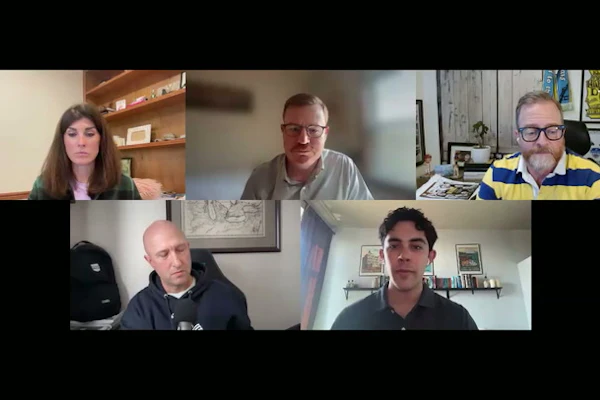
Sean Riley: Hi, I’m Sean Riley, and welcome to the End of the Line video podcast. I’ll be handling hosting duties this week as we all try to recover from a long PACK EXPO week.
As always, I’m joined by Liz Cuneo from Healthcare Packaging, Matt Reynolds from Packaging World, and Derrick Teal from ProFood World. Thankfully, we also have Casey Flanagan today, wearer of many hats at PMG.
We’ve taken off the monkey suits—no more ties, no more fancy dress. We’re actually sitting for a minute. We’re going to go over some things we saw during the show that might be relevant and that we didn’t get to cover in the videos everybody put together during the week.
I’m going to start with Casey, who I think has some connectivity to talk about that will hopefully weave us all together so we don’t have to wing it.
Casey Flanagan: Exactly. I think this is a good starting point because I’d be very surprised if you guys didn’t also see something along these lines on the show floor.
One of the big themes I saw this year was connectivity. Not just collecting data—that’s kind of old news—but finding new and creative ways to use that data once you connect it.
One place I saw that was with RedZone. They had their Champion AI system, which was basically an AI tool embedded into existing manufacturing workflows. On the front end, an operator or anybody who needs information can chat with it like any other LLM, but it’s all connected to their manufacturing data. It’s an in-house expert built right in.
The big distinction was that insights from it aren’t just for management to review after the fact. It’s for anybody on the plant floor to get real-time insight. I thought that was pretty cool.
On a similar note, there was StockIQ, a logistics company. They had this Edison agentic AI, which was really cool. Agentic AI actually takes tasks off people’s hands. If there’s a basic, repeatable task, it can do things like basic communication with vendors or reviewing inventory. It’s connected to their systems and able to boost productivity and add efficiency.
Lastly, I attended an educational session with Reading Bakery Systems on AI and continuous mixing. Basically, AI is currently being used in its early stages, and the focus right now is automation: collecting production data and automatically adjusting parameters based on programmed rules.
The future potential is for AI to learn the relationship between those different inputs and figure out an adjustment that the operator might not see. Maybe an operator thinks, “We need to adjust our oil amount or the brand of oil we’re buying.” But the AI might be able to say, “Actually, the mixing is just a little too fast. If you slow it down, you’re going to get the product you want.”
Pretty cool uses of the latest technology, data management, and AI to really boost productivity on the plant floor.
Did you guys see anything along those lines?
Sean Riley: Go ahead. You go first, Derrick. Let’s not fight.
Derrick Teal: I was going to say that I’m in agreement with Casey in terms of data being the big takeaway from the show. As you guys know, we’re shooting videos out there, and data is not photogenic. It’s very hard to take a picture of data.
There were other companies I saw doing exactly that: taking data and making it actionable.
One thing I saw was data-related, but a little different. It was Specright. We talk about ERP a lot—or EPR, sorry. See, I don’t deal with it. That’s why Matt should have gone to that booth instead of me.
Matt Reynolds: I say it all the time anyway.
Sean Riley: It’s funny you say that because I did a bunch of podcasts, and it kept coming up, and I kept saying ERP. But wait, isn’t there ERP—enterprise resource planning or something?
Matt Reynolds: Look at you! And the data that comes out of the ERP can be used to report into EPR. It becomes alphabet soup, as all of these things do.
Sean Riley: They’ve really got to workshop that.
Derrick Teal: I’m grateful to be back in hoodies because the tie was probably cutting off circulation to my brain.
Sean Riley: One of our coworkers came up to me and said, “So you do own a tie?”
Liz Cuneo: That reminds me of a coworker who said to me, “You own a hoodie?”
Sean Riley: I wonder who that was.
Derrick Teal: Anyway, one of the things they had was really neat. It’s something I’d seen years ago in a different industry—something similar.
It brings together different material components in one source, where you can piece together what you’re looking for in an end product for your package. You can look at different resources, thicknesses, and types of plastics, and it’s all right there.
If you want to ensure your packaging is going to comply with California’s requirements, for example, it’ll help you design it, find suppliers, and identify the different pieces to see whether you would be in compliance.
It has information like California’s requirements, but it still has you double-check it. As we’ve talked about, it’s very difficult right now because there’s such a patchwork of state rules. This helps you put that together and gives you better insight into whether you’re ultimately going to be in compliance.
They’ve incorporated AI, so you can ask questions and say, “I’m looking for this,” and it’ll help you put everything together and decide which supplier you want to look at for that product.
I’m sort of babbling because it’s outside my wheelhouse, but I thought it was really neat. It was a very in-depth presentation on how it can help packagers with their product.
The other thing I thought was really neat was when I got over to the confectionery side and saw some cool machines.
With sandwich cookies, you have your base cookie, the filling, and then something has to put the top on as it comes down the line to finish that sandwich.
But what happens if you have, say, a windmill shape? It’s not just round or square. You could have an upside-down windmill and end up with quality control issues.
This new machine sees the cookie bottoms as they’re coming in. As it grabs the top, it spins it and puts it on exactly as it needs to be. That company was Royal Houdijk. I’m terrible with names.
Matt Reynolds: It was Royal Houdijk. Pat did a story on that equipment not too long ago. There are some real-world applications of it. Interesting company—very innovative.
Derrick Teal: The other one I saw that was really neat was related to keeping pipes heated. I talk about sustainability a lot, and with something like chocolate, you don’t want it sticking to the inside of those pipes.
Right now, they’ll use heat jackets supplied by a boiler. You’re sending water around the pipe because you don’t want the water touching your product. The water heats the pipes as the product passes through.
There’s a cost to heating that water, even though boilers are pretty efficient. This company—I’m blanking on the name—was using frequency modulation, I think, to essentially vibrate the pipes as the product passes through, with much less energy involved.
They were saying you could get the same effect using about 10% of the energy normally used to heat those pipes.
I feel bad that I can’t remember the company’s name. I’ve been looking through my cards to see if I can find it. It was really neat to see, and I’ll definitely be including that in our Innovation Reports for 2027.
Sean Riley: Fantastic. Very cool. Matt, you had something to add?
Matt Reynolds: In one ear, out the other. I can only fit so much at once.
It was in regard to data. First of all, Derrick mentioned Specright. They actually convened what’s called the Sustainable Packaging Data Council, which is a set of brand owners for the most part, but also NGOs and solutions providers.
I believe Trayak is involved, and I think Lorax is involved. I could be wrong on both of those—I’m going off the top of my head.
There are all these different rules in Oregon, California, and Colorado, so it’s a method of standardizing or harmonizing your packaging data.
What Derrick saw was everywhere. There’s the data Casey was talking about from the operations side. We’ve seen AI systems like Harmony AI. I first saw them at PACK EXPO East, but they were here again. Burge walked me through it.
It’s an AI layer that goes on top of existing software and works with your typical EPR—excuse me, ERP—systems.
Sean Riley: See? It goes back. I had that down, and now we’ve loosened the lines on the ship.
Matt Reynolds: That’s one of them: the operational side. The other side is EPR, extended producer responsibility.
We’re seeing companies like Recyda, which was an interesting one. They were at the APR booth—the Association of Plastic Recyclers. They’re essentially creating software where enterprise data from ERP is the input.
We know how much film from Amcor, at what gauge, whether it’s mono- or multilayer—all of that can be organized and reported out in a way that goes to Colorado or Oregon.
So, yes, data everywhere, and connectivity: taking disparate systems like SAP and knitting them together in one common layer, then being able to export to different places like Colorado and California in different formats. There’s one hub, or a single source of truth, for all the packaging materials people are using.
On the operations side, it’s keeping machines running and humming along. I saw a sensor company [name unclear]—the biggest sensor company you’ve never heard of. They have sensors all over every line at a company they wouldn’t name. Let’s say the world’s largest retail company for e-commerce and D2C, so you can kind of narrow it down to Amazon.
They’ve got sensors on everything. It’s not the OEM—the equipment manufacturer—building these sensors into the equipment. This is a third-party layer of sensors that a brand owner can bring into its own systems.
They can report whether a bearing has been shaking or the temperature in a section of conveyance is getting a little warmer. That warmth might indicate something is out of spec.
We’ve always talked about big data. Now AI is taking that big data and actually doing something with it, allowing brands and equipment users to make decisions and act on data that was previously too big, too scary, and too noisy to pull a signal out of. It was all over PACK EXPO.
Sean Riley: One of the big questions was whether the data is good enough. Is AI at a point where it can figure that out for you? By “good enough,” I mean whether your data is organized and usable.
Matt Reynolds: I don’t know the answer to that, but I have to assume it’s getting better at making inferences and spotting patterns.
Even with the AI we use every day, if something is misspelled, it’s able to spot that and still read through it.
Let’s say two digits get transposed in a report so that something is impossible, like 1,000 degrees. It’s really not going to be 1,000 degrees in this corner.
I have to assume there are limits—a ceiling and a floor—where it’ll accept the data. Otherwise, it might reject it and say, “This is unrealistic. There was an extra digit or something was transposed.” But I don’t know. That’s just a guess.
Derrick Teal: I would say it’s not necessarily at the point where it can make a decision, per se. But as Matt said earlier, it gives producers a chance to look at it.
It’s good enough to say, “There’s probably something you want to look at here.” Ultimately, it’s still the human’s responsibility to look at it and make sure this is something that needs to be acted on.
And just to add, the company was the [name unclear] Food and Powder group, and it was their Tesla Tube.
Sean Riley: Fair enough. We’ve left Liz in silence. I don’t want to cut you off, Casey. I’ll come back to you, but I feel bad that we’ve left poor Liz.
Liz, does any of this jibe with what you saw? You spent a lot of time in the Healthcare Packaging Pavilion and the West Hall. Did you see some other things that were cool? What were your encounters at PACK EXPO?
Liz Cuneo: Being in the healthcare pavilion and some of the packaging and printing areas, I probably saw less AI than you guys.
I did see some interesting inspection and detection machinery that incorporates AI to do a better job and look for things outside the traditional box of defects, if you will. It’s interesting to see different ways AI is being used besides data analytics or faster, better programming. Things are getting more precise when we talk about inspection.
I got to see a lot of actual, tangible things this time, which I always love, like different ice pack options for cold chain shipping and mailers.
We talked with a lot of companies, and that GLP-1 focus is still not going away. There’s so much growth in that segment, which affects different mailers and cold chain solutions, and there’s more volume in that area in general.
I got to see some cool OTC pill bottles with new tamper evidence and single-handed opening. It’s always fun to see and touch these things at the shows.
Derrick, you mentioned that AI is hard to take a photo of, and that’s totally true. I’m lucky to be able to take photos of real things and different packages. That’s always been a highlight for me: seeing it in action versus just behind a computer screen.
Lots of cool innovations. I’m going through my 60-something videos right now, still processing them, and 300 photos, making sense of it all.
Sean Riley: Fantastic. I’m still amazed by how much the GLP-1 boom has touched and influenced our packaging and processing lives.
It keeps coming up in reports. It was a big thing in PMMI’s State of the Industry report—how it’s driving changes in actual package sizes and packaging because people are eating differently.
I guess it makes sense that everything trickles down to packaging, but it’s interesting that it has such a major impact. You came across it with cold chain and things like that.
Liz Cuneo: A lot of these really big pharma companies are building new plants. I keep seeing these releases: a new plant here, a new plant there.
A new plant means more equipment purchasing, more employees, and different autoinjector pens. I saw labeling solutions for autoinjector pens and plunger rod insertion.
You see those mechanics, and then you get down to the end: cold chain, shippers, and all of that. There are opportunities throughout the whole process, from processing to packaging and manufacturing.
Then, as you mentioned, it trickles down even further into food, which is really crazy. We’ve talked before about the rise in protein-focused foods and what that might look like for packaging and smaller portions. It’s interesting to see that it’s still shaking up the industry.
Sean Riley: It really is. I wouldn’t have thought it would have as much of a footprint as it has.
Matt Reynolds: Liz was talking specifically about getting the drug safely to a consumer, maintaining the cold chain, and not going outside temperature windows. That’s huge in and of itself.
But then the consumer takes the drug, their behavior changes, and that change ripples across packaging. You have to have more SKUs in smaller sizes, smaller snack packs, and then there’s the protein we talked about.
It’s a ripple effect in the packaging supply chain before the drug reaches the consumer. Then it hits the packaging supply chain again after the consumer takes it and their behavior changes.
Liz Cuneo: One last comment: If you talk about the distribution of these drugs, there are pharmacies popping up all over the place. Hims & Hers—you guys have seen those commercials.
Sean Riley: Ro. I was going to say Ro.
Liz Cuneo: All these online, direct-to-consumer pharmacies that we’d never heard of until now. I don’t know if they’re all new, but somebody I was talking with at a cold chain company said these little mom-and-pop pharmacies that had 12 employees now have 560 because of GLP-1s.
That’s all they distribute, or they’re servicing these online pharmacies. It’s not just through doctors’ offices. It’s consumers going online, and there’s a whole new segment and distribution path for these drugs. That requires more shipping packages and containers.
Sean Riley: Very cool. I’d cut Casey off, and I know we need to circle back. What was it you wanted to comment on, Casey? I wanted to make sure we didn’t forget about Liz.
Casey Flanagan: No worries. It was just a quick thing about AI and its reliability, especially if it doesn’t have good data going into it.
It got me thinking about agentic AI. StockIQ had a really cool solution, and this isn’t to knock StockIQ, but thinking about using agentic AI to handle things like talking to a vendor—there’s something kind of scary about that to me.
Overall, human review is still so important with AI. That’s all I really wanted to say.
Sean Riley: I say all the time on here that I’m surprised how trusting industry has become. I think we were slower to get it onto the plant floor, but you guys have just given examples where it is on the plant floor.
I’m very surprised how trusting we are about involving it in day-to-day production. When you were talking about measuring oil levels and things like that, that’s getting it pretty close.
I’m hoping somebody is overseeing it to make sure our overlords aren’t taking everything over.
Derrick Teal: Casey and I talked about that in our podcast from PACK EXPO—how it’s a really bad idea to let AI run wild in your plant. It’s just not a good idea.
As good a tool as it is in many respects, it’s still just that: a tool. It’s not the brains. It’s just a tool.
Casey Flanagan: Totally.
Matt Reynolds: I saw an interesting cartoon the other day. It had a stagecoach and wagon, which was our technology only about 100 years ago. There were two pioneers in the wagon, hooked up to the Starship Enterprise instead of a horse, and it said, “Giddy up.”
That’s pretty much the state we’re in right now. We’re allowing something much more powerful than we’ve ever known to control a lot of things. I thought that was apt for a lot of the AI discussion around PACK EXPO.
Sean Riley: I think that’s a good way to put a bow on our discussion today and wrap up what we saw.
I’m sure it’ll spill into upcoming End of the Line episodes, where some PACK EXPO things we forgot about will get covered.
Thanks again to everybody for being here, and thanks to everybody for listening.
All: Thanks, everyone.