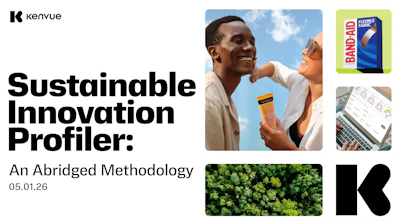
Kenvue developed the Sustainable Innovation Profiler, a patent-pending tool that integrates packaging circularity assessment into product development by combining lifecycle assessment, green chemistry, and real-time environmental metrics. The system helps developers evaluate sustainability tradeoffs early in design, enabling informed material and component choices that improve environmental performance while maintaining consumer benefits.
- The Profiler evaluates products across four metrics: Product Environmental Footprint, Product Carbon Footprint, Green Chemistry, and Packaging Circularity.
- Over 600 product developers have been trained to use the tool since its integration into Kenvue's innovation process in 2025.
- Packaging Circularity combines four criteria: post-consumer recycled content, material efficiency, recycle readiness, and recyclability disruptors (which can override other scores).
- Real-time assessment capabilities allow developers to see immediate environmental impacts of material and component selections without re-entering data into separate systems.
- Kenvue's packaging changes across brands like Listerine and Aveeno have eliminated over 7,000 metric tons of virgin plastic annually using Profiler-guided decisions.
Packaging sustainability rarely hinges on a single design attribute. A package can use more recycled content but create problems for recycling. A lighter structure can save material but compromise product protection. And a recyclable alternative may fail to deliver the performance consumers expect. For Kenvue, those are not abstract sustainability questions. They are product-development decisions that need to be made while there is still time to change the package.
The scale of those decisions is considerable. Kenvue is the consumer health company behind brands that include Aveeno, Band-Aid Brand, Johnson’s, Listerine, Neutrogena, Nicorette (excluding the U.S.), Tylenol, and Zyrtec. It reports $15.1 billion in annual net sales and has approximately 22,000 employees, 27 owned and operated manufacturing sites, and a presence in more than 165 countries. Its portfolio spans self-care, skin health and beauty, and essential health.
Across that range of products, formats, and markets, one of Kenvue’s challenges has been creating a common way for teams to evaluate sustainability choices around products and packaging. The Sustainable Innovation Profiler was developed to address that need and support Kenvue’s Healthy Lives Mission commitment that by 2030, 75% of new product development, using scientific principles, will have improved environmental performance. In 2025, the company integrated the patent-pending Profiler into its Human-Centered Innovation process and has trained more than 600 product developers to use it.
Beyond a traditional LCA tool
When Kenvue began developing the Profiler in early 2024, lifecycle assessment was an obvious part of the discussion. But the team did not want LCA to stand alone.
“We sat down and said, how do we define what is a sustainable product?” says Oliver Price, R&D global head of product resiliency and sustainability at Kenvue. LCA needed to be part of the answer, he says, but so did “green chemistry approaches for the formula and also some of the packaging circularity metrics.”
Product carbon footprint, although already captured among the environmental impacts considered through LCA, was also pulled out as a separate metric. The larger objective was to bring several types of information together in a way that could guide developers toward materials and design choices likely to improve environmental performance.
There was another issue Kenvue wanted to solve: getting people to actually use the tool. Price says many team members had experienced difficulty driving adoption when sustainability tools sat apart from the systems developers use every day.
“One of the things we really struggled with in other organizations is uptake and making it really easy for people to use within the organization,” he says. Kenvue worked closely with product developers and packaging engineers to fine-tune the Profiler to the users’ needs.
The result is a system tied to Kenvue’s existing formulation and packaging information rather than a separate application that requires teams to re-enter specifications. “They don’t have to take packaging specification data or formulation data and put it into another system,” Price says. Developers can select different materials and components and “see in real time what that impact is.”
Price explains that the tool is designed to make sustainability tradeoffs visible as developers work through different material and component options. “A bit like an Amazon cart, you can go in and select and suddenly you can see the impact of those choices.”
That real-time capability is central to what distinguishes the Profiler from a traditional product-by-product assessment. The methodology describes it as a comparative, screening-level decision-support tool rather than a system for producing ISO-compliant LCA or product carbon footprint studies.
The Profiler is designed to put environmental data in front of developers earlier in the process and at much greater scale than a formal verified assessment, which can require considerable time, resources, and cost.
Although the Profiler is designed for rapid, large-scale assessment, Kenvue has also subjected the methodology to outside review and limited assurance. Independent firm ERM CVS assessed the methodology’s alignment with relevant external standards, while the company’s 2025 Healthy Lives Mission Report says the full methodology, approximately 200 pages, also underwent scientific review by experts at Yale University.
Four metrics, with packaging getting its own deep dive
The Profiler evaluates products across four metrics: Product Environmental Footprint, Product Carbon Footprint, Green Chemistry, and Packaging Circularity.
The Product Environmental Footprint considers 16 environmental impact categories across the product life cycle, including water use, land use, resource consumption, and ecotoxicity. Product Carbon Footprint isolates greenhouse gas emissions. Green Chemistry evaluates such factors as aquatic environmental impact, renewable origin, and ingredients facing emerging scientific concern. Packaging Circularity focuses specifically on the design and material choices that influence circularity.
In order for Kenvue to classify an innovation as having improved environmental performance, it must improve in at least one of the four metrics without regressing in another compared with a baseline product.
Packaging Circularity itself combines four criteria: post-consumer recycled content, material efficiency, recycle readiness, and recyclability disruptors.
Price describes the first three criteria, saying, “Let’s reduce and make it as efficient as possible. So using less, let’s make it so you get rewarded when you move away from virgin materials. And recyclability is something that is desirable as well.”
 Kenvue’s Sustainable Innovation Profiler methodology outlines the four metrics used to assess product sustainability. To qualify as an improvement, a product must improve in one or more metrics without regressing in another.Kenvue, from its publicly available Sustainable Innovation Profiler
The fourth criterion captures “the things we really don’t want to see,” he says—or packaging features that can interfere with recycling.
Within the weighted score, PCR content, material efficiency and recycle readiness each carry an assigned weight. Material efficiency looks at packaging weight per product dose. Recycle readiness measures the proportion of the package designed for recyclability.
Recyclability disruptors work differently. They are not simply another weighted factor. The methodology treats them as an override. A designated disruptor can send the Packaging Circularity rating directly to “Very Poor,” regardless of performance in the other three criteria. Examples include the use of finishing processes such as pearlization or metallization, as well as materials such as PVC or ABS.
That does not necessarily stop a project. When the dial turns red, Price says, “there needs to be a discussion with the project teams.” At that point, teams can weigh the packaging issue against “what’s the consumer benefit here versus many other risks the project might be facing.”
In that sense, the Profiler is less about automatically choosing one package over another than about making the tradeoff impossible to miss.
Creating a defensible comparison
Because the tool measures improvement relative to another product, choosing the correct baseline is critical. Kenvue’s methodology specifies that the baseline should be the product being directly replaced or most cannibalized by the innovation and must offer the same primary consumer benefit.
Price calls baseline selection “one of the tensions within the process.” Kenvue has built training and support around it, including a group of sustainability champions across packaging and formulation.
In most projects, the comparison is relatively clear because marketing and financial planning have already identified the product most likely to be displaced by the new launch.
A genuinely new format is more difficult. In those instances, Kenvue may identify a suitable comparison elsewhere in the same product category or elsewhere in its portfolio. And when no reasonable comparator exists, Kenvue has added a non-comparative capability designed to flag environmental hotspots and potentially problematic material choices.
The data powering the Profiler
The relatively simple output developers see depends on a much more complex collection of environmental and materials data.
“Underpinning the Sustainable Innovation Profiler is an amazing data set,” Price says. “That database is really powerful, and we spend a lot of time curating it.”
Much of the underlying information comes from Ecoinvent, a lifecycle inventory database, and SPICE, a cosmetics sustainability initiative. When a new material does not align with an existing dataset, Kenvue uses a governance process with its materials organization and external experts to identify an appropriate proxy.
For packaging specifically, the Profiler combines composition data with internal information such as Kenvue’s list of recycling disruptors. Packaging inputs can include component weights, PCR content, and recyclability status.
The methodology also calls for regular reviews, automated data synchronization, and defined triggers for updates as scientific information, supplier data, and regulatory requirements evolve.
Listerine makes the impact visible
Listerine offers a straightforward example of how the Profiler can quantify a packaging decision. Kenvue introduced bottles made with 100% PCR plastic across Asia Pacific, Europe, the Middle East, Africa, and Latin America, while North American bottles use 50% PCR. The company reports that the changes eliminate more than 7,000 metric tons of virgin plastic annually.
Listerine also changed the label adhesive to a wash-off version designed to release during the recycling process, improving the quality of recovered PET.
“The packaging engineers were able to model that within the tool and see the impact straight away,” says Kenvue Senior Director Global Sustainability Christopher Hillman. “Having that data at hand really helps make informed decisions on what we’re doing and why we’re doing it through the innovation process.”
For Le Petit Marseillais Peach and Nectarine Shower Gel, the Profiler assessed changes to the bottle. Packaging developers increased PCR content from 30% to 99.87% and improved material efficiency. That resulted in a 19-point Packaging Circularity gain, earning the project a “Good” rating.
Other packaging changes across the portfolio follow similar principles. Aveeno rolled out 100% PCR bottles for adult lotion and body wash globally, removing approximately 300 metric tons of virgin plastic annually. The brand also launched an all-plastic lotion pump in Europe, the Middle East, and Africa, removing the metal component that had hindered recyclability.
 Nicorette replaced its previous plastic secondary pack with a recyclable paper carton, reducing plastic use by 85% while also addressing material use, carbon reduction, and potential EPR considerations.Gayatri Keskar/Kenvue, from the 2026 Packaging Recycling Summit
Meanwhile, in Europe and Canada, Nicorette moved secondary packaging for its 2-mg coated lozenge from a plastic blister pack and box to a recyclable paper carton and box, reducing total plastic use by 85%. The redesign has since been expanded to additional lozenge sizes.
When consumer needs pull in another direction
The Profiler becomes more interesting when the sustainability choice is not so straightforward. Hillman points to Neutrogena Hair Restore Strength + Purity Shampoo as an example. Its pump contained a metal spring that reduced packaging circularity, but the product formulation and consumer experience required the performance the pump provided. “It needs to have a pump, and it needs to work,” he says.
Kenvue knew there were more sustainable alternatives, but if they did not evacuate the product correctly or meet the consumer need, they were not viable. More broadly, Hillman says, packaging choices can also be constrained by functional requirements such as oxygen or UV barriers.
Kenvue’s 2025 Healthy Lives Mission Report shows how that decision registered in the Profiler. The shampoo improved the Product Environmental Footprint by 37%, reduced the Product Carbon Footprint by 6%, and improved Green Chemistry by nine points. But the metal spring negatively affected Packaging Circularity, resulting in a “Very Poor” rating and preventing the product from qualifying as an overall environmental improvement.
Price sees value in making results such as this visible. The decision, he says, can then be “proactively and openly taken.” Instead of being handled in a vacuum or reliant on the project team, the tradeoff becomes part of a systematic governance process.
That also gives Kenvue information beyond the individual project. ”That’s the beauty of having it systematically deployed now within the organization,” Price says. “Individual projects get to see things, but then the programs can see where our real hotspots are.”
Recyclable pumps are one such hotspot; another is flexible packaging. Hillman says Kenvue continues to look for opportunities to transition flexible structures toward mono-material formats. But the question is whether those alternatives still provide the necessary barriers and how the packaging will actually be managed at end of life. “And that varies depending on which country you’re in,” he notes.
For a company selling products in more than 165 countries, those regional differences add another layer to what might otherwise appear to be a simple packaging-material decision.
Refill is coming
Other packaging strategies remain outside the Profiler’s current scope, including reuse and refill, even though Kenvue already has brands pursuing those formats. Le Petit Marseillais, for example, introduced doypack refills for shower gel in 2025. Kenvue says each refill uses at least 50% less plastic than a standard bottle, and the brand has sold more than 1.5 million doypacks.
Hillman says the current exclusion was based on development priorities rather than a fundamental technical obstacle. The company initially focused on its largest packaging formats and the areas where the most innovation was moving through its pipeline.
“There isn’t a technical reason for why we haven’t included reuse and refill in there,” he says. “That’s part of our roadmap as we move forward in the evolution of the tool.”
Adds Price, “We have the method ready to go. It’s just finding the time with all the other builds that we want to put in.”
Engineered products, including categories such as wound care and feminine care, are also planned additions. Kenvue’s public methodology describes a three-year roadmap for bringing currently out-of-scope product types into the Profiler.
Bringing EPR into the design conversation
The packaging module itself is also likely to evolve as regulation and societal expectations change. Price says Kenvue is interested in strengthening the way minimization is addressed. Material efficiency already rewards reductions in packaging weight per dose, but the company is looking at whether more explicit minimization rules should be added.
The bigger opportunity may come from connecting environmental data with the financial consequences of packaging regulation. Because the Profiler already centralizes structured packaging information, Price says Kenvue could potentially build market-specific EPR fee structures into the system so teams could see the potential cost of their packaging choices at the point of design.
That capability could become increasingly valuable as EPR expands. “Today there isn’t a harmonized approach for extended producer responsibility,” Hillman says. In the U.S., for example, states are adopting different criteria, while requirements also vary among countries. Building those rules into the Profiler could give packaging engineers greater visibility into how the same design may be treated from one market to another.
Making the Profiler public
Beyond using the Profiler internally, Kenvue has published an abridged version of the methodology behind it. The public document lays out the four metrics, baseline-selection principles, packaging circularity weighting, data governance, and external assurance approach.
Price says the decision reflects Kenvue’s broader commitment to having the method externally reviewed and being transparent about how it measures improvement.
“We felt that it was really important as part of that journey to share with other stakeholders, peers, and others around what we’ve been doing,” he says. External key opinion leaders also reviewed the method during development.
The public version may be particularly useful to companies that do not have deep in-house LCA expertise. As Price notes, “not every small company has LCA practitioners.”
But the larger lesson may be the structure surrounding the methodology. Kenvue has tied sustainability data to existing product information, embedded it in a development stage gate, trained the people using it, established governance for questionable results, and created a way to see recurring technical problems across the portfolio.
The Profiler does not remove the tradeoffs that come with sustainable package design. Pumps still need to dispense. Flexible structures still need to protect products. Recycling systems still vary by market. Increasingly, EPR rules do too.
What the system changes is when and how those issues become visible. Rather than discovering the environmental consequence after a package has been finalized, Kenvue is putting it in front of developers while they are still choosing the materials, components, and formats that determine it. PW