Recycling succeeds only when package design, on-pack messaging, local collection programs, MRF equipment capabilities, and end-market demand all work together. Misalignment at any point—from consumer confusion to film contamination to missing markets—breaks the recycling chain, making coordination between brand owners, municipalities, and processors essential.
- Recycling fails at multiple points: package design, consumer understanding, MRF processing capability, and end-market availability must align for success.
- Contamination rates in regions like Chicagoland reach 20-25%, with bagged recyclables and film being the most common problems.
- Cart tagging programs directly improve behavior—one community reduced tagged carts from 357 to 142 in one year through targeted feedback.
- MRF technology upgrades require significant investment; WM spent $1.4 billion over four years to add optical sorting and AI systems to handle evolving materials.
- Film remains the hardest material to recycle because it wraps around equipment, contaminates multiple streams, and lacks reliable end markets even when collected.
Recycling can fall apart in several places. A resident can misunderstand the instruction on a package, a material can arrive at a materials recovery facility in a form that’s difficult to sort, or a bale can leave the facility with no reliable end market waiting for it.
That gives CPG brand owners a practical way to think about recyclability. The package design, the on-pack message, the local recycling program, the MRF equipment, and the demand for recycled content all have to line up better than they often do today.
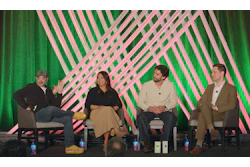
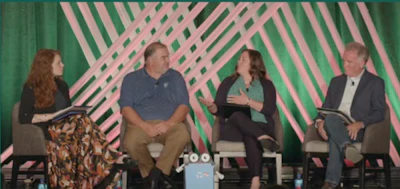
Those were among the main points from “Closing the Loop,” a panel discussion at the Packaging Recycling Summit, produced by Packaging World and held in June in Rosemont, Ill. Moderated by Juliet Mathey, the recycling education and outreach specialist for the Metropolitan Mayors Caucus, the discussion moved from the curb to the MRF and then upstream to package design, labeling, extended producer responsibility, and the markets needed to turn recovered material into new products.
Simplifying recycling without oversimplifying it
Recycling education has become harder as programs and packaging have changed. Jim Marcinko, recycling operations director at WM, has worked in recycling for over 30 years and has watched the industry move from source-separated collection to dual-stream and single-stream systems, along with much more automated sorting.
Years ago, he said, many programs told residents to recycle plastics one through seven, even though PET and HDPE were the primary targets. Today, the industry is trying to make the message more recognizable by focusing on items residents understand, such as tubs, lids, and bottles, especially those coming out of the kitchen.
However, the local message still has to match local materials recovery facility (MRF) capabilities. Christina Seibert, executive director at the Solid Waste Agency of Northern Cook County, or SWANCC, connected that need for simpler education to a harder constraint. “We can only do that when we get information from our MRF partners on what they’re able to manage,” she said. “I’m really glad to be here and be in an audience with brand owners who are creating the packaging in the first place because that’s been a missing piece to our discussions.”
That gap between what is designed, what is collected, and what can actually be processed became much more visible when global recycling markets shifted. After China’s National Sword policy, announced in 2017 and implemented in 2018, put new pressure on recyclable material markets, Illinois recycling stakeholders began looking for more consistent guidance.
 The Recycling Contamination Task Force developed simplified guidelines to help Illinois residents understand which common materials belong in the recycling cart and which items create contamination problems for MRFs.Solid Waste Agency of Northern Cook County
Seibert pointed to the Recycling Contamination Solutions Task Force, an ad hoc group formed through work with the National Waste and Recycling Association’s Illinois chapter and the state chapter of the Solid Waste Association of North America, or SWANA, to standardize accepted recyclable materials statewide and develop simplified recycling guidelines. The task force continues to revisit the list as MRFs and markets change, with Seibert noting that paper cups and polypropylene cups have recently been added.
Walter Willis, executive director of the Solid Waste Agency of Lake County, or SWALCO, said guidance had become too word-heavy in earlier years. The goal now is a simple front-end message, with more detail available online for residents who want it. “If you really want to drill down, we have that information on our websites, but for most people, just keep it simple,” he said. “And one of the things we’re seeing now more and more is the skepticism over whether the material’s actually being recycled. So, our message really has to change to prove that it is actually happening.”
A closer look at what residents put in the cart
One Northern Illinois effort is testing how far education can go when it’s backed by data, advertising, direct outreach, and cart-level feedback. Mathey’s organization, the Metropolitan Mayors Caucus, received a $2 million EPA Recycling Education and Outreach Grant, with partners including SWANCC, SWALCO, and several counties.
That grant helped fund the Feed the Cart campaign across a region of nearly 9 million people. The campaign includes tools such as Recycle Coach, a localized app that gives residents collection schedules, pickup reminders, and guidance on what belongs in the recycling cart, along with media coverage, social media, billboards, handouts, and direct education.
Seibert said the group is measuring progress against two goals: increasing recycling tonnage by 15% and lowering contamination. SCS Engineers helped establish a baseline in a mostly privatized market, and Seibert said residential recycling in the Chicagoland area was about 530,000 tons in 2024. A 15% increase would put that number at about 610,000 tons by 2026, or roughly another 80,000 tons. The contamination target may be just as difficult, since Seibert said the region believed it had a contamination rate of about 20% to 25%.
The next phase of Feed the Cart will use MRF data to focus more directly on the most common problem materials. Seibert said the campaign has already built awareness, and the next phase will focus more directly on the materials that need to be captured and the contaminants that need to be reduced.
One of the most direct consumer awareness tools is cart tagging. Willis said SWALCO works with haulers in three communities, selecting about 500 homes and visiting the same homes four weeks in a row. “When you get right in and you show people what they’re doing wrong directly, it does change behavior significantly,” he said. “Even if you do well, we give you a ‘Looks good,’ so it’s both positive and, we’re trying to make you become a better recycler.”
 SWALCO’s first round of cart tagging showed contamination rates falling over four weeks in Waukegan and Zion, suggesting that direct feedback at the cart can help residents better understand what belongs in the recycling stream. Solid Waste Agency of Lake County
In Waukegan, Ill., Willis said the local MRF, LRS, told SWALCO that its hauler tagged 898 carts in March 2025 and 173 in March 2026. In May, the number dropped from about 357 the previous year to about 142.
The most common mistake is still bagged recyclables. Willis said some residents believe they’re helping by keeping recyclables from blowing out of the cart, when the opposite is true once the material reaches the MRF. “People think they’re doing the right thing, but they don’t understand that you need to keep the recyclables loose, because if you bag them, most likely they won’t even make it through the MRF,” he said.
The tagging program has also exposed language barriers, which is why outreach materials are being produced in Spanish as well. Other contamination comes from food, soil, and yard material, sometimes because residents are trying to avoid extra trash costs when garbage exceeds cart capacity.
What happens inside the MRF
Those local lessons matter to MRF operators because contamination usually starts as a mistaken decision. Marcinko said personal communication through cart tagging is among the most effective ways to help residents improve.
“Residents are not usually trying to sneak contaminants into the recycling cart,” he noted. “In many cases, they believe an item is recyclable or are unsure where it belongs, and it ends up in the MRF, where it can cause problems or jam machinery.”
MRFs are also changing how they operate to keep up with shifts in the recycling stream. Marcinko said WM has spent $1.4 billion over the last four years upgrading its recycling facilities, replacing aging plants and adding newer sorting technology. That includes building just under 50 new facilities and spending about $35 million, possibly more, to address film recovery.
Newer facilities use more optical sorting, vision systems, and AI technologies, with fewer screens than older operations. That can help the facilities capture materials they might not have recovered previously, including HDPE items beyond traditional bottles. It also gives operators more ways to manage contamination that historically created problems.
Film remains one of the hardest materials to handle. Marcinko said WM knows EPR will put more pressure on the system to recycle film, but film that enters the curbside recycling stream moves into many different commodities and requires significant effort to remove.
“Once film gets into the curbside stream, it wraps around equipment and contaminates multiple material streams, which makes it much harder to recover,” he explained.
That creates a clear distinction between store drop-off film and film that comes through a MRF. Grocery store return film is cleaner, while MRF film can carry grit, glass, and other contaminants, especially when residents place other recyclables inside a bag.
Where package design shows up downstream
The MRF perspective also points back to package design. Marcinko said optical sorters may use cameras or spectrometers to identify materials before ejecting them into the proper stream. However, trouble can arise when, for example, a PET bottle is covered with a PP label, and the equipment reads the package as PP.
While operators can train machinery to recognize some of these items, the process takes time. “We can teach the system to pick up on those nuances,” Marcinko explained, “but it’s not something that happens overnight.”
Carbon black pigment creates another challenge because it can be identified as the conveyor belt, since the equipment does not see light reflection. Some newer systems use lasers to pick up the 3D image of black packaging, but that technology is not in every plant. Marcinko said WM is adding the technology as it builds new facilities.
 WM’s Recycle Right materials identify common contaminants that can create problems inside MRFs, including bagged recyclables, loose plastic bags and film, food and liquids, batteries, tanglers, electronics, and yard waste. WM
Those kinds of sorting adjustments can help, but they also underscore the value of consistency in package design. MRFs can’t keep changing equipment for every packaging change. Marcinko said machinery generally remains in place for about 10 years, even though it can be programmed and trained to recognize different shapes and material combinations.
Even when a MRF can identify and separate a package correctly, that’s only one step in the recycling chain. The material still has to move into a market that can use it. “Whatever’s recyclable, it has to get collected, get processed, and go somewhere,” Marcinko said. “Because if it doesn’t go somewhere, then it’s not recycled.”
The quality of the material also helps determine how well the economics work. Contamination wastes processing time on material with no value, Marcinko said, and those costs ultimately reach the customer. Cleaner bales improve yields for the buyers that turn recovered material into new feedstock. That makes design, collection behavior, MRF performance, and end markets part of the same business equation.
Why recycled-content demand matters
Recycled-content demand is one way to strengthen that equation. Seibert said she would like to see as much recycled content built into packaging as is technically and legally possible, rather than leaving that choice to consumers at the shelf.
She also urged brands to connect recycling to an outcome when space allows. Simple messages such as “Recycle this cereal box to make new boxes” or “Recycle this aluminum can to save greenhouse gas emissions” can give residents a reason to participate beyond the act of placing an item in the cart.
Labels can help, she added, but they cannot solve the whole communication problem. Asked about How2Recycle, Seibert said she thinks the label has a strong premise, but it is not always easy for consumers to use. “I think it has really good potential, I just worry that it isn’t the place where we rest,” she said. “I don’t think that it’s the be-all and end-all for answers.”
Marcinko added that national packaging messages can also run into regional market differences. Glass may have a market in one part of the country and limited access in another, especially where transportation costs make the economics difficult.
EPR brings brand owners into the system
EPR could help address some of those differences by funding system improvements, expanding access, and creating more consistent end markets. Willis described how producer involvement fits into the broader system. “It’s the third part of the three-legged stool,” he said. “We need the brand owners to continue to understand their packaging and what it does downstream.”
Education funding is part of that discussion. Willis said programs are supposed to be spending up to $1.50 to $2 per household per year on education, but current spending is nowhere near that level.
Seibert emphasized the need for cooperation before policy is written. “When we are setting policy, we need to collaborate because we need implementable policy that’s operationally and technically viable,” she said. “The only way we’re going to get there is by having a mutual understanding that we each have competing goals in some of these areas.”
She also pointed to a practical challenge for brands. Seven states have packaging EPR laws, and some are large population states. Brands, however, generally design packaging for a national market, and sometimes for markets beyond the U.S. Conflicting state requirements can create logistical problems for implementation.
The hard case of flexible film
Flexible film shows how hard consistency can be in practice. Willis said SWALCO has worked on film and plastic bag legislation, education, and recovery programs. That work includes outreach to help residents understand that film is not limited to retail bags, but also includes bread bags, wraps, and other flexible plastic packaging. SWALCO is also engaged in the Hefty Renew program in several communities, which offers one way to capture film through a system connected to curbside collection.
Still, film remains one of the hardest packaging materials to recycle, even under EPR. Willis cited a boat wrap recovery program in Lake County, where collected material was still waiting to be recycled because markets were not available. The example points to one of the central challenges with film recovery. Collection alone does not close the loop if the material has no reliable market.
Even clear trash bags are a problem for MRFs. Marcinko said WM tries not to accept bagged recyclables because employees cannot know what is inside. A clear bag may be followed by many opaque bags, he said, and bags can contain household garbage, hypodermic needles, or other material workers should not have to discover by opening them.
Seibert added that a MRF running a line at 30 or 40 tons an hour does not have time to break open bags, and bags that reach screens can wrap around equipment and cause downtime. “Don’t bag your recyclables,” she said. “It’s simple as that.”
Keeping trust in recycling
Asked to close with their final thoughts on where recycling education and system confidence need to go next, Marcinko pointed first to materials that are working well and then to those that still need support. Cardboard packaging, he said, is growing quickly in WM facilities and works well because it is easy to capture, easy to market, and supported by domestic markets. Plastics are still changing, PET markets need support, and batteries must be kept out of the recycling stream because of fire risk.
Seibert brought the discussion back to packaging design, access, and trust. She said recycling becomes easier for residents when the materials themselves are easier to understand and manage.
“We’ve got to simplify the materials, and I think that getting that along with uniformity and access will go a long way to the consumer trust and belief in the system and their participation,” Seibert said. “And when we can’t make it simple for the consumer, there has to be a way to get things in the back end or to design it out on the front end.”
Willis wrapped up on a similar practical note, pointing out that brand owners need to be part of the message that reaches shoppers. “At the end of the day I’m still an optimist,” he said. “I do believe that if we can get a simple message across and we’re all saying the same thing—the hauler, the municipality, the brand owner—that’s going to be key. We have to overcome the skepticism that is out there. I’d really like to put that to rest.” PW