Procter & Gamble is applying its century-long expertise in cleaning to develop three advanced recycling technologies—LAZRmark laser marking, FlexLoop solvent extraction, and dissolution purification—that remove contamination from plastics and enable higher-quality recycled material for new applications.
- LAZRmark uses laser technology to mark packaging directly instead of using labels and inks, reducing decoration-related contamination in recycling streams.
- FlexLoop employs solvent extraction to deep-clean recycled plastics by removing contaminants, odors, labels, and non-intentionally added substances (NIAS) trapped in polymer matrices.
- Dissolution technology purifies polypropylene and polyethylene by separating odors, colors, and contaminants while keeping polymer molecules intact for higher-purity recycled applications.
- P&G partners with companies like LasX, Lindner Washtech, PureCycle, and Dow to scale these technologies beyond its own packaging portfolio.
- The three technologies address different recycling stages: prevention of contamination, deep decontamination of difficult materials, and final purification for sensitive applications.
Procter & Gamble’s latest recycling work starts with a familiar idea inside the company. P&G has built much of its business on cleaning, and Teo Medellin, director, corporate packaging sustainability, Procter & Gamble, used that history to explain why the company is developing technologies that can clean recycled plastics more effectively.
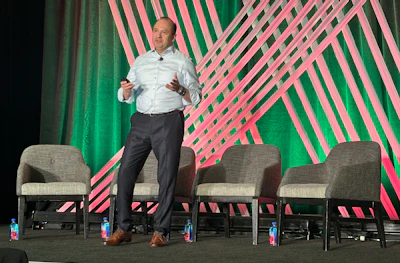
Medellin laid out that work during a presentation at the Packaging Recycling Summit, held in June in Rosemont, Ill., and produced by Packaging World. The focus was not only on P&G’s own packaging, but on technologies the company believes can help improve real-world recycling outcomes beyond its own portfolio.
“We know a thing or two about cleaning,” said Medellin.
He began by walking through the long arc of cleaning. Humans relied on water and mechanical force for thousands of years. Soap improved the process by helping pull oils and dirt into water. Later, synthetic detergents addressed limitations in soap, particularly where minerals could interfere with cleaning performance. P&G’s Dreft, followed by the development of a heavy-duty detergent over a roughly 15-year period, became part of that history.
Medellin used that story to frame P&G’s sustainability work. The company’s “It’s Our Home” strategy includes reducing its own impact, enabling consumers to reduce their impact, and scaling industry-wide solutions that reduce environmental impact.
Packaging examples from the presentation included Tide’s journey toward 50% recycled content, lightweighted bottles, a one-material package with an HDPE cap, and new Tide formulations that Medellin described as part of the next generation of cleaning products, some of which may not require plastic. But the core of his presentation centered on three recycling technologies: LAZRmark, FlexLoop, and dissolution.
Medellin said the technologies are not within P&G’s own business model, so the company draws from what it knows, identifies ideas worth pursuing, finds partners to develop them further, and participates in scale, sometimes as an early adopter.
Laser marking reduces decoration-related recycling challenges
The first technology Medellin discussed was LAZRmark, a laser-based decorating system developed with LasX for polypropylene and polyethylene packaging. Instead of applying labels, inks, or adhesives that later have to be removed during recycling, LAZRmark marks the package surface directly.
Medellin pushed back on defining the technology only by what it removes. The larger opportunity, he explained, is to use the technology where cleaner material can improve recycling outcomes.
LAZRmark is an ultra-high-speed, high-resolution system capable of online decoration at more than 300 parts per minute. According to Medellin, P&G and LasX developed the technology to move beyond the slower coding and limited messaging traditionally associated with laser marking. Because the decoration is digital, the system also gives packaging teams flexibility to change graphics or effects without adding label materials to the recycling stream.
 P&G is using LAZRmark laser-marking technology on its Tide cap, eliminating the need for additional inks, labels, or adhesives on that component.LasX, insets added for emphasis by Packaging World
The technology has been approved by the Association for Plastic Recyclers (APR) for PE and PP. P&G has already used LAZRmark on a Tide cap, and Medellin said additional applications are underway.
A deeper wash for recycled plastic
From there, Medellin moved into decontamination and purification. Current mechanical recycling systems can involve dry washing, room-temperature washing, and hot washing. His point was that washing technology can continue to evolve, just as cleaning products evolved from water to soap to surfactants and detergents.
FlexLoop moves P&G’s recycling work from cleaning into deeper decontamination. The solvent-extraction technology, developed with Lindner Washtech, is designed to remove contamination from plastic by immersing recyclables in a solvent, then evaporating, circulating, and filtering that solvent for reuse. Medellin compared the concept to dry cleaning but applied to plastic recycling.
For recyclers, he described FlexLoop as another form of washing, one that can go beyond dry, room-temperature, or hot washing. “Think about it as a different type of wash line,” he said.
 FlexLoop solvent-extraction technology is designed to remove contamination from plastic, producing cleaner recycled material from unwashed feedstock.Teo Medellin, Procter & Gamble
In an example shared be Medellin, FlexLoop produced a visibly cleaner output than the unwashed plastic feedstock. The process can de-ink material, remove solids, address adhesives and labels, and reduce odor. Medellin said that makes it especially relevant for films, where labels, residues, and other contaminants can limit the quality and potential end uses of recycled material.
FlexLoop also is designed to address NIAS, or non-intentionally added substances. Medellin explained that contaminants can diffuse into a polymer over time and become trapped in the polymer matrix. Solvent extraction is intended to pull those contaminants back out, creating cleaner recycled plastic for applications that require higher levels of purity, including contact-sensitive uses.
Dissolution purifies PP and PE for new uses
Dissolution takes purification a step further by using a solvent to put the polymer into solution, which allows odors, colors, and contaminants to be separated from the material. Medellin described it as nonchemical recycling because the polymer molecule remains intact. In the case of polypropylene, he said, the material remains polypropylene, but changes state as part of the purification process.
 P&G is incorporating recycled PP from PureCycle into Tide caps, demonstrating one use for purified rPP in packaging.Teo Medellin, Procter & Gamble
PureCycle licenses P&G’s dissolution technology for PP, which is designed to remove odors, colors, and contaminants from the material. Medellin described PureCycle as a “fantastic success story” and shared that P&G is participating in the launch of PP packaging made with recycled material, including a detergent cap made with PureCycle mateerial.
P&G also is working with Dow on Verso Vita, a dissolution technology for PE. The companies are developing the technology to target hard-to-recycle plastic waste and support plastic-to-plastic recycling through high-purity, contaminant removal.
Recycling innovation depends on shared expertise
Together, LAZRmark, FlexLoop, and dissolution address different points in the recycling process. LAZRmark reduces decoration-related contamination before packaging enters the recycling stream. FlexLoop cleans and decontaminates difficult materials such as film. Dissolution purifies polymers so recycled plastic can move into new applications.
Medellin closed by widening the point beyond P&G’s own work. Recycling innovation, he suggested, depends on companies bringing forward the expertise they already have and finding partners that can help put it to work.
“What are the things that we can be doing together and are we activating those teams? Are we activating those capabilities that you have built through many years in business?” he said. “We are trying. We’ll continue to clean and find ways to clean the world. Please join.” PW