The robotics industry is poised for explosive growth as AI and software-defined automation make systems easier to deploy, maintain, and improve after installation, with companies moving beyond automotive applications toward broader adoption across small and mid-sized manufacturers.
- AI and software-defined automation are transforming robotics from brittle, static systems to adaptable ones that can learn and improve after deployment
- Non-automotive robot orders have outpaced automotive orders for several years, with small and mid-sized companies increasingly investing in automation
- Lower barriers to entry through AI, reduced costs, and government support are enabling small businesses to access robotics technology that was previously out of reach
- Software-defined automation separates hardware from software, allowing companies to run applications on any hardware rather than being locked into proprietary systems
- Practical AI deployment is shifting focus from whether AI works to where it creates real business value, with setup times dropping from months to minutes or hours
AI and software-defined automation are changing the future of robotics, moving the industry toward systems that can be easier to deploy, maintain, and improve after installation.
Mike Cicco, president and CEO of Fanuc America, sees the robotics industry on the edge of a much larger adoption cycle. “We’re poised for an explosion of growth,” he said during a keynote presentation at Automate 2026 produced by A3 Association for Advancing Automation and held in June. “I tell my team all the time, 'Get ready for it because it’s coming.'”
For CPG companies that have already installed robots, or are considering where automation could fit next, the keynote showed how the industry is working to make robotics easier to use and easier to support over time. The focus has shifted beyond simply getting a robot into a plant, toward making automation systems simpler to deploy, adapt, and improve after installation.
The four keynote panelists represented Fanuc, Schneider Electric, Cognex, and Intrinsic, and each approached the shift from a different angle. Customer urgency, AI, software-defined automation, and open architectures all came into the discussion. So did humanoid robots, although the panelists treated them less as a question of form and more as a way to talk about physical AI, safety, and automation that moves closer to the tasks people perform.
From brittle systems to adaptable ones
Looking back over the past decade, Matt Moschner, president and CEO of Cognex, pointed to how much the robotics industry has evolved. When he first attended Automate in 2016, he said, many systems were difficult to set up and hard to change once they were deployed.
“If I reflect on 2016 to 2026, if I’m honest, the systems we were working on then were complex. They were brittle, and they were only as good as the day they were deployed,” he said. “When I think about today, I see a much higher level of simplicity that many technology providers have brought to automation, lowering the barrier to learning and deploying.”
That difference matters because manufacturers are not only buying a system for the day it is installed. They also have to live with it, maintain it, and make it work as conditions change.
Newer systems are becoming more adaptable, and in some cases can improve after the factory acceptance test. Moschner pointed to Cognex machine vision as one example.
“It can improve, it can learn. And a lot of that is because of AI,” he said. “I think of a Cognex machine vision system. When we launched a new vision tool, that tool was never going to get better than the day it was released. With a lot of our AI tools today, our customers can incrementally train. We can intervene and improve those models on the fly.”
 Matt Moschner, president and CEO, CognexA3
The customer mindset is changing as well. Over the last couple of years, uncertainty around global trade and tariffs caused some companies to pause. Now, Moschner said, automation is being viewed as a way to reduce risk and help companies operate with more agility.
“The complexity is coming down. The ability for your teams to own those technologies once they’re deployed has never been better,” he said. “And at the same time, the urgency that all of you are likely feeling to deploy technology and automate more has never been higher.”
Growth beyond automotive
Industry statistics from A3 over the past several years show that robot orders in North America have been uneven, with automotive demand fluctuating and non-automotive sectors gradually increasing their share of orders. Cicco said North American robot order data requires some context. A3 data reflects when robot suppliers receive orders from customers, not when those robots are shipped to end users. Automotive also remains a large user of robots, but the sector is cyclical and has been affected by changes in electric vehicle strategy.
Outside automotive, the story looks different. Cicco said non-automotive robot orders have outpaced automotive orders for several years, even if many of those investments do not generate major headlines.
“A mom and pop shop in Wisconsin buying three robots isn’t a headline, but that’s happening hundreds of times, and it’s really creating that pull,” he explained. “The democratizing of software is a big part of that. Fanuc and Google have an MOU to integrate, and that’s new for us, but it’s exciting because it’s lowering that barrier of entry to the customers.”
That lower barrier to entry came up several times during the keynote. AI, lower costs, and government support for automation are helping small and mid-sized companies look more seriously at robotics, Cicco said.
“Customers are able to get in at a much lower bar right now. AI is bringing down the barrier of entry, so small to medium-sized companies can get into it. The cost of everything is becoming much more affordable,” he said. “We have strong government support for automating companies. We all know that we want to make more things in America.”
For André Marino, SVP of industrial automation, North America, for Schneider Electric, the issue comes down to U.S. manufacturing's ability to compete. Increasing capacity alone will not be enough, he said.
“Automation is now a competitiveness strategy,” Marino said. “The U.S. cannot win by adding capacity alone. We need to be more competitive, and automation is a way to do that when we connect energy, we connect the machines, and we deal with the labor shortage, et cetera.”
 Andre Marino, SVP, industrial automation, Schneider ElectricA3
Schneider Electric is applying that thinking in its own operations. The company has more than 21 factories in the U.S., including a 60-year-old plant in Lexington, Ky., that has been modernized with automation and AI and is now one of the company’s lighthouse factories.
Waiting too long to invest carries its own risk, particularly for small and mid-sized companies, Marino said.
“Eighty-five percent of the manufacturing in the U.S. is small and mid-sized companies," he explained. "This is a challenge we need to meet with easy-to-use technology with applications and more open and software-defined automation that will help us tackle this old siloed automation that was so hard to adapt."
AI has to work in production
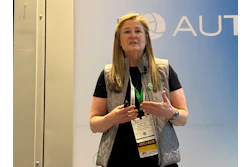
Wendy Tan White, CEO of Intrinsic, urged manufacturers to think about AI in practical terms. It’s less about whether AI is interesting and more about where it can actually make a difference in a real operation. She compared AI to the early internet, which was difficult to define at first but eventually became a backbone for applications people now use every day.
“You should think about it in an applied sense. Where would it make a difference to your business today,” Tan White said. “If you look at all of us [panelists], we’re already having to think about AI ourselves. So where would I use it in my business today.”
Intrinsic was founded five years ago with funding from Alphabet, and Google has since brought the company back in as a separate entity. That timing, Tan White said, reflects a larger change in what software and AI can do in the physical world.
“I think we were set up five years ago because the moment when software and AI would be mature enough to meaningfully transform how physical automation systems work was coming, and Google bringing us back reflects that it’s here. Software and AI can now fundamentally change the power and leverage of hardware and solutions,” she said.
The company’s software platform is already working in machine shops as well as large factories. The goal, Tan White said, is to help hardware do things it could not do before, and to make those capabilities useful to customers.
“The problem is, as technologists, we love tech,” she said. “It’s a sexy, fun thing to do. But if it doesn’t actually add anything for you, it doesn’t really matter.”
 Mike Cicco, president and CEO, Fanuc AmericaA3
The same issue applies from the robot supplier side. Fanuc has long had advanced capabilities inside its robot software stack, Cicco said, but broader use requires making that software easier for more people to access.
The company’s work with Google and Intrinsic is aimed at creating a common platform that can serve different types of manufacturers. A large company may want to compile MES data across a factory. A smaller company may simply need to reprogram a robot more easily when its product changes.
“Or you can have a very small or small to medium-sized business where all you’re trying to do is reprogram that robot easily each day because your product changes,” Cicco said. “And we found a way to still keep the strategic things that Fanuc thinks are important and probably other robot companies think are important too.”
At Cognex, the shift to AI vision began about 10 years ago, after the company acquired ViDi Systems, a startup in Switzerland. The move pushed Cognex beyond decades of programmatic vision tool development and into a different way of solving inspection problems.
According to Moschner, customer questions have changed since then. At first, he said, customers wanted to know whether AI could solve the problem. Now, they are asking how long it takes to set up, whether they can maintain it, and whether the system will continue to perform over five to 10 years.
“And I like to tell our customers that I have something called open folders. A folder where I park ideas that just for whatever reason aren’t ready to be actioned,” he said. “Go back to that open folder, go back to those inspection ideas, those points in the line that you had always wished you could automate. Chances are you can solve that problem now, and that’s really exciting.”
Early AI vision deployments could take months to set up. Today, some can be set up in minutes or hours because the tools and workflow have improved, he added. Customers also need ways to monitor model health, interact with live production data, and feed that data back into the system.
The cost of automation has never been limited to the equipment itself. Robotic arms and machine vision systems remain significant investments, but suppliers are reducing the engineering and support burden that comes before and after installation.
“The truth is the real cost was everything that sat before it, which was the upfront engineering and everything that sat behind it, which was the ongoing maintenance and support,” Moschner said. “And so what we’re seeing is the costs before and after that investment in the automation equipment are coming down, which is improving the ROI.”
Cicco also addressed a concern that often comes up around AI-enabled robotics. An AI system may tell a robot what to do, but the robot’s embedded control system still determines whether that action can be performed safely and reliably.
“But you still have all the embedded software that controls safety, that controls the reliability of the robot, that controls how it moves,” he said. “And so they’re two separate systems, and there’s a harmony between them.”
Software-defined automation targets closed systems
Software-defined automation was one of the larger technology changes discussed during the keynote. According to Marino, "the PLC is not going away," even as automation becomes more software-enabled. Hardware still has to connect software to the physical world, and deterministic applications remain necessary.
The larger change is the move from hardware-defined automation toward open, software-defined automation. Marino described plants where proprietary systems run their own software and hardware, making it harder to maintain systems and use data across the operation.
“We are seeing a shift from hardware-defined automation to more open systems, and that openness is very important,” he said. “With software-defined automation, you separate the hardware from the software. The hardware is still necessary for reliable, real-time operations, but the software is what connects and controls how it interacts with the physical world.”
Marino compared the shift to what happened in IT. People can run software without being tied to a specific brand of PC. Automation has historically worked differently, with software and hardware more tightly linked.
“Now we are moving to a software-defined world. It’s open, and you can run your applications on any hardware,” Marino said. “Vendors will need to convince end users that their hardware is the best on the market. Otherwise, they will have to compete for space, and in the end, users will decide which hardware they want to use.”
The reason openness is so important is that AI depends on data. Software-defined automation is needed to move from optimizing one robot or one cell to orchestrating an entire factory, Marino said. Without that, companies may improve individual systems without improving the full operation.
 Wendy Tan White, CEO, IntrinsicA3
Intrinsic was built around a similar idea. The company’s goal is to help users focus on the task they want to perform rather than the complexity of combining hardware and software.
“In a way we were birthed because we actually believe the same, which is that what really matters is that you can combine almost any hardware and abstract it,” Tan White said. “That way, you can focus on the process you want. In the end, what matters is being able to complete the specific task your business needs.”
At the product level, that thinking is reflected in the Intrinsic Intelligence Cell, a more productized cell that can integrate Fanuc robots, Cognex cameras, and software. Tan White said the goal is to give users a better experience when creating, running, and changing an application.
Humanoids keep the focus on the task
Humanoid robotics was one of the most talked-about topics at the show, with the event hosting the first Humanoid Robot Pavilion. Panelists went beyond discussing humanoids as just a new robot form, using the topic to explore physical AI, safety, and automation that approaches human-level work.
Because Fanuc’s core business is industrial robotic arms, Cicco tends to think about humanoids less in terms of physical form and more in terms of the applications they are meant to serve.
“What is happening very quickly is that the automation is moving much more closely to the human tasks that more directly help people in their day-to-day jobs at work to try to make them more efficient,” Cicco said. “Some companies, not ours, are using a human form of a robot to do that. The safety regulations in that form of robot aren’t up to speed, and there are still a lot of questions about how that’s going to be implemented.”
A human-type task could be addressed with different robot configurations. It could involve multiple arms or a robot on an autonomous mobile robot, Cicco said. “What we’re really seeing is automation moving closer to the human-task level,” he noted.
According to Marino, manufacturers should start with the task rather than the robot’s shape. He added that humanoids still need more development before widespread factory use,.
“First, I think we need to discuss the task and then the form and not the other way around. A lot of people are discussing the form and not the task,” Marino said. “Second is there’s an evolution in technology that must happen for humanoids to have a safe space in a factory.”
One challenge is that large language models (LLMs) are not trained on spatial AI or the 3D environments in which robots operate. World models are currently being developed to simulate how robots interact with their surroundings, explained Marino.
“Robots and large language models today cannot predict the consequences of their actions, which is critical when we are talking about humanoids,” he said. “We are optimistic the field is moving in that direction, but it’s not there yet.”
Moschner viewed humanoids as one expression of the industry’s move from static automation to systems that can learn and adapt. The exact physical form matters less to him than the underlying technology.
“For me, the humanoid is sort of the embodiment of automation 10 years ago. It was very static, set and forget. And today it’s very dynamic, meaning it can learn and adapt to the environment around it,” he said.
From Tan's perspective, the appeal of humanoid robots comes from their perceived versatility, but that same flexibility can be achieved without copying the human form.
“People like humanoids because they can do many different tasks, but those capabilities don’t have to be in that form factor,” she said. “You could have a cell that has that sort of multi-system ability.”
She also noted that robots have an advantage people do not have. They can change tools. “There’s a reason why we have a generalist hand. We have to use forks and knives and saws and other tools because we don’t have the ability a robot has to change its end effector,” she said. “A robot does though. So why would the future follow exactly the way our human beings are formed to do things. So I think we’re going to see that evolution.” PW