Sysco's struggle with Extended Producer Responsibility reporting revealed that inconsistent packaging data across suppliers and lack of standardized terminology made compliance difficult and risky. The new GS1 Extended Producer Responsibility Data Model, released in May 2026, provides a free standardized framework that solves these problems by mapping packaging attributes to state requirements using Global Trade Item Numbers as the backbone.
- The Problem: Sysco faced inconsistent packaging data from tens of thousands of suppliers, with the same material (like HDPE) appearing as HDPE, HGP, or POLYMER_HDPE across different systems.
- The Solution: GS1 US released the Extended Producer Responsibility Data Model in May 2026, developed by over 50 companies and 80 members across retail, foodservice, and healthcare industries.
- How It Works: The model uses Global Trade Item Numbers (GTINs) at each packaging hierarchy level to document material type, weight, and state-specific EPR classifications without requiring separate data sets per state.
- Organizational Impact: EPR compliance requires buy-in from finance, merchandising, logistics, and legal teams—not just sustainability departments—and fees arriving accelerates this alignment.
- Business Value: Item-level packaging data enables operational efficiencies beyond compliance, including optimization of refrigeration, electricity usage, and packaging design decisions.
Two years ago, LC Ede's team at ubiquitous wholesale food distributor Sysco pulled some packaging sustainability attributes from GS1's Global Data Synchronization Network, combined them with internal taxonomy data, and tried to estimate the food service giant's Extended Producer Responsibility (EPR) reporting obligations. After all, they had a little budget left at the end of the year, so why not? It seemed manageable.
"It was hard and messy," said Ede, director of sustainability data and reporting at Sysco, at GS1 Connect in Las Vegas last month.
The experience of working through year-one of EPR data collection without a standard framework, reliable supplier data, or organizational buy-in is familiar to anyone who's tried it. The data is inconsistent, the terminology doesn't reconcile across suppliers, the states don't agree on definitions, and the internal stakeholders who need to be involved don't yet feel the urgency, she said, at least until the fees arrive.
Well, they've arrived. Oregon and Washington are already assessing fees for non-recyclable or hard-to-recycle packaging materials. California, Colorado, Maryland, and Minnesota are in various stages of implementation, and more states are coming. For brand owners who haven't started building their EPR data foundation yet, Sysco's experience is worth paying attention to.
The taxonomy problem
Before a company can report its packaging obligations to a state Producer Responsibility Organization (PRO, like the Circular Action Alliance/CAA), it needs item-level data on what its packaging is actually made of. That includes material type, weight, and packaging hierarchy at every level, from single unit to case to pallet. For a company like Sysco, which sources from tens of thousands of suppliers across multiple lines of business, getting that data in any usable form was the first obstacle.
"I have a case or a box all these different types [of packaging]," Ede said. "It could be made out of many different types of paper, many different types of plastic. We all have very technical names. Sometimes that name will be the high density polyethylene, HDPE. Other times that HDPE might be in the beginning, and then it's fully spelled out afterward. Or it's something like corrugate-paperboard, or corrugate-double-ply. You kind of just want all of those attributes to be in the same section."
It was hard and messy.
High-density polyethylene showed up as HDPE in one system, HGP in another, and POLYMER_HDPE in a third. Corrugated came in as corrugate(d), paperboard, corrugated double-ply, cardboard, and variations in between, coming in from hundreds of suppliers, each entering data according to their own internal conventions.
Even where data came in, it rarely reconciled. When Sysco tried to match supplier-provided packaging attributes against its own item data, the material weights almost never added up to gross weight minus net weight. The company ended up estimating its EPR reporting obligations based on archetypes, or broad packaging categories rather than item-level data. That's a method that creates real risk of over- or under-reporting as fees increase and audits become more likely. A six-pack of aluminum cans seems simple enough — until EPR reporting requires documenting each component separately: the cans themselves, the paperboard carrier, material type, weight, and the applicable state classification codes. And those codes aren't the same in every state. Slide from GS1 Connect Session 301, June 2026.
Getting the organization to the table
EPR compliance isn't a sustainability department problem. Finance has to be involved for fee calculations and accruals. Merchandising teams manage supplier onboarding and data requirements. Logistics touches packaging at every distribution tier. Legal interprets the state regulatory requirements. Getting all of those functions engaged before fees materialize is harder than it sounds, Ede said.
By the time you explain all of that [EPR background], your meeting is over.
That changed when fees were assessed in Oregon and Washington. "The reporting obligation, the fees coming, that makes people a little bit more aware," Ede said. "Now we've been doing it for a year or so. I think all of those leaders in those different functions are able to come to the table and work really fluently together. But initially it was a lot of discussion, a lot of education, and a lot of change management."
Sysco has since hired a dedicated packaging engineer to support EPR reporting, evidence of how seriously the compliance function has matured inside the organization.
On the supplier side, the spectrum is wide. Some suppliers, particularly in chemicals and disposables, have more sophisticated packaging data infrastructure than Sysco itself. Others, especially smaller regional brands selling into one or two distribution sites, have little to none.
"That's where the education component comes in," Ede said, "and where you really want to simplify it or build guardrails in our systems so that the supplier isn't accidentally entering the wrong information."
A common framework
The naming problem Ede described is industry-wide, which is why GS1 US formed its Cross Industry Extended Producer Responsibility Workgroup in May 2025. Over 14 months, more than 50 companies and 80 members from retail grocery, foodservice, apparel, general merchandise, and healthcare worked to map the data attributes required for EPR reporting across all major state programs into a single standardized framework.
The result, the GS1 US Extended Producer Responsibility Data Model, was published May 30, 2026, just days before GS1 Connect. It's available as a free download from the GS1 US website in both Excel and JSON formats, and it's designed to be technology-agnostic, so usable regardless of whether a company shares data via GDSN, API, flat file transfer, or any other mechanism.
"We wanted a solution that could meet everyone where they are in their data," said Norma Crockett, director of customer success at GS1 US, who co-led the workgroup. "Not everyone uses GDSN, even if we'd want everyone to. We needed something that could be interoperable and standard." A single pallet of strawberry jam involves five distinct packaging components — glass jars, paper trays, cardboard boxes, stretch wrap, and a wooden pallet — each requiring its own material type, weight, recyclability value, and state EPR classification codes. Multiply that across tens of thousands of SKUs and the data challenge becomes clear. From the GS1 US EPR Data Model guidance, published May 30, 2026.GS1 US
GTINs as the backbone
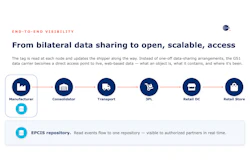
The data model is built on the GTINs (Global Trade Item Numbers) already assigned to products at every level of the packaging hierarchy. A jar of Smuckers' jelly has one GTIN. The carton or secondary multipack of three jars has another. The case of 24 has yet another. Each level carries its own set of packaging attributes for EPR reporting: packaging type, material, weight, and EPR material classification.
Crockett used a tube of Super Glue to illustrate the level of granularity required. That one product has three distinct packaging components, each documented separately in the data model:
- The plastic bottle: type BOTTLE, material POLYMER_HDPE, 1.21 grams, EPR class PLASTIC, EPR group PLASTIC_RIGID_BOTTLES_JUGS
- The blister wrap: type BLISTER_PACK, material POLYMER_LDPE, 0.5 grams, EPR class PLASTIC, EPR group OTHER_FLEXIBLE_AND_FILM_ITEMS
- The card backing: type CM (carton/paperboard), material PAPER_PAPERBOARD, 0.4 grams, EPR class PAPER_AND_FIBER, EPR group ALL_FORMS_W/O_PLASTIC
State-by-state complexity shows up in the grouping codes. Colorado and Oregon classify aluminum cans under one group designation; California uses another. The GS1 data model accounts for both, mapping to each state's requirements without requiring companies to maintain separate data sets per state.
"All three states agreed on paper and fiber as a classification," Crockett said of the aluminum can example (a six-pack with a paperboard boxO. "But they were like, 'oh, groups — we're going to make it complicated again.'"
The Circular Action Alliance, the PRO that collects EPR data on behalf of multiple states, is among the organizations engaged with the GS1 workgroup.
Eco-modulation is the next layer
As companies get the baseline right (material type, weight, hierarchy) the next layer of EPR complexity is eco-modulation. That's a carrot/stick fee structures that reward packaging designed for recyclability, compostability, or reuse. Some state programs are already beginning to incorporate eco-modulated fees, and the GS1 data model includes attributes to communicate recyclability claims and values.
Sysco has been collecting post-consumer recyclability data from suppliers and is preparing for that shift. "I think the next step from those basic 'is it recyclable?' questions is more verification," Ede said. "Talking about recyclability certifications, or understanding if there's some ISO or ASTM standard attached to the item for its packaging that verifies what they're saying is correct."
Version 1.0 of the GS1 data model covers the three most established state programs. Maryland's covered materials list was published as the document was being finalized. Updates will follow as more states come online and as implementation experience accumulates.
Business case beyond compliance
At GS1 Connect, a Deloitte sustainability advisor asked Ede why EPR data investment is good business beyond the fee exposure. Her answer wasn't about sustainability optics.
"Any time that you're able to get more specific item level data, you can look for operational efficiencies," Ede said. "We see the same thing with greenhouse gas emissions. We can streamline refrigerant use, electricity usage. But until you measure it, you don't know where your data gaps are. You don't even know what you need to improve."
The same item-level packaging data that satisfies an Oregon PRO's annual report can expose gaps between stated and actual material weights, flag components that weren't captured in previous reporting cycles, and inform packaging design decisions for the next product development cycle.
For packaging teams that haven't yet begun building their EPR data foundation, the state fee schedules are the forcing function. Oregon and Washington are already on. More are (including 800-lb gorilla California) are coming. Sysco's two years of hard and messy experience is, at this point, avoidable.