Herb Wong of Antares Vision quickly sorted the working relationship between he and his client Dana Biancardi of massive berry producing brand Driscoll's.
"She's Batman," said Wong, chief customer officer at Antares. "I'm Robin."
The arrangement remains after about five years, the span of what they call one of the most ambitious serialization projects in fresh produce history. Biancardi, senior program manager at Driscoll's, represents the business outcomes and operational reality. Wong handles the technical architecture, making it function at scale.
Together they've put a unique, serialized identity on more than one billion clamshells of strawberries, raspberries, blackberries, and blueberries, including production throughput above 50 million serial numbers/month and a migration to fully GS1 Digital Link-compliant codes now underway.
The project isn't finished, but what they've built is already rewriting what is possible for a fresh produce brand trying to close the loop between the farm and the consumer.
Two Million Unactionable Survey Responses
Driscoll's sources from more than 4,000 independent growers across the U.S. and Mexico, and its berries move through thousands of retail locations globally. By its own estimate, the company receives more than two million consumer survey responses per year, but it couldn't act on the direction those results gave.
"Consumers say 'we love your berries,' but that information was useless, because you don't know the variety, you don't know where those berries came from," said Wong.
PTI labels on the trays carried supply chain data, but once merchandisers broke them down at retail, that connection was gone. "So harvest date, there's no way to track that," said Biancardi. "Variety information, field conditions, the producing area... we really have no way to link that info back to a product."
Without traceability to the source, quality problems couldn't be attributed to specific farms, fields, or varieties. High-performing growing conditions couldn't be isolated and replicated. The company was, to paraphrase Biancardi, flying blind by making important decisions from a minuscule amount of feedback.
"We can't know what we don't know," she said. "And we aren't able to improve the things that are working well and stop the things that maybe aren't working well." Antares Vision Group calls it the trade-off triangle: 99% scanning accuracy, sub-second throughput, and consumer-grade hardware. Those three requirements that typically require picking two. The project delivered all three, finishing at 98.7% accuracy and a 0.55-second average scan time on Zebra devices.
Give Every Clamshell an Identity
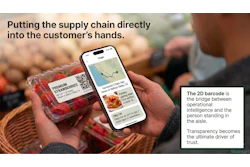
The idea was to give every individual clamshell a unique identifier (grounded in GS1 standards, but not yet Digital Link) linking it back to its specific variety, grower, harvest event, and field block. When a consumer scans the QR code and submits feedback, that response attaches to an actual clamshell, farm, or harvest date, not a generic survey database.
Driscoll's brought in Antares Vision Group, a global provider of supply chain traceability solutions for regulated industries, to take over a serialization project that had already been attempted and had stalled at 40% scan accuracy. The incoming team was presented with three requirements that, taken together, defined what Wong calls the trade-off triangle.
Good, cheap, fast? Pick two. I can deliver any two. But we actually had to deliver all three, and that was something quite challenging.
The first requirement was 99% scanning accuracy across millions of items under active field conditions. The second was sub-second scan speed — throughput could not slow the harvest. The third was compatibility with consumer-grade smartphones, given the cost constraints on hardware across thousands of farms.
"If you want 99% accuracy and you want me to do it in less than a second, then give me the flexibility to get the best cameras or scanners," said Wong. "If you let me pick the hardware, I can do that without budget constraints. But if you say you have a budget and you need me to hit 99%, and you can't get better hardware — I can do that. But it's going to be a slower scan."
This was one of those projects that required all three.
Marketing's Percceived 'Pimples'
Before the field scanning could even begin, there was a packaging design hullaballoo.
The QR code that each clamshell would carry had to be as large as possible for cameras to reliably detect it under variable field conditions. That included different lighting, different scan angles, dusty or dirty or wet surfaces, or a human harvester moving quickly through the field. The marketing team said not so fast.
"They referred internally to the QR code as the 'pimple,' because they thought it ruined the look of the boxes," said Wong. "They wanted to make it as small as possible. So while we were trying to make it big, they were coming back saying, 'make it small, make it smaller.'"
A minimum size was eventually negotiated that was about 1 mm smaller than Wong's team wanted, probably a few mm larger than marketing did.
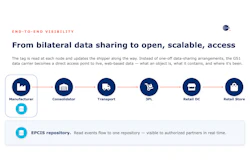
The "pimple" is a funny shorthand for a tension that shows up in plenty of serialization projects. The operational requirements of a traceability system and the brand requirements of a consumer-facing package are not always aligned, and neither side fully appreciates the other's constraints until they are forced to resolve them together. With a proprietary QR code, a consumer scan flows only into Driscoll's internal systems. GS1 Digital Link turns the same scan into a universal data carrier, accessible to warehouse, logistics, retail, and consumer touchpoints without custom integration.
In the Field
The serialization architecture begins before a clamshell ever reaches a farm. Every package arrives from the label manufacturer with a unique QR code already applied. At each farm, dedicated QA personnel (referred to within the project as clam-scanners) tie that serial number to the ranch, date, field block, and variety, using stationary scanners or handheld guns.
"We tried to get Driscoll's to classify the way they were going to scan, and we were told repeatedly, 'they can do it any way they want and you'll figure it out,'" said Wong. "We didn't understand that until we started doing it. When you have so many variables, you don't try to control everything. Certain things you need to let go and grow organically."
Added Biancardi, "We learned really quickly that there was no way growers would adopt this solution if it impacted their labor by any means. That was our ultimate challenge."
During peak harvest periods, getting the fruit into coolers fast is the priority. Scanning slows that down, and even if it's a little bit of a drag, in high-volume windows growers will skip it. Missed scans from dirty or wet QR codes (conditions in the field are not laboratory conditions) added variability.
By generating reports that compared expected versus actual scan counts for each grower and making those reports visible, compliance improved on its own.
"We found that if you compare the report of what they were supposed to harvest against the number of trays scanned, and you show that to the growers, magically the numbers get better," said Wong. "Not everything required a complex technical solution. Some things just take care of themselves."
Driscoll's is still evaluating whether a more formal incentive or accountability structure is warranted. The visibility itself has turned out to be valuable to growers, who can now see their own quality data in ways they couldn't before.
The Numbers
The project now covers virtually all of Driscoll's North American growers:
- Over 1 billion clamshells serialized to date
- More than 50 million serial numbers processed per month, sustained
- 11,000+ Zebra handheld and stationary scanning devices across 4,000+ farms in the US and Mexico
- 2.7 billion serial numbers expected annually by 2028
- Sub-second scan time — 0.55 seconds average on Zebra devices
- Final accuracy: 98.7% (against a 99% target)
The project inherited a system that peaked at 40% accuracy. Antares Vision was asked to reach 99% and arrived at 98.7%.
"Driscoll's let us have the other three tenths," said Wong. "Thank you, Dana."
A hardware decision midway through changed the economics. Consumer smartphones, the original target, were designed for two-year replacement cycles — a management burden across thousands of farms. A deal with Zebra switched the program to purpose-built industrial devices rated for five to ten years of field use.
"That was a game changer," said Wong. "These devices can go from five to ten years. They stay in production a long time." The QR code on a Driscoll's clamshell connects every point in the journey, from the farm where it was harvested, to the store shelf, to a consumer's taste-and-rate survey, to actionable quality data. The scan is the thread.
What the Data Show
"We're in the early phases of the data. It's a good start, but unfortunately it's not enough to really make any key decisions off of just yet," said Biancardi. "As we get growers to adopt this, we're looking forward to being able to do bigger things with the data."
Driscoll's hasn't marketed the QR code to consumers — no campaign, no call to action. The roughly 5,000 linked responses since the consumer-facing component went live in late 2024 are entirely organic.
"Consumers just being interested and wanting to scan the QR code," said Biancardi.
As sample sizes grow, the planned use cases include variety comparisons (which berries score highest in which markets), producing region analysis, and issue detection. Quality problems can now be isolated within days rather than weeks, stopping substandard product before it reaches more consumers.
GS1 Standards as the Architecture
"We didn't invent a system," said Wong. "We built on a standard. That's why it scales."
GTINs (Global Trade Item Numbers) as the foundation for serialization created a shared data language readable by any retailer, logistics provider, or regulator without custom integration. It also created the pathway to what Driscoll's is now pursuing: GS1 Digital Link.
The current system works inside Driscoll's walls — consumer surveys come in, harvest data flows back, and the company has visibility it never had before. But the QR code is proprietary. Retailers can't tap the data stream. A scan at point of sale doesn't trigger supply chain data sharing.
"Because some parts of this are still proprietary — because of the trade-off triangle, we couldn't fully use a GS1-qualified Digital Link code — we took some shortcuts," said Wong. "But now as we're moving to GS1 Digital Link, this is going to open things up."
The Digital Link Pilot
Driscoll's is running a live GS1 Digital Link pilot with three major retail partners, names undisclosed at GS1 Connect. One has already confirmed it can read the code. The other two were expected to respond by summer 2026.
The code format changes, label specs change, and the pimple problem resurfaces — Digital Link requires slightly more real estate than the existing proprietary QR. Wong's team ran its first proof of concept with a borrowed craft cutter to produce test labels at precise sizes.
"Dana and her team had to figure out how to peel the stickers — that was a real problem," said Wong. "There were hundreds of these we were trying to peel. But through that we've gone through the first concept where we can now see how Digital Link can work in the field, how it can work across the ecosystem."
The minimum viable size has increased by one millimeter from the existing pimple. Marketing has been informed.
"This gives you the ability to run coupon and loyalty programs based on an actual purchase versus someone going in the store and scanning a QR code to get cheaper berries," said Wong. "There are things we haven't fully discovered yet, but we'll see."
A Blueprint for Fresh Produce
"I've worked with a lot of different companies," said Wong. "Driscoll's is the most innovative, most courageous. Some of the things they're trying to do, no other company has done."
By building on GS1 standards rather than proprietary technology, the project has the potential to become a template. The Digital Link migration will complete the move from a powerful internal system to a universally readable one, enabling any supply chain partner to act on the same data that consumers and growers already can.
For packaging pros, the project illustrates what the 2D barcode transition means in practice for perishables. It's not just a compliance step for Sunrise 2027, but a structural change in what the package can carry and what the brand can learn from it. A clamshell is not a complex package (except in PET recycling circumstances, but that's another subject). With a unique identifier and the right data architecture behind it, it becomes a connected object that can speak for itself when asked by the right interrogator.