Walmart and Hanes conducted a pilot program using RFID tags and 2D barcodes with a new GS1 SSCC++ encoding scheme that allows cartons to transmit their location and contents throughout the supply chain, achieving nearly perfect tracking accuracy and enabling brands to recover millions in claims disputes while improving on-shelf availability.
- The eight-week pilot shipped 30,000 cartons and half a million units with 99.9998% detection rates at distribution centers and 97% detection at retail stores
- GS1's updated RFID Tag Data Standard (TDS 2.3) enables SSCC++ tags to carry web addresses, allowing cartons to automatically report their location to the shipper's database
- The technology works with both RFID chips and 2D barcodes, eliminating the need for expensive hardware upgrades at every checkpoint
- Supply chain visibility at four key nodes—packing, 3PL consolidation, regional distribution, and retail stores—enables verification of expected contents instead of merely discovering what's in a carton
- The approach replaces complex bilateral data-sharing agreements with a standardized GS1 backbone, reducing infrastructure costs and making supply chain data accessible to all partners
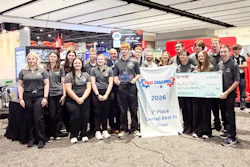
 Auburn University's Soundarya Korlapati (center) and GS1's Jon Gregory demo Project Brilliance live at GS1 Connect 2026, scanning a pilot carton to check its contents against what the brand owner packed.
Over eight weeks running from mid-February to mid-April 2026, Hanesbrands (recently acquired by Gildan Activewear) shipped roughly 30,000 cartons, about half a million individual units, to multiple Walmart locations under a pilot that tracked each carton at every point it was handled, from the pick line to the store. Presented across several sessions at GS1 Connect, the results were striking. A packaging-validation audit showed a perfect match to the trade items that were supposed to be in the cartons*, and downstream read points recorded nearly 100% detection (99.9998% DC detection and 97% store detection) of items observed across multiple checkpoints.
* Editor’s note: PW might call these cases, but stakeholders in the pilot standardized on using the term 'cartons' throughout the project.
“Frankly, I was shocked,” said Jonathan Gregory, senior director of global standards at GS1 US, who led the project. Analyzing the cartons that flowed to two specific Walmart stores, he said, “we missed one tag at one read point out of all the cartons that went to those two stores. And that tag was read at other read points along the pathway.”
A multimillion-dollar blind spot
The pilot was aimed squarely at a problem every retailer and supplier knows all too well: claims compliance. When a brand owner ships a carton [case] and a retailer believes it arrived short, the two sides have historically had little more than competing records to argue over.
Dan Hardy, director of customer operations at Gildan, described his company’s opportunity as a funnel. “At the bottom of the funnel, or the lowest-hanging fruit, is claims compliance,” he said. “I don’t have great visibility to solving for carton shortages when I ship them to … Walmart, or proving to … Walmart that what I say I put into a carton is actually what is there, and being able to have that visibility throughout that total chain to prove that and recoup that money.” His verdict on the scale of the problem? “That’s a multimillion-dollar issue for Hanes.”
Further up Hardy’s funnel sit richer prizes. So-called “on-shelf availability” data across all of Gildan’s major retail accounts, and sharper forecasting and replenishment models once the company can see the nodes between its dock and the store. “What it’s not,” he said of today’s supply chain, “is it’s not transparent and it’s not traceable.”
On the retail side, Randall Anzalone, senior director of inventory visibility and accuracy at Walmart, framed the same gap in the language of his operations teams with a common metric—on time and full.
“Did it come on time, and then did I get everything I was supposed to get?” he asked. “We don’t do a very good job of understanding — from supplier to the 3PL, did that handoff happen? … And then I lose visibility as I go through my entire supply chain.” With import DCs, consolidation DCs, fashion DCs and regional DCs all in the path, he said, “that whole chain, there was a lot of trust that we really had to rely on, because that’s all we had.”
Cartons that phone home
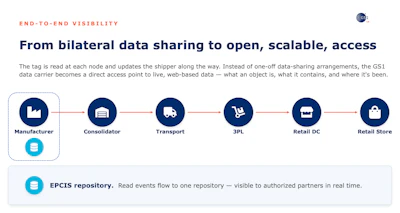
The technical breakthrough behind the pilot is deceptively simple. Last fall, GS1’s RFID Tag Data Standard (TDS 2.3) was updated so that a logistic unit’s RFID tag can now carry a web address (a host name) in addition to its identity. Until now, Gregory noted, a logistics barcode like the Serial Shipping Container Code (SSCC) has been as opaque as a plain UPC. It’s meaningless unless you already hold the data to interpret it. The concept in one slide: a web address encoded in the logistic unit's tag lets a carton "phone home" to the sender's EPCIS repository at every step, from manufacturer to retail store.GS1 US
“It gives a web address, just like a QR code for a product, but puts it on a logistic unit. Now it doesn’t just identify what logistics unit it is — it also says where you go to get information about it, or how to inform the shipper that it is right here at this location,” Gregory said.
The “SSCC++” tag encoding scheme encodes the Serial Shipping Container Code together with the sender’s host name, all directly in the tag. A reader anywhere in the chain can read that tag, append its own location identifier, and construct a web call that lands on the sender’s Electronic Product Code Information Services (EPCIS) repository, so in effect, the carton “phones home.” The approach leans on three GS1 global standards working in concert: the Tag Data Standard for the RFID data structure, GS1 Digital Link for the web address, and EPCIS for capturing and sharing the event data.
Crucially, that thin layer of effort replaces a thicket of paperwork.
“I don’t need the traditional bilateral data-sharing agreements that I would have had to construct to get data exchanged across all these partners,” Gregory said. Paul Arguin, vice president of global RFID technology at label and packaging supplier r-pac International, has spent his career preaching exactly this point. “If you go down a path without standards, it’s going to be very, very difficult to communicate, to share the data you need to share,” he said. Before the SSCC++, “we had to actually figure out API structures” for every partner. “This allows you to have a common interface … we do it once and be done.”
You don’t have to use RFID
For a brand owner weighing packaging investment, one of the pilot’s most important findings is that 2D data capture can be used as well. The logistics data carrier can just as easily be printed as chipped, and serialized content data from carton scan/pack activity could be captured by scanning a serialized 2D barcode. “Yes, we used RFID for that,” Gregory said of the packing validation, “but a 2D barcode that has a GTIN and a serial number could have been image-scanned. So you didn’t need to use an RFID reader to capture serialized carton content data.” Scan-pack an item with an image scanner, he noted, and “you’re getting that robust data that way. There are multiple ways to get to the data in the 2D world.”
That flexibility dovetails with the industry’s march toward Sunrise 2027, GS1’s target date for retailers and brands to be able to process 2D barcodes at point of sale.
“Shout out for Sunrise 2027 and the 2D barcode on the Hanes/Gildan product,” Hardy said. “We’re not fully compliant, but we will be. I think we’ll be there before most of the retailers,” he joked. For packaging teams already re-architecting artwork for the 2D transition, the takeaway is that the same barcode they are adding for the checkout lane can pull double duty as a supply-chain data carrier, potentially without a single RFID inlay.
From discovery to verification
For Justin Patton, director of the Auburn University RFID Lab, the significance runs deeper than any single feature. Two decades into retail RFID, he noted, “the vast majority of UHF RFID tagging is happening at the factory, and then most of that doesn’t get referenced or touched again until right before it goes home with the customer. We’re skipping almost the whole supply chain in between.” The reason, he argued, is trust, and the difference between two ways of reading a box. Verification, not discovery: the reader pulls a carton's expected contents from the tag and checks them off in real time, returning a simple "verified" result without opening the box.GS1 US
“Discovery is: I have a box, it has some RFID tags in there … I’m going to scan it, and I hope I got everything,” Patton explained. “Verification means I have a box, I have a list of things that should be in that box … ‘Let me scan it. Did I get them all?’ That’s a very different thing.” A camping analogy drew knowing laughs: throw gear in the car with no packing list and you’ll forget something. Work from a list and you’re covered. By letting a downstream partner pull the expected contents straight from the tag, Operation Brilliance finally lets every checkpoint verify rather than merely discover.
“I think we finally closed the loop on that this year with Operation Brilliance ... getting that data to the downstream partner in a manageable fashion where they can do verifications instead of forcing discovery all the time,” Patton said.
Four nodes, 30,000 cartons
The Hanes/Gildan and Walmart pilot followed Gildan’s Direct Store Delivery Consolidation flow of mixed, store-specific cartons that cross-dock at a Walmart regional distribution center. It captured inventory at four basic stages. It began at the Hanesbrands DC, where cartons are packed against a weekly replenishment order (one to four assorted cartons per store), staged to pallets, and shipped. From there, goods moved to a Walmart 3PL an hour down the road that cross-docks and diverts them; then to the retailer’s regional DC, with its multiple internal touch points; and finally, to the retail store. The pilot captured read events at four stages, brand-owner DC, 3PL cross-dock, retailer RDC (inbound and outbound), and store, with each event posted to a shared EPCIS repository.GS1 US
Apparel made an ideal proving ground precisely because the items were already tagged. Walmart’s apparel business is “100% saturated” with item-level RFID, Anzalone said, so the pilot never had to tag the socks and T-shirts inside the cartons. What was new sat one level up, in a web address on the logistic unit itself, tying those existing item tags to the carton’s SSCC. In other words, the innovation was in the secondary packaging, not the product tag.
At pack-out, an RFID tunnel validated the pick ticket against the carton’s contents and associated each item’s serialized identity with the carton’s SSCC. Cartons were then aggregated to pallets—each pallet assigned its own license plate number (LPN)—and confirmed again, and pallets were validated a third time on the outbound dock, each event uploaded to the EPCIS repository. Downstream, Walmart read the cartons at the 3PL dock door, their Walmart regional distribution centers (RDCs) inbound and outbound, as well as in identified stores.
“Every time … we’re reading these things, it’s kind of like phoning home and creating this record,” Anzalone said, “that makes it so helpful and useful to us to know exactly where this thing has gone, where maybe it didn’t get read.” Where he once read “200 of Dan’s [Hanes’] T-shirts” and tried to reconcile them against an advance ship notice by counting, he can now tell a supplier, “I’m missing these exact items,” and pinpoint where in the chain they were lost.
A challenge and a prayer
Getting there in eight weeks wasn't easy. Hanesbrands did not use an RFID chip in its SSCC labels, so r-pac had to supply roughly 50,000 RFID-enabled carton labels on short notice. The SSCC++ required a 160-bit inlay when most of the industry, r-pac included, stocks 96-bit chips.
“There’s not a lot of chips out there,” Arguin said. “So we had to do some creative things, including using antennas … and modify them on the fly so they could tune them correctly … within a very short amount of time, a few weeks. … It was a challenge and a prayer.”
A second constraint shaped the design, and Hardy’s baseline was non-negotiable. “The cartons fly through our distribution center and they have to continue to do that,” he said. “I’m not going to slow it down.” The team briefly considered adding RFID print-and-apply, but the pick line was a mixed lane. “We didn’t want to necessarily use up some of those inlays on products that … weren’t part of this program,” Arguin said, so rather than print, they scanned the SSCC in the existing validation tunnel, ran the pack check, and encoded the SSCC++ in the same pass. Three factors made the whole thing possible, Hardy said: the SSCC++ label, Gregory’s work to stand up a common EPCIS repository, and the fact that both Hanes/Gildan and Walmart already had the reading infrastructure in place. The only new hardware was a single 3PL dock-door reader.
Underneath the label sat a quieter packaging question. Does the tag actually work where it’s placed? That was a job for Auburn.
“I have to know that these things can be read, that they exist, the quality is good, and it’s placed on the right area,” Anzalone said, “regardless of if I’m using infrastructure in a ceiling or some kind of autonomous robotics or hand-wanding. It has to work.” As he boiled it down, GS1 defines what the data is and lets partners share it, while “Auburn makes sure that it performs as it’s supposed to.” For a program riding on a converted RFID label, inlay selection, antenna tuning, and label placement weren’t afterthoughts but the foundation.
Replacing infrastructure with data
One of the pilot’s most consequential findings was that heroic engineering may no longer be required to read a carton accurately. Because each checkpoint knew the exact list of items to expect, readers did not need to isolate cartons to audit them. The traditional, finicky approach of tuning power and timing so a reader captures one box and not its neighbor flying by as quickly as 600 feet per minute.
“For a long time in the supply chain, we got hung up on RFID because the technology became a min-max [minimum-maximum] problem,” Patton said, or to read everything in one box, nothing in the next. “Since we can just blast the heck out of it, even if we missed that one, we have a good opportunity to pick it up later. … We take all this pressure off the technology and put it back on the data.” Gregory summed it up in a phrase that became a refrain across several stages and panels at the event. “You replace infrastructure with data,” he said.
That redundancy has direct commercial value. As Hardy pointed out, if a claims dispute hinges on a carton Walmart missed at DC receiving, the same carton read at outbound or at the store can settle it. During testing, a densely packed 72-carton pallet outran the aggregator as a truck pulled away. But downstream reads confirmed the shipment anyway, so Hanes was covered. “You say, ‘Okay, I actually did ship that, you actually did receive that,’” he said.
Proof in 28 socks
If the data tables made the case on paper, an Auburn demonstration made it tangible. Soundarya Korlapati, Ph.D., senior research engineer for retail applications at the Auburn RFID Lab and the pilot’s lead architect, described an actual case pulled from the study. The case? One carton of 28 Hanes socks, packed at the Hanesbrands DC on March 17, 2026. Using an off-the-shelf handheld reader, she scanned the SSCC++ tag, which retrieved the carton’s expected contents; as the reader captured each item, its entry on screen turned from yellow to green. A single pilot carton, 28 Hanes socks packed March 17, becomes the demo: scanning the SSCC++ tag turns each expected item from yellow to green as the handheld confirms it.Auburn University RFID Lab
“There’s a story that the data tries to tell you in multiple ways,” Korlapati said. An unread item does not necessarily mean a missing item, though. It may signal a misread, tag interference, or reader placement, distinctions that let partners locate a genuine shortage and pin it to a specific node. “The power of SSCC++ is it can provide you real-time feedback,” she said, “and there’s no manual opening of the case to verify the items.”
Beyond claims: credibility and cargo
Claims compliance is only the nearest use case. Gregory frames Brilliance around “three Cs”: claims, credibility, and cargo. Credibility covers product authenticity. Elsewhere at GS1 Connect, a demonstration validated an injectable drug down to the unit of use before it reaches a patient, using the same GS1 backbone. Cargo addresses organized retail crime, a threat Gregory tied to hard numbers. The National Retail Federation cited a 93% increase in organized retail theft between 2019 and 2023, and theft from Class I rail carriers rose 40% in 2024. Greater visibility at each touch point, he argued, gives law enforcement and asset-protection teams “actionable, precise information” and a nonviolent way to follow the breadcrumbs.
Who pays, and why brands should now be motivated
The unglamorous obstacle to supply-chain RFID has always been economics. The value of tagging, Gregory noted, “is often realized” at the retail store by way of inventory accuracy, fewer out-of-stocks, omnichannel fulfillment. “But a lot of the burden and the cost is on the left-hand side,” where the brand owner source-tags to satisfy a retailer’s requirement. That imbalance is why so much tagging has been compliance-driven, and why the middle of the chain went dark in the first place.
In effect, Operation Brilliance is an argument for changing that math. By making claims recovery, early exception detection, and on-shelf availability visible to the brand owner, and not only the retailer, it hands the party that bears the packaging cost a return on it. Patton described the shift as moving “from being pure compliance and mandates from the retailers” toward “a push model from the suppliers,” one that lets them “get in the game … and feel good about” what they ship. For a brand owner, that is the difference between tagging as a tax and tagging as an asset. The value case cuts both ways: suppliers gain early exception detection and chargeback defense, while retailers gain trusted receiving and better inventory accuracy, with no carton isolation required.Auburn University RFID Lab
What comes next
For all the enthusiasm, the partners were candid about the work ahead. Anzalone anticipates a wave of operational questions once visibility becomes routine. For instance, if a supplier is short two cases off a pallet, is that still acceptable, or does the line stop? “The line goes pretty fast at Walmart,” he noted, and line downtime might come at a bigger cost than minor shrink. His aspiration is bigger than any single metric. “Imagine a world where there’s no ‘on time and full’ fines anymore. Everybody knows exactly what they’re getting and when. It’ll be a beautiful thing.” A perfect packing-validation match to expected GTINs, 100% detection across redundant downstream reads, easy data access across multiple solution providers, and no need to isolate cartons to validate contents.GS1 US
Hardy pointed to scaling and governance — particularly the question of where the shared data repository lives and who owns it when every partner maintains its own. “You’ve got the data now; what do you do with it?” he said, adding that he hopes AI can help close the resource gap. Arguin, for his part, believes a second run would be far smoother: “Now we have the toolkit … it’s not as insurmountable as the first day I learned about it. And the chips are there.”
GS1’s roadmap points beyond apparel. Next steps flagged at the conference include building a global application standard, embedding the phone-home logic in “smart” reader firmware so any checkpoint becomes a sensor, and piloting temperature logging for cold-chain and perishable goods — a step that would turn a logistic unit’s tag into a condition monitor as well as an identifier, and one that should interest food and healthcare packaging teams in particular.
Whether that future arrives has less to do with the technology than with who shows up. Patton framed the gap with a running joke: when event organizers want a retailer to talk RFID, they "call Dillard's, Walmart, you can call Carters, you can call Nordstrom." When they need a supplier, "we call Dan." It's the same imbalance that kept the middle of the chain dark — brand owners shoulder the source-tagging cost, while the clearest payoffs have traditionally accrued to the retailer. Brilliance is pitched as the fix for that math. The claims recovery Hardy is chasing, plus the on-shelf availability and tighter replenishment higher up his funnel, land squarely on the brand owner's side of the ledger, and the claims benefit that played out in the Hanes-to-Walmart handoff repeats at every upstream node. Anzalone's world with "no 'on time and full' fines anymore" is, after all, a supplier's world too.
The task now is to make more brand owners want in. "The goal … is to stop making this just a pure compliance program and make brands and CPGs want to actually do this," Patton said. "To put the tags on themselves … because that's true, full supply chain traceability."
So one real measure of success, one that Patton is already looking forward to, is the day he stands on one of these stages and Dan Hardy of Hanes is no longer the only brand owner in the room.