Create a free Packaging World account to continue reading
Live at PRS Day Three: Circularity Insights from WM, BPI, and ThePackHub
WM talks ideal packaging for MRFs, BPI highlights compostable packaging at venues, and ThePackHub emphasizes how sustainable innovation follows regulation at PRS day three.
Leaders from WM, ThePackHub, and BPI shared their insights and lastest innovations in recycling on Wednesday at the Packaging Recycling Summit in Rosemont, Ill. Here's what they had to say:
Aesthetics can threaten package recyclability
Eye-catching packaging may help a product stand out on the shelf, but it can carry a cost when it undermines recyclability.
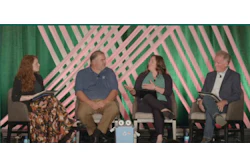
At the summit recycling industry leaders explained how companies can (L to R) Matt Reynolds of Packaging World, Mark Neitzey of Van Dyk Recycling Solutions, and Jim Marcinko of WM Packaging Worldset their packaging up to be recycled successfully—including moving away from black plastic and multi-layer materials.
"Very few MRFs in North America can recognize and make a sorting decision on black plastic," said Mark Neitzey, sales director at VAN DYK Recycling Solutions. "You have to add a laser to support sorting, which adds capital, and then you still can't tell the different polymer type."
Neitzey pointed to black-bottom takeout trays with clear lids, suggesting an all-clear package would be more recyclable. "Something needs to be done to work together there," he said.
Multi-layer materials create their own challenges for recyclers, potentially leaving them to continuously chase sorting effectiveness, according to Jim Marcinko, recycling operations director at WM.
"The less multi-material packaging the better," Marinko said. "We can try to work around some thing like sleeves; you can train the machinery to a certain degree. The problem is, that you're always chasing that format. Things change, and you have to keep figuring it out."
Venue circularity as a foundationAlex Truelove, Senior Policy Director, BPIPackaging World
Much of the packaging used in the U.S. will need meaningful redesign work to become circular, whether that means making it recyclable, reusable, or compostable, said Alex Truelove, senior policy director at BPI, during a session the Summit.
Truelove said composting offers a particular opportunity in settings that generate high tonnage of food waste and packaging volume, such as hospitals, stadiums, and convention centers. He pointed to Petco Park, home of the San Diego Padres, as an example of a venue making progress on packaging circularity.
Large venues like these can help create a foundation for broader composting infrastructure, Truelove said. By proving compostability can work in a controlled setting, building relationships with composters, and developing trust in the system, these projects can help pave the way for future expansion.
“Maybe it starts with the stadium or hospital, and then from there, that can expand to residential and other facilities,” Truelove said. “We’ve seen that happen, so it’s great to see experiments like this helping us move toward that reality.”
Europe sets the stage for U.S. sustainable packaging regulations
Europe has long shaped sustainable packaging initiatives in the U.S.—through paperization, single-use plastic restrictions, recycled content mandates, and more.
In a session, Paul Jenkins, CEO at ThePackHub,Paul Jenkins, CEO, ThePackHubPackaging World said the looming EU law—the Packaging and Packaging Waste Regulation (PPWR)—may be next in that trickle-down effect on U.S. regulations.
"The biggest driver for packaging innovation is regulation," Jenkins said.
He advised that U.S. brands consider PPWR requirements such as mono-material development, material simplification, and recycled content minimums to prepare for working with global companies—and for any regulations that may cross the North Atlantic.
"CPGs, retailers, and packaging suppliers, they all have policies and mandates to improve the environment," Jenkins said. "But let's be honest, that is really driven by the regulatory landscape that's come forth these days."
We’ve done the legwork to identify and vet experienced packaging and processing consultants you can contact directly for your next project. Decades of combined experience in packaging line engineering, machinery selection, package and materials development, and food processing operations.
Discover How to Stay Ahead of the Competition at PACK EXPO International
See new solutions from 2,600 exhibitors. Gain insights from 150+ free educational sessions. From automation & robotics to real-time data insights, find the tech for your company’s future at North America’s largest packaging & processing event.

 (L to R) Matt Reynolds of Packaging World, Mark Neitzey of Van Dyk Recycling Solutions, and Jim Marcinko of WM
 Alex Truelove, Senior Policy Director, BPIPackaging World
 Alex Truelove, Senior Policy Director, BPIPackaging World
 Paul Jenkins, CEO, ThePackHubPackaging World