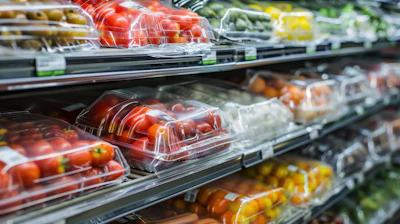
PET thermoform recovery in the U.S. and Canada reached a record 264 million pounds in 2024, but the amount of recycled PET actually used in new thermoforms fell significantly, with virgin resin accounting for 79% of feedstock as recycled content dropped from 18% to 12%, revealing a persistent weakness in thermoform circularity.
- Record Recovery: PET thermoform recovery hit 264 million lb in 2024, the highest NAPCOR has recorded, though improved data collection contributed to the increase.
- Declining Recycled Content: Recycled PET in new thermoforms fell from 18% in 2023 to 12% in 2024, while virgin resin made up 79% of the 2.05 billion lb of feedstock purchased.
- Processing Challenges: Thermoforms mixed with bottles create yield losses and quality concerns for mechanical reclaimers due to irregular shapes, lower intrinsic viscosity, and adhesive contamination.
- Limited Dedicated Infrastructure: Dedicated post-consumer thermoform bales represented less than 1% of feedstock purchased, with only a handful of U.S. facilities on the West Coast producing thermoform-only bales.
- Weak Economics: PET bale prices collapsed from 17 cents per pound in May 2024 to 3 cents per pound by May 2025, while record imports of recycled PET undermined domestic demand.
PET thermoform recovery in the U.S. and Canada reached a record 264 million lb in 2024, according to a new market analysis from the National Association for PET Container Resources (NAPCOR). Yet the amount of recycled PET going back into new thermoforms moved in the opposite direction.
Thermoform converters purchased more than 2.05 billion lb of PET feedstock during the year, with virgin resin accounting for 79% of the total. The share of post-consumer recycled PET fell from 18% in 2023 to 12% in 2024.
The figures reveal a persistent weakness in PET thermoform circularity. More trays, cups, clamshells, tubs, and other thermoforms are being recovered, but relatively little of that material is returning to the same type of packaging.
These findings come from NAPCOR’s first standalone and fifth annual "PET Thermoform Market Analysis," which examines production, recovery, recycled-content use, end markets, and policy developments. The report also illustrates how closely thermoform recycling remains connected to the PET bottle recycling system.
Recovery gains reflect collection and better measurement
The 264 million-lb recovery figure is the highest NAPCOR has recorded, although the year-over-year increase cannot be attributed entirely to greater collection.
As Lauren Laibach, director of data services at NAPCOR, explains, improvements in the organization’s data collection probably contributed to the increase. NAPCOR added cross-checks to its 2024 survey of reclaimers to capture thermoform content that may have been missed in previous years.
 Recycled content usage is significantly lower in PET thermoformed food packaging compared to non-food/non-medical applications. Survey respondents reported over 84% of PET thermoform sales to food/foodservice markets were 100% virgin, while that fraction for non-food/non-medical applications was only 35%. NAPCOR
Collection also expanded in some areas. Rumpke Waste & Recycling, for example, began explicitly accepting PET thermoforms in additional communities in response to demand from Eastman for feedstock for its advanced molecular recycling process.
“It’s hard to quantify how much of the year-over-year increase from 2023 can be attributed to each cause, but both likely drove it,” Laibach says.
The results nevertheless suggest that more thermoforms are reaching recycling facilities. What happens after collection remains more complicated.
Thermoforms place added pressure on bottle reclaimers
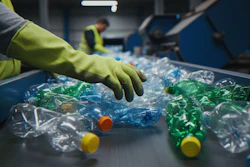
Most recovered PET thermoforms are processed with PET bottles rather than through dedicated thermoform streams. That arrangement gives thermoforms access to an established recycling system, but it also introduces materials that many bottle reclamation facilities were not designed to handle in large quantities. According to Srinivasan Prabhushankar, technical director at NAPCOR, the average concentration of thermoforms in curbside PET bales has moved beyond the levels many mechanical reclaimers prefer.
Thermoforms can generate greater yield losses and material-quality concerns than bottles. Higher concentrations add costs and operating challenges for an industry already dealing with difficult market conditions and the closure of domestic reclamation facilities.
“There are very real limitations to how much economic pain mechanical reclaimers can withstand,” says Prabhushankar.
Several physical and material differences make thermoforms harder to process. Compared with bottles, they can have irregular shapes, greater bulk, lower intrinsic viscosity, lower crystallinity, and different flake density after grinding. They also tend to produce more fines and dust.
Look-alike packaging made from other resins can contaminate the PET stream, while labels and aggressive adhesives may be difficult to remove during washing. These challenges can reduce usable output and make it harder for reclaimers to meet end-market specifications.
Technology can address many of the problems. Advanced optical sorting can remove look-alike packages, enhanced wash systems can improve adhesive removal, and solid-state polymerization can increase intrinsic viscosity. The results depend on each reclaimer’s equipment, process configuration, and customer requirements.
Chemical recycling may also offer another outlet. Prabhushankar said PET thermoforms can be a desirable feedstock for those processes, potentially creating a better path for some recovered material while reducing pressure on mechanical bottle reclaimers.
More recovered material is not returning to thermoforms
Despite the record recovery volume, recycled-content use in new thermoforms declined during 2024. That change was influenced partly by growth in food and foodservice packaging rather than a broad reduction in PCR use across every thermoform application.
Food packaging represented approximately 79% of reported PET thermoform sales. According to Laibach, significantly more pounds were sold into food and foodservice applications in 2024, and those packages used less recycled content on average than non-food and non-medical applications. The average recycled-content rate therefore fell as lower-PCR applications made up a larger portion of the market.
The longer-term numbers point to a growing difference between PET bottles and thermoforms. NAPCOR data show that rPET use in food and beverage bottles has increased substantially since 2018. Pounds of rPET sold into sheet and film markets in 2024, however, were less than half the amount sold a decade earlier.
Cost remains the largest barrier to using thermoform-derived rPET in new food-contact thermoforms, Prabhushankar says. The technology needed to decontaminate the material and produce resin suitable for food contact is available, but the economics make broader adoption difficult.
 Pounds of recovered PET thermoforms have grown significantly since 2022, though the higher bale fractions recorded in that time likely had been increasing over a longer period. NAPCOR
Dedicated thermoform collection and sorting remain limited as well. Only a handful of U.S. material recovery facilities produce thermoform-only bales, all on the West Coast. Inconsistent demand and low prices give other MRFs little incentive to invest in separate sorting lines.
Dedicated post-consumer thermoforms represented less than 1% of the feedstock purchased for new PET thermoforms in 2024.
Package design affects the entire PET stream
CPG companies can reduce some processing challenges through package design. NAPCOR points brand owners and thermoform suppliers to the Association of Plastic Recyclers for PET thermoform design guidance.
Prabhushankar identifies several choices with a significant impact. These include using clear PET with an IV between 0.72 and 0.90 dL/g, choosing monolayer constructions, and using labels, inks, and adhesives that are preferred or recognized by APR for PET packaging.
These decisions matter beyond the recovery of an individual tray or clamshell. Because thermoforms are commonly mixed with bottles, a difficult-to-process thermoform can affect the yield and quality of the broader PET bale.
Brands using both bottles and thermoforms should therefore consider how the formats interact after collection. Compatibility with sorting and bottle reclamation systems may be just as important as whether a package is technically made from PET.
Domestic demand is becoming a larger concern
NAPCOR’s findings also point to weakening economics across the North American PET recycling market. Laibach says that average East Coast curbside PET bale prices declined from 17 cents per lb in May 2025 to 3 cents per lb one year later. At those prices, PET becomes a less attractive commodity for MRFs to sort and market, potentially placing continued collection at risk.
At the same time, imports of recycled PET reached record levels in 2024 and 2025. NAPCOR says some manufacturers have increasingly relied on imported resin to meet voluntary targets or recycled-content requirements rather than purchasing material recovered and processed in North America.
This development changes the challenge facing PET recycling. Collection growth was previously viewed as the primary constraint. NAPCOR now sees evidence that insufficient domestic demand is also limiting recovery.
“Meeting recycled content goals with imported rPET undermines the health of the North American reclamation system,” Prabhushankar said.
For CPG companies, recycled-content purchasing decisions can influence whether domestic recyclers have stable markets for the material they produce. NAPCOR recommends sourcing PCR from within the U.S., Canada, and Mexico to support the regional reclamation system.
Record thermoform recovery shows that more material is entering the recycling stream. Converting that progress into circularity will also require packages designed for existing systems, investment in sorting and processing, and dependable North American demand for the recovered resin. PW