Bacterial cellulose, a natural biopolymer produced by fermentation, is emerging as an innovative material for advanced face masks that can deliver active ingredients for skincare, wound treatment, and topical prescriptions while offering environmental benefits over conventional products.
- What it is: Bacterial cellulose is a 100% natural biopolymer synthesized by Komagataeibacter bacteria, commonly found in fermentation processes like vinegar and kombucha production.
- Key properties: Features a flexible structure, exceptional water-retention capacity, biocompatibility, and nanoporous design that creates a "second skin" effect ideal for active ingredient delivery.
- Beyond skincare: Applications extend to wound dressings, burn treatments, ulcer care, tissue regeneration, and controlled-release drug delivery systems.
- Environmental advantage: As a biodegradable, bio-based material requiring fewer forestry resources than plant cellulose, it offers a sustainable alternative to synthetic products.
- Current challenges: Manufacturing scalability, quality consistency, sterilization compatibility, regulatory approval, and cost reduction remain barriers to broader commercialization.
Face masks have become a household staple for many who relish the self-love, skin hydration, “girls’ night” trend of women (and girls) everywhere. Compared to 20 years ago, face masks are becoming a mainstream skincare product. But what if the mask delivery platform could offer users more than hydration and plumping? What if it could deliver wound treatments and topical prescriptions?
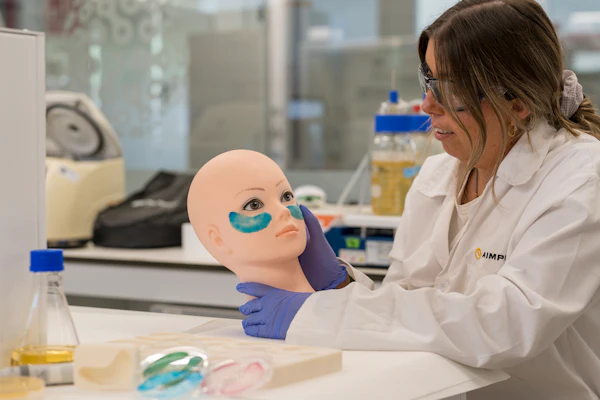
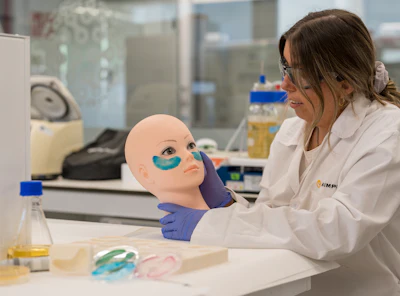
AIMPLAS, the Plastics Technology Centre, is investigating the potential of bacterial cellulose, a 100% natural biopolymer produced by certain bacteria, to develop innovative facial masks. These masks are based on bio-based and renewable hydrogels capable of acting as carriers for active ingredients intended for skincare, and more.
What it is
According to AIMPLAS, bacterial cellulose is mainly synthesized by bacteria of the Komagataeibacter genus, which are commonly found in fermentation processes associated with products such as vinegar or kombucha. During growth, these microorganisms generate a three-dimensional network of intertwined nanofibrils that forms a flexible, durable material capable of retaining large amounts of water. Thanks to this structure, bacterial cellulose easily adapts to the face, creating a “second skin” effect that makes it an ideal support for active ingredients in cosmetic applications.
Bacterial cellulose stands out for its flexible structure and high water-retention capacity, characteristics that make it highly attractive for cosmetic applications. An additional advantage is that, as it is made from a biodegradable material free from synthetic fibers, it represents a more environmentally friendly alternative to many conventional products.
Moving beyond skincare
The possibilities of bacterial cellulose extend well beyond skincare. Thanks to its biocompatibility, high water-absorption capacity, and nanoporous structure, this material has significant potential in healthcare applications related to skin health.
It can be used in the development of dressings and patches for burns, wound and ulcer treatments, and can also support the capability of incorporating active compounds for controlled release. AIMPLAS states that its properties also favor applications related to tissue regeneration and the development of new biomaterials for the healthcare sector.
“The versatility of bacterial cellulose makes it possible to develop innovative solutions for both skincare and biomedical applications. It is a natural, biodegradable material with very interesting properties for the development of sustainable, high-value-added products,” says María José de Manuel Herrera, Biotechnology Researcher at AIMPLAS.
 AIMPLAS
For such dressing or patches, specific packaging is dependent on the intended medical application and is required to maintain moisture levels, protect the active ingredients, and prevent contamination.
"Because bacterial cellulose can retain large amounts of water, maintaining moisture content is often critical to preserving its physical properties and intended performance. Likewise, if active ingredients are incorporated into the material, the packaging may need additional barrier properties against oxygen, moisture loss and light, depending on the stability profile of those compounds,” says Herrera.
For wound care applications, sterility is another key consideration. “In many cases, bacterial cellulose dressings are expected to be supplied sterile, which requires packaging systems compatible with sterilization processes while maintaining product integrity throughout storage and distribution,” she continues.
A Lower environmental impact
Cellulose is the most abundant organic polymer on the planet and is traditionally obtained from plant sources, reports AIMPLAS. However, bacterial cellulose is an innovative bio-based alternative that can be produced through fermentation processes while requiring fewer forestry resources.
Although bacterial cellulose itself is bio-based and biodegradable, Herrera says that medical and cosmetic applications often require packaging solutions capable of maintaining sterility, moisture levels and product stability, which can involve multilayer structures that are more difficult to recycle.
“This highlights the importance of evaluating the entire product system rather than focusing only on the biomaterial” she explains. “Life cycle assessment studies are essential to understand where the main environmental impacts occur and to identify opportunities for improvement.”
Bacterial cellulose also offers a high degree of purity because it does not contain lignin or hemicellulose, components found in plant cellulose whose removal requires additional processing. Other notable characteristics include biodegradability, flexibility, transparency, and an extraordinary ability to absorb and retain water.
These properties make bacterial cellulose a highly promising material for developing new solutions in sectors as diverse as cosmetics, medicine, and biotechnology. Among these biomedical applications, Herrera says that wound dressings are the most mature.
“Several bacterial cellulose-based wound care products have already reached the market in different regions. Controlled-release systems, advanced wound care products, and regenerative medicine applications are also progressing, although many remain at the research, preclinical, or early clinical development stages,” she says.
A look at the challenges
So, before this can become a household staple, there are some challenges that should be addressed. The main ones before broader commercialization involve manufacturing scalability, quality consistency, sterilization, packaging compatibility, and regulatory approval.
“For healthcare products, demonstrating safety, performance, and reproducibility is essential, and regulatory requirements become increasingly demanding as the product incorporates active pharmaceutical ingredients or makes therapeutic claims,” says Herrera. “At AIMPLAS, we are particularly focused on helping bridge the gap between laboratory research and industrial implementation. This includes process optimization, material characterization, scale-up studies, and validation activities that support future regulatory and commercial pathways."
Herrera says that among the most important challenges are increasing productivity and yield, reducing fermentation times, improving downstream processing efficiency, and minimizing the risk of microbial contamination. “Production costs are influenced not only by fermentation itself but also by purification, washing, sterilization and drying steps, depending on the final application.”
Through the development of materials such as these, AIMPLAS continues to promote research into advanced biomaterials that contribute to creating more innovative, functional, and environmentally friendly products. In the not-so-distant future, Herrera says that this material has potential for healthcare applications beyond wound and skincare, including prescription products.
“Beyond wound dressings, researchers are investigating bacterial cellulose for drug delivery systems, tissue engineering, regenerative medicine, implantable biomaterials, and advanced therapeutic patches. Prescription topical products are also an interesting area of development, particularly when controlled delivery or prolonged contact with the skin is desired,” she says.
But of course, Herrera stresses that the path to commercialization becomes more complex when therapeutic claims or pharmaceutical active ingredients are involved. In these cases, regulatory requirements, clinical validation, and manufacturing controls are substantially more demanding than for cosmetic applications.
But there is potential for the face mask delivery platform to offer users a healthcare application that they can comfortably use any night of the week—girls’ night not required.