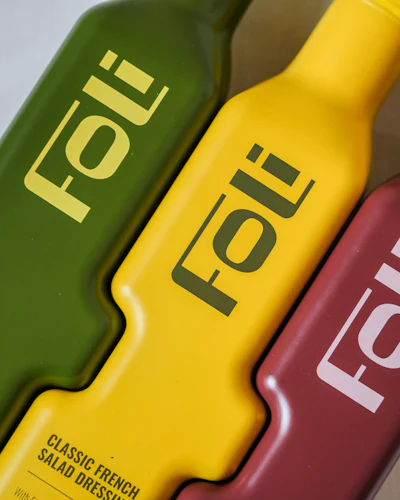
Foli, founded by French entrepreneur Nohra Currie, revolutionized condiment packaging by creating custom interlocking glass bottles that puzzle together like a coordinated collection. The distinctive design combines premium olive oil, salad dressing, and balsamic vinegar in sculptural bottles with complementary shapes and colors, making condiments beautiful enough to display on kitchen counters and dining tables.
- Interlocking Design: Foli's bottles feature curved projections and recesses that allow adjacent containers to nest together, creating a compact, visually coordinated collection
- Premium Ingredients: Products include extra virgin Spanish olive oil, French salad dressing with no added water or refined sugar, and Italian balsamic vinegar, priced at £13 for dressing
- Custom Glass Production: Currie invested in custom molds and substantial minimum orders, choosing glass over aluminum and plastic for sustainability and product protection from light exposure
- Rapid Market Success: Foli launched in March 2026 and was stocked in approximately 150 U.K. stores by October, including luxury retailer Harrods
- Accessibility Feature: The distinctive bottle shapes help consumers with visual impairments identify products by touch, an unexpected benefit of the structural design
A disappointing bottle of salad dressing was all it took to send French entrepreneur Nohra Currie into the condiment business. With a background in fashion and business, including time spent working at Microsoft, Currie was new to food manufacturing and packaging. But after examining the ingredients in the dressing she had purchased, she began looking for a better alternative and found little that appealed to her.
“I didn’t want to start a food brand,” says Currie, founder of U.K.-based Foli. But what began almost as a joke about making her own salad dressing eventually developed into a line of premium condiments distinguished by their unconventional packaging. Foli’s olive oil, classic French salad dressing, balsamic vinegar, and more recently introduced chili-infused olive oil are packaged in custom-molded glass bottles with distinctive colors and shapes that interlock like puzzle pieces. Arranged together, the bottles form a coordinated set that can be displayed on a kitchen counter or dining table.
The concept addresses some of the frustrations Currie had with conventional condiment packaging. She wanted containers that would be attractive enough to leave out, rather than the assortment of differently shaped bottles typically found in kitchens. She also wanted packaging that would protect the products from light and be enjoyable to handle.
The result is a packaging system that gives each product its own identity while allowing the bottles to fit together as a single collection. The design also accommodates additional products, allowing Foli to expand its range without changing the basic packaging architecture.
From salad dressing to a condiment collection
Currie’s first priority was to develop a product she would want to eat. She began experimenting with salad dressing recipes with her sisters during a family gathering in August 2025, then traveled to olive groves and mills in Spain and Italy and visited balsamic vinegar producers in Modena, Italy, to source ingredients.
She wanted to find the highest-quality ingredients she could at a price that would make the products commercially viable. That included extra virgin olive oil and balsamic vinegar, which became the foundation of Foli’s French salad dressing.
The decision to initially launch three products rather than one was partly economic. As Currie explains, sourcing ingredients for the dressing required purchasing substantial quantities of olive oil and balsamic vinegar. Rather than use those ingredients for a single product, she decided to offer them individually as well, making the business more scalable.
The initial range comprises extra virgin olive oil made from Spanish Picuda olives, classic French salad dressing made with extra virgin olive oil, mustard, and other natural ingredients, and Italian balsamic vinegar. The olive oil is packaged in a 250-mL (8.5-oz) bottle, the dressing in a 240-mL (8.1-oz) bottle, and the balsamic vinegar in a 230-mL (7.8-oz) bottle.
 U.K.-based Foli’s custom-molded glass bottles feature interlocking shapes that allow the olive oil, classic French salad dressing, and balsamic vinegar to fit together as a coordinated set designed for kitchen countertops and dining tables.Foli
Currie says the dressing contains no added refined sugar or water, unlike many competing products that use water and less expensive oils to reduce costs. Despite skepticism from a friend who questioned whether there was a market for premium salad dressing in the U.K., the product became Foli’s bestseller.
The name Foli was inspired by folie, the French word for madness or craziness, a reference to both the unusual bottle design and the reactions of people who questioned Currie’s decision to enter such a competitive category. The letters “oli” also connect the brand to olive oil.
“I thought when I looked at the bottle, and everyone also was saying to me I was crazy to start a business and it was such a competitive industry, it suits me,” she says.
Rethinking condiment packaging
Although product quality was the original motivation for launching Foli, packaging quickly became central to Currie’s plans. She was dissatisfied with the appearance of existing olive oil, vinegar, and dressing bottles, particularly when they were used together.
“I think the strategy was similar to salt and pepper packaging—they’re always pretty,” she explains. “You have Le Creuset, and you have some other brands that are very pretty.”
Currie enjoys entertaining and wanted condiments that would complement a carefully arranged table. She also disliked the assortment of bottles of different heights, shapes, and colors that accumulated around the stove or inside kitchen cupboards.
Restaurants offered another example of what she wanted to improve upon. Currie often noticed olive oil and balsamic vinegar bottles sitting on tables in direct sunlight, which can compromise the quality of olive oil. The bottles also tended to become messy from drips after pouring.
“I just didn’t want that,” she says. “I wanted something pretty.”
Her goal was to create primary packaging that would be equally suitable for storage, everyday use, and tabletop presentation, without requiring consumers to transfer the contents into decorative serving bottles.
Developing the interlocking glass design
Currie’s answer was to develop three bottles with complementary contours. Each has a narrow neck and a rectangular body with curved projections and recesses that allow adjacent bottles to nest together. The interlocking design creates a compact arrangement while allowing consumers to separate the bottles for individual use.
The bottles share a common silhouette, but their individual contours make them visually distinct. Together, they create a continuous arrangement in which the shapes of one container fit into those of the next.
Currie initially explored aluminum because of its light weight. However, manufacturers told her that the shape she wanted couldn’t be produced using their aluminum bottle-making processes. Other packaging suppliers encouraged her to use PET, but Currie was adamant about avoiding plastic for food packaging, citing concerns about health and sustainability. She ultimately chose glass, which she felt was a better fit for both her product and packaging priorities.
Finding a manufacturer willing to produce the interlocking glass bottles proved difficult however. Currie contacted suppliers in the U.K., Central Europe, and Asia, many of whom told her the design would be too costly or might not be technically feasible. “Eventually someone said, okay, we’ll try. We can’t guarantee, but we’ll try,” says Currie.
To communicate the concept to the manufacturer, Currie enlisted a glass engineer to prepare CAD drawings. The drawings were then refined with the manufacturer, and several samples were produced before the final design was approved.
But developing a custom bottle also required a level of investment that would have been unnecessary with stock packaging. Unlike a small food producer that could purchase a few hundred standard bottles and apply printed labels, Currie had to invest in custom molds and commit to substantial minimum order quantities before she knew whether the packaging would succeed.
“It was a massive commitment from a financial point of view because I had to order a lot of bottles without being able to test them or show them to anyone,” she says.
Currie says that once the upfront tooling costs were covered, however, producing the custom shape wasn’t necessarily more expensive than producing another glass bottle of comparable size.
Color, texture, and functionality
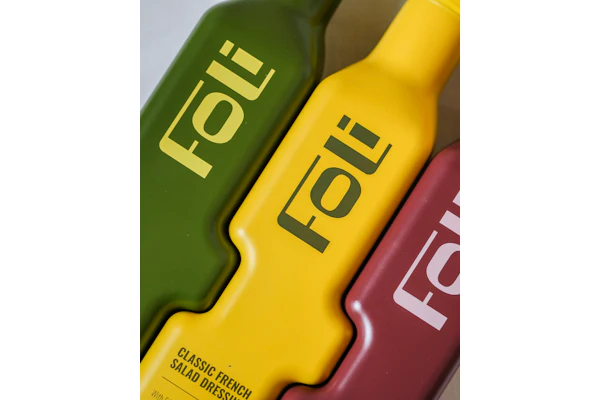
The bottles’ distinctive shapes are complemented by an equally unconventional color palette. The extra virgin olive oil comes in deep olive green, the French dressing in bright yellow, and the balsamic vinegar in a rich burgundy. The newly introduced chili-infused olive oil, packaged in a 240-mL (8.1-oz) bottle, adds orange to the collection.
The colors were chosen to reflect the ingredients rather than follow conventional category graphics. Currie says the choices seemed obvious to her. Green represents olives, burgundy reflects the color of mature grapes, and yellow represents the mustard and garlic in the classic French dressing.
Each bottle features large, vertically oriented Foli branding, with product identification and ingredient information positioned lower on the container. The graphics are kept relatively simple, allowing the colors and sculptural shapes to dominate the presentation.
The glass bottles feature an opaque, silky finish that serves both functional and aesthetic purposes. According to Currie, the finish protects the contents from light exposure, which is particularly important for olive oil, while giving the bottles a distinctive tactile quality.
“They feel like silk, and they feel a bit warm as well because of the silk print,” she says.
The finish also contributes to the premium impression Currie wanted the packaging to convey. She says consumers often become attached to the bottles, keeping them on display and handling or rearranging them long after purchase.
While the unconventional shape raised questions during development about whether the bottles would stand securely, be comfortable to hold, or break easily, Currie says those concerns haven’t translated into problems with normal use. The bottles are relatively small, can be held with one hand, and pour like conventional condiment bottles.
She deliberately avoided adding elaborate dispensing mechanisms. Each bottle uses a standard screw cap, with consumers free to add a separate pourer if desired. Currie says she wanted to keep the dispensing simple, reasoning that the bottles were already distinctive enough without additional features.
An unexpected benefit of the interlocking shapes emerged when someone suggested to Currie that their tactile differences could help consumers with visual impairments identify individual products. Once users learned which shape corresponded to a particular condiment, they could potentially distinguish the bottles by touch.
Currie acknowledges that accessibility wasn’t part of the original design brief, but she recognizes the potential usefulness of the feature. It offers another way in which a distinctive structural design may provide value beyond its appearance.
Packaging intended to stay on display
Making the original containers attractive enough to remain on display was an important part of Currie’s vision for Foli. Nevertheless, she’s surprised by the degree of attachment consumers have developed to the packaging.
“People keep them in the kitchen and on the worktop,” she says. “You start to live with this product every day, and it becomes part of your life, which is very unusual from a marketing perspective because it’s there every day in front of you, and that means you create an attachment.”
That attachment can extend beyond the contents of the bottle. According to Currie, some customers are reluctant to discard the containers once they’re empty.
The packaging’s appeal also extends to the gift sets. Made from Kraft paperboard, the carton features white line drawings that trace the outlines of three bottles, connecting the structural design of the primary containers with the graphics on the outer pack. A large opening on the front exposes the bottles, allowing the products themselves to provide much of the visual impact.
 Foli’s paperboard gift carton features white outlines of the interlocking bottles, with a large cutout that puts the products on display. The set pairs extra virgin olive oil, chili-infused olive oil, and balsamic vinegar in a coordinated package designed for gifting.Foli
Other panels carry product descriptions, nutrition information, and the brand’s message, “Gather with Love, Dress with Style.”
The arrangement allows the same package to function as a retail display and gift presentation. It also reinforces the relationship among the individual products, encouraging consumers to see them as a coordinated collection.
Sustainability was another consideration in the packaging design. In addition to selecting glass for the primary containers, Currie chose cardboard for the secondary packaging. She also says the printed finish doesn’t prevent the glass bottles from being recycled.
Rapid development and retail acceptance
Foli moved from initial concept to commercial launch in a relatively short period. Currie recalls buying the disappointing salad dressing in late July 2025, experimenting with recipes in August, and sourcing ingredients during September and October. She finalized her olive oil selection following the December harvest, while bottle development continued into early spring 2026, when the finished containers were delivered.
The company held a soft launch in March, followed by a broader launch in May. By October, Foli was sold in approximately 150 stores in the U.K., including Harrods.
Currie credits the packaging with helping attract the attention of the luxury retailer. She says the Harrods buyer was immediately interested in the products and requested samples. “The buyer saw them and loved them,” Currie recalls. “And then I sent her some samples, and in her office, everyone was playing with them.”
The brand’s premium positioning is reflected in its pricing. Currie says Foli’s French salad dressing retails for £13, substantially higher than most competing dressings in the U.K. She attributes the price to its ingredient formulation, including a high proportion of quality olive oil and balsamic vinegar rather than water or inexpensive refined oils.
The olive oil and balsamic vinegar are priced more comparably with existing products in their respective categories, which Currie believes gives Foli opportunities beyond specialty retailers.
 Foli expanded its original three-product lineup with the introduction of chili-infused olive oil, packaged in an orange-red glass bottle that fits into the brand’s interlocking design. (**Foli
The interlocking packaging system also provides a means for range expansion. Foli has introduced its chili-infused olive oil in an orange bottle that fits into the existing collection. The product is available individually and as part of new three- and four-bottle gift sets, including the Signature Quartet, which combines all four condiments. Currie is also considering other products, including wine vinegar, that could be offered at lower price points.
Although Foli is currently focused on the U.K., Currie would like to expand into the U.S. market, where she would apply the same approach to ingredient sourcing that she used in developing the original product line.
“I chose the best product as close to home as possible,” she says. In the U.S., that could mean sourcing ingredients from American producers rather than importing them from Europe.
Freedom to try something different
Looking back on the development process, Currie believes her lack of experience in food packaging gave her a degree of freedom that might have been harder to achieve within a large CPG company.
She didn’t begin with an established bottle specification, a target market-share requirement, or a conventional category design brief. Instead, she developed the package around what she wanted to use in her own kitchen and on her own dining table. That approach required persistence when manufacturers questioned the feasibility of the design, and it involved financial risks that would have been avoided by using stock packaging. But it also allowed Currie to pursue a concept without having to satisfy multiple departments or adhere to established category conventions.
“I just wanted to create something I love,” she says, “something I would buy if I saw it in a shop, thinking that if I like it enough, someone else will like it enough.” PW