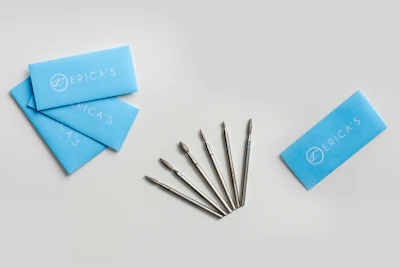
Erica Schlabach, owner of Erica’s ATA, admits she loved the legacy packaging that she recently replaced. The clear thermoformed PET blister packaging that held her company’s carbide and diamond nail file bits were pretty, convenient, and, she says, “much cheaper” than the alternative.
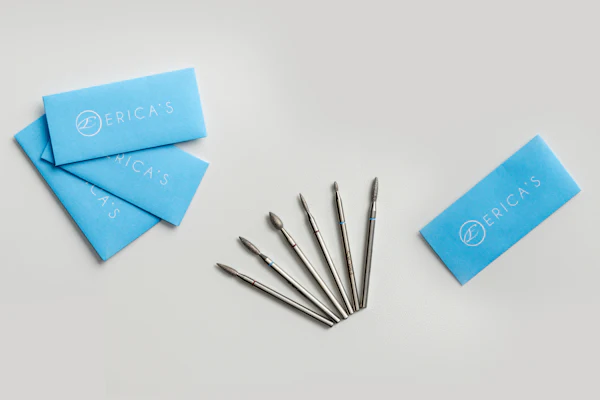
But now, every bit that Erica’s ATA ships has gone out in branded paper packets from JBM Packaging. Schlabach says the family-owned business chose to pay more for packaging that better matches its values.
 Erica's legacy PET plastic packaging had a fitted cavity designed to securely hold individual manicure tools.Erica's ATA
For Schlabach, the choice to leave plastic stemmed from a desire to promote sustainability. She says data from the Organization for Economic Cooperation and Development (OECD) convinced her team it was time to act. The OECD’s 2022 Global Plastics Outlook found that plastic consumption has quadrupled over the past 30 years.
“We want to help our planet,” Schlabach says. “As nail techs, it can be hard to find ways to be sustainable…We collectively agreed it was time to bring awareness to this issue in the nail industry.”
Schlabach says the brand chose to partner with JBM because the manufacturer’s values align with those of Erica’s ATA. She cites JBM’s B Corp, Sustainable Forestry Initiative (SFI), and Forest Stewardship Council (FSC) certifications and its offering of 100% recyclable paper packaging with soy-based ink as evidence of the manufacturer’s environmental commitment.
“I actually wrote the CEO a handwritten note to tell him how impressed I was with their mission,” Schlabach says. “It was that important to me.”
JBM’s lead time was also reasonable, she says.
Materials and construction
JBM uses 80-lb classic white paper for all four sizes, says Jessica Black, director of sales. The bags are a standard paper packet, with no window. They’re printed lithographically in one color, with a flood coat and soy ink.
Schlabach says the packaging’s ability to stand up to the tools’ sharp points, rough edges, and odd shapes “was our biggest question.” Since switching to paper, she says there have been no inquiries about broken packaging.
Black says the packets use a standard coin adhesive, which she says is likely a stronger hold than the plastic baggies they replaced. After discovery conversations with JBM’s team, Erica’s ATA received multiple material samples that JBM describes as eco-friendly and fully recyclable to narrow down for its needs. Performance testing was completed with sample mock-ups, Black says.
The packaging didn’t need any unique barrier protection, according to Black. She says the adhesives are water-based, so they don’t affect recyclability, and the inks are soy-based.
Two of the four sizes use latex closures, and the other two are sealed with stickers, according to JBM. Erica’s ATA added a small Universal Product Code (UPC) sticker over each closure so techs can identify the tool inside. Schlabach says the closures and sticker seals “have held up really well.”
The paper-based packaging doesn’t present any obstacles to ease-of-use when opening during service, Schlabach says. Erica’s ATA team completed internal testing before launching the new packaging.
Two brand colors and a recycling symbol
Erica’s ATA worked with JBM’s Innovation Team on the branded bags. Each of the four sizes carries the company’s logo and a curbside recycling symbol. Schlabach says the goal was to elevate the look of the packaging with the brand’s two colors, blue and white, for “an identifiable and simple feel.”
 The curbside recyclable label on the paper-based packs.Erica's ATA
The brand also decided to include the recycling symbol on-pack to help prompt customers to take action, Schlabach says. The brand’s social media channels call attention to sustainability monthly, with a reminder that the packaging is recycle-ready.
Paying more for paper
Switching to paper came with trade-offs, Schlabach says, chiefly cost.
Erica’s ATA is able to justify the difference in cost because the new packaging better aligns with brand values, including prioritizing U.S. vendors, supporting JBM’s Fair Chance Program, and being more sustainable wherever it can, Schlabach says.
The switch brought practical benefits, too.
“The paper packaging gives our tools a more refined, high-end look, and it takes up significantly less storage space than the plastic tubes did, which makes life easier for our warehouse team," Shlabach says.
The feedback she hears most is how nail techs love the look, Schlabach says.
“I'll be honest: we loved our plastic packaging for its aesthetics and convenience,” Schlabach says. “But the nail industry puts heavy focus on aesthetics and convenience over environmental impact, and we want to change that. So yes, it was worth it. Now I'm proud to show off our products in packaging that better reflects our brand.”
The ultimate goal is to serve as an example to other small brands, Schlabach says.
“We hope our decision encourages other nail techs, salons, and businesses to take action too,” Schlabach says. “Whether it's going plastic-free, doing dry manicures to save water, or using reusable diamond hand files to cut waste, together we can build a greener nail industry.”