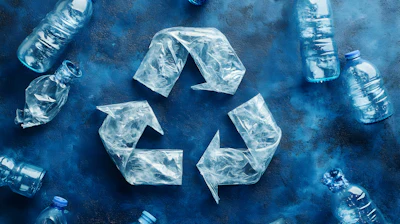
Brand owners must commit to using domestically sourced recycled PET to stabilize the U.S. recycling system, as strong collection efforts are undermined by declining domestic end-market demand and rising imports.
- PET collection in the U.S. is strong and growing, with more than $1.5 billion invested in infrastructure, but domestic processing capacity is contracting rapidly—seven of 30 PET recycling facilities closed in the last 12 months.
- The core problem is a supply-demand mismatch: recyclers are producing quality recycled flake and pellet, but manufacturers are increasingly buying 25% of recycled PET from imports instead of domestic sources.
- Domestic recyclers face competition from historically low virgin PET prices (same as 2019) while their own costs have risen, creating unsustainable market pressure.
- Brand owners and packaging manufacturers have the most immediate power to stabilize the market by committing to domestic recycled content, which would restore demand and prevent further facility closures.
- Long-term solutions require policy measures like extended producer responsibility (EPR), recycled content mandates, and certification systems—but these will take years to implement, making near-term brand action critical.
Concern over the stability of PET recycling has been building across the industry in recent months, as reclaimers shutter facilities and processors struggle to place material. Those concerns were explored in depth during a webinar late last week hosted by The Recycling Partnership, where stakeholders from across the value chain examined the challenges facing the system and discussed the short- and long-term solutions needed to stabilize it.
The session, titled “From Crisis to Correction, how Industry Can Stabilize PET Recycling,” brought together recyclers, policy experts, and material processors for a candid discussion of what has changed in the PET landscape. While headlines have focused on facility closures and market instability, speakers emphasized that the underlying issue is not a lack of recyclable material or a failure of collection systems. Instead, the problem is a growing mismatch between supply and end-market demand, driven by global economic pressures and shifting purchasing behavior.
As moderator Keefe Harrison, founder and CEO of TRP, warned, “The market is at a critical point now where if it goes any further, we are going to see risk of landfill PET, and then we have to consider everything that comes along with that as far as trust in recycling.”
Strong collection meets shrinking domestic end markets
As speakers explained, PET supply in the U.S. recycling system remains strong and growing, even as end-market demand weakens. Investments in collection and sorting infrastructure have increased capture rates, and curbside programs continue to deliver a steady stream of material.
Brent Bell, VP of recycling at WM, confirmed that the supply side of the system is functioning at a high level. “We’re actually capturing more material from our curbside programs than we ever have before in the history of WM,” he said, pointing to more than $1.5 billion invested in infrastructure and automation.
However, the network of domestic reclaimers that process that material into usable feedstock is contracting. Adam Gendell, director of material systems at TRP, described a system losing critical processing capacity at a rapid pace.
“There are only 30 PET recycling facilities in North America,” he said. “In just the last 12 months, seven of these 30 have shut down and closed. We find this to be over a quarter of the capacity to recycle PET.”
 The Recycling Partnership
The situation is even more severe for facilities that process curbside material (as opposed to materials from deposit return schemes), which are essential to the broader recycling system. “If we look at just that capacity, that’s over a third of it lost in the nation,” Gendell added, noting that in some regions the losses are even more pronounced.
For material recycling facilities, or MRFs, the impact is immediate. PET must continuously move through the system, and as outlets disappear, the pressure builds. Bell illustrated the scale of the challenge. “We move about 700 loads a month, so that’s about 700 trucks a month that have to find a home,” he said. “As more domestic facilities close down, we’re faced with lack of end markets.”
Pete Keller, VP, recycling and sustainability for Republic Services, emphasized how quickly market conditions translate into operational stress for recyclers. “When you’ve got published indices at zero and you’ve got 700 truckloads a month, you’ve got to figure out where to send the material,” he said. “Liquidity becomes a big concern.”
The breakdown is happening at the point of sale
Despite the contraction in processing capacity, panelists were clear that recycling itself is not failing. The system continues to collect and process material effectively. The breakdown is occurring at the point where recycled PET must be sold and turned back into new products.
“If people hear me say nothing else today, hear me say this, this is not the failure of plastic recycling,” said Kate Bailey, chief policy officer for APR – Association of Plastic Recyclers. “We know how to recycle plastics. We are doing it today. We are all here today because we are seeing some serious cracks in the foundation that we need to fix if we are going to stay on course and solve these problems.”
Bailey pointed out that reclaimers are successfully producing recycled flake and pellet, but without consistent buyers, the system cannot sustain itself. “Recyclers need buyers,” she said. “That is where the system is breaking down.”
Manufacturers ultimately determine whether recycled PET is used. They can choose between virgin resin and recycled content, and within recycled content, they can source domestically or import material from overseas. Increasingly, those decisions are moving away from domestic supply.
 Webinar speakers included, from top, l. to r., and bottom, l. to r., Adam Gendell, The Recycling Partnership, Brent Bell, WM, Pete Keller, Republic Services, Keefe Harrison, TRP (moderator), and Kate Bailey, APR.The Recycling Partnership
Bell said reclaimers themselves are pointing to imports as the primary reason for closures. “Our first question is always, why are you guys closing? What’s going on?” he said. “What we’ve heard is that it’s this massive number of imports that are coming in that are replacing what was once a home for recycled PET.”
Imports and low-cost virgin resin reshape the market
A major shift in purchasing behavior has taken place over the past two years, with imports playing a growing role in the U.S. market.
“What we’ve seen is a huge surge in the last couple years where companies are now buying 25% of recycled PET from imports,” said Bailey. “It means companies are not buying from you in Toledo, Ohio. They’re buying from Taiwan instead.”
These imports are often perceived as lower cost and, in some cases, higher quality, though panelists raised concerns about transparency and verification. At the same time, domestic recyclers are competing against historically low prices for virgin PET.
“Today, there is more new virgin PET plastic being produced than there ever has been in the history of the world,” Bailey said. “Second, it is at unusually low prices. The price of virgin PET earlier this month was the same price it was in 2019.”
“Think about that. What else in your life is the same price as it was in 2019? Yeah, nothing. So, recyclers are all facing increased costs and yet we're competing against an industry that has somehow gotten cheaper and is producing more
For recyclers, the result is sustained downward pressure on domestic markets rather than a short-term fluctuation. Pete Keller, VP of recycling and sustainability at Republic Services, highlighted how imports distort the market. “When 25% of the consumption is imported material of questionable origin, there’s a structural problem in the marketplace,” he said. “All the settlement [overall domestic market price] is just down, down, down.”
Quality considerations intersect with market dynamics
Quality remains an important factor, particularly for high-performance applications such as beverage bottles. These uses require food-grade recycled PET with consistent clarity and processing characteristics. However, panelists cautioned against viewing quality as the primary driver of the current downturn.
“There’s certainly a spectrum of quality out there as there is with any manufacturing feedstock,” Gendell said. “Is there a role for our domestic system to up its game? Yes, of course. Is that the primary hurdle right now? It’s hard to say yes.”
Different end markets have different requirements, and some applications, such as thermoforms, can utilize less processed material. Gendell noted that thermoform packaging once consumed a much larger share of recycled PET than it does today, suggesting an opportunity for near-term demand growth.
Panelists also raised concerns about the integrity of some imported material. Keller spoke bluntly about the need for better verification. “If I’m going to say anything sensational today, some of it is not recycled, full stop period,” he said, referring to imported material marketed as recycled content.
These concerns reinforce calls for greater transparency and traceability in global supply chains. As Gendell noted, “The whole direction that recycling is going right now is one with more transparency, more traceability, and more product stewardship.”
Brand commitments seen as the fastest path to stabilization
Alongside diagnosing the problem, panelists devoted significant time to discussing solutions. In the near term, they repeatedly pointed to brand owners and packaging manufacturers as the key to stabilizing the market. Gendell emphasized that the solution is fundamentally straightforward. “The stuff has to get used in new stuff, and then everything else works itself out,” he said.
Bailey reinforced that packaging producers have the most immediate influence. “Short-term, we know there are buyers for these materials,” she said. “The packaging companies are the ones today who have the most immediate impact on solving this situation.”
Speakers stressed that commitments to use domestically sourced recycled PET would help restore demand, support existing infrastructure, and prevent further facility closures.
Keller said interest from brands is not the issue, but valuation remains unresolved. “All the brand owners are interested in the material. They’re interested in the transparency, the traceability, the domestic supply,” he said. “They just haven’t figured out how to value it.”
Policy solutions are essential but will take time
Longer-term solutions will depend on policy measures that strengthen demand and support domestic recycling infrastructure. Extended producer responsibility programs, recycled content mandates, and incentives for domestic sourcing were all discussed as part of a comprehensive approach.
Bailey noted that EPR will play an important role but is not an immediate fix. “We only have seven states with EPR laws, and we have a national problem. We only have one state that's actually started their EPR program, which is Oregon,” she said. “So yes, EPR can be helpful, but we are talking years down the road before the tools are in place to actually make that part of the solution.”
Minimum recycled content requirements are already helping to create baseline demand in some states, but panelists emphasized the need to refine these policies. Without provisions that prioritize domestic material, companies may continue to meet requirements with imports.
Additional policy options include certification systems to verify recycled content, incentives for domestic sourcing, and federal support for recycling infrastructure. Bailey pointed to the need for broader recognition of recycling as a domestic manufacturing sector deserving of investment.
A pivotal moment for PET recycling
PET occupies a central role in the recycling system, both economically and symbolically. It is one of the most widely recycled materials and a key contributor to the value of curbside programs. As a result, disruptions in the PET market have broader implications for the entire recycling ecosystem.
Bell underscored the importance of maintaining public trust. “The last thing we want to do is have more distrust in a recycling system,” he said. “To tell a municipality we can’t find homes for recycled PET is not a great conversation to have.”
 The Recycling partnership
At the same time, supply is expected to continue growing as new policies and investments drive higher collection rates. Without corresponding growth in demand, the imbalance will only intensify.
Panelists agreed the situation is serious but can be addressed with coordinated action across the value chain. “This is a serious situation, but this is a solvable situation,” Bailey said.
The path forward will depend on whether brand owners and policymakers move quickly to strengthen demand and keep material flowing through the domestic system. PW