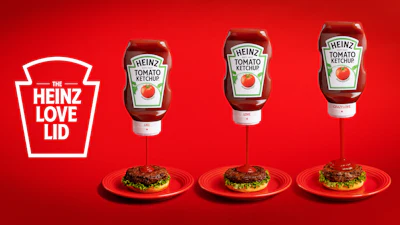
Heinz introduced the Love Lid, a limited-run adjustable closure that lets consumers control ketchup flow through three settings using a patented rotating-core mechanism made from standard polypropylene.
- The Love Lid features three flow settings: Like, Love, and Crazy Love, controlled by rotating an internal core that rises to increase flow
- Made from the same polypropylene as standard Heinz lids with unchanged recyclability, avoiding common multi-part closure complications
- Works as a consumer-applied retrofit on any existing 20-oz Heinz bottle without requiring line changes or bottle modifications
- Available exclusively as a limited-time e-commerce bundle through Walmart.com (U.S.) and HeinzToHome.co.uk (U.K.), including one bottle, lid, and usage guide
- Developed in partnership with Beta Design Office and Wieden+Kennedy London to personalize ketchup dispensing experiences
Kraft Heinz today introduced the Heinz Love Lid, a consumer-adjustable closure that lets users dial the ketchup flow rate through three settings labeled Like, Love, and Crazy Love. It arrives as a limited-run grilling-season activation rather than a change to Heinz's standard closure, but the mechanism itself is a real functional addition to a bottle format the company has otherwise left alone.
In answers provided to Packaging World, a representative from the company detailed the mechanical and material decisions behind the closure.
The lid is a two-part closure built around a patented mechanism. According to the company, it has a smaller inner aperture, and as the dial is rotated, an internal core rises to progressively increase the flow. That approach varies effective orifice restriction through vertical travel of a core rather than by rotating a series of fixed openings into alignment, which is the more common arrangement in adjustable dispensing closures.
Materially, the closure is conventional. A representative from the company told Packaging World that the Love Lid is made from the same type of polypropylene used in Heinz's traditional lids, and that its recyclability is unchanged from the standard closure. That answer is notable given that multi-part closures frequently introduce recyclability complications when a mechanism requires a second resin or an elastomeric or metal component.
"The Heinz bottle was left completely intact for this lid innovation, and the Heinz Love Lid works on any [existing] 20-oz. Heinz bottle," the representative says. Because the neck finish is unchanged, the lid functions as a consumer-applied retrofit rather than a line-applied closure: users remove the original lid, remove the induction seal film, thread on the Love Lid, set the dial, and squeeze.
Kraft Heinz says the Love Lid was developed in partnership with Beta Design Office and Wieden+Kennedy London.
An ecommerce-only launch
The Love Lid is not sold on its own and is not reaching physical retail shelves. It is available for a limited time only as a bundle containing one bottle of Heinz Tomato Ketchup, one Love Lid, and a printed guide suggesting settings for different foods.
Kraft Heinz directs U.S. buyers to TheLoveLid.com, which redirects to a Walmart.com product listing. Walmart was not named in the announcement, but a representative from the company confirmed to Packaging World that the Love Lid is available exclusively through Walmart.com in the U.S. In the U.K., it is sold through HeinzToHome.co.uk. Kraft Heinz did not characterize the arrangement with Walmart beyond the exclusivity itself.
The channel decision carries packaging implications of its own. An e-commerce-exclusive bundle has to survive parcel shipping rather than pallet-to-shelf distribution, which puts the secondary pack, not the closure, under the most mechanical stress. A glass-free, PET-bottle bundle helps, but the outer carton still has to protect a filled 20-oz bottle and a separate loose closure through single-parcel handling. Kraft Heinz has not detailed how the bundle carton was designed or tested.
Bundling the closure with a bottle it is known to fit also removes a variable. Because the lid is consumer-applied and depends on a matching neck finish, pairing it with a specific 20-oz bottle avoids the fitment questions that would come with selling the closure as a standalone accessory.
Positioning
Kraft Heinz frames the closure as a response to how differently consumers use the product.
"We all experience love differently and our fans' connection to ketchup is no exception. People have deeply personal rituals around how much ketchup they squeeze, and we celebrate every one of them," says Nina Patel, vice president, Global Heinz at the Kraft Heinz Company.
The company describes the Love Lid as a continuation of recent bottle and closure work, following the Heinz Dipper, and as part of an effort to give consumers more ways to personalize dispensing.
For brand owners weighing similar adjustable-dispensing projects, the Heinz approach is worth noting for what it leaves alone. By holding the resin, the neck finish, the bottle, and the recyclability profile constant, and by keeping the closure out of the filling line entirely, Kraft Heinz added a mechanical function without opening up a package qualification, a line change, or an end-of-life question. What it took on instead is an e-commerce fulfillment and secondary packaging problem, and a limited window in which to prove consumer demand.