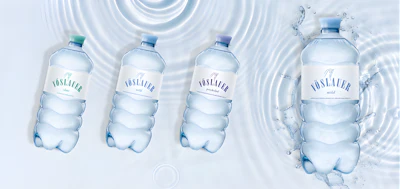
Vöslauer Mineralwasser, an Austrian mineral water brand, partnered with Amcor to introduce a redesigned tethered closure that the companies say prioritizes consumer comfort and recyclability alongside compliance.
“We appreciate that our customers have high standards and our commitment to quality is as evident in our packaging as it is in our mineral and flavored waters,” Mag. Yvonne Haider-Lenz of Vöslauer Mineralwasse says.
The new closure is designed with drinking comfort and sustainability in mind, they say. The Vöslauer design focuses on keeping the cap functionally out of consumers’ way once opened. The closure opens to a wide angle and clicks into place, preventing it from swinging back toward the consumer’s face when taking a sip. According to Amcor, the closure is also “intuitive and easy to open.”
The whole tethered function is designed below the shell of the closure. According to Graeme Hood, director R&D, Amcor Global Rigid Packaging Solutions, two arms connect the tamper evident band to the closure shell. The two arms are connected to the cap and band by thin film joints, allowing the closure to bend at the joints and work as a hinge.
Additionally, there is a protrusion that acts as an element to help open the closure by providing a pivot point. This allows the closure to maintain its open position.
The closure underwent standard tethered durability testing. Hood says that all tests were in accordance with ISBT, CETIE & CEN test methods.
“The closure uses the same standard HDPE material as our existing single‑piece closures,” Hood says. “To enable the tethered function, we redesigned the tamper‑evident system and integrated it into the overall closure structure. This went through several design iterations to achieve optimal functionality and durability.”
Mono-material approach supports recyclability
A key enabler of the closure’s sustainability profile is its mono-material construction, Hood says the closure uses high-density polyethylene (HDPE)—the same standard as existing single-piece closure—for both the cap and tether. Additionally, the tether isn’t a separate element and is fully integrated into the closure structure.
Keeping the closure on the bottle is mandatory for single-use bottles up to 3 liters under the EU Single-Use Plastics Directive.
By avoiding mixed materials in the closure, the design eliminates a common barrier to recycling, where incompatible polymers can complicate sorting and reprocessing streams.
“The closure is compatible with standard PET beverage recycling streams, where the appropriate collection and recycling infrastructure is in place,” Hood said.
This compatibility with standard PET recycling streams positions aligns with an industry push for increased design for recyclability, the company says.
For Amcor, “appropriate collection and recycling infrastructure” means recovery facilities with the capability to separate the cap/closure from the bottle, and send them down their appropriate resin streams.
This tethered cap closure isn’t the first time Vöslauer and Amcor have collaborated. Vöslauer also used Amcor’s Secure Flip sports cap to better align with sustainability commitments, the company says.
The Secure Flip sports cap features a non-detachable tamper-evident band that is retained within the closure after opening. This helps eliminate alternative detachable tabs being discarded.
No disruption on the filling line
The new tethered closure design didn’t require any major changes to the filling line, according to Hood.
“As is typical for tethered closures, the capping chucks were adapted to suit the new closure geometry,” Hood says. “Other line adjustments that were made were primarily linked to overall closure lightweighting rather than the tethered function itself.”
The R&D director also says that there were no issues running the closures on customer lines, cap feeding/orientation remained smooth without tangling. He also says there were no issues with speed or reject rates.
For other beverage companies interested in transitioning to tethered caps, Hood advises that it’s possible to maintain operational efficiency while meeting sustainability requirements. He says Vöslauer Mineralwasser didn’t experience downstream labeling, conveying, or secondary packaging issues and was able to adopt the closure without changes to the bottle neck finish.
“It's all about preparation, planning and validation up front,” Hood says. “From pilot tooling and molds, up to ramping up production with the customer.”