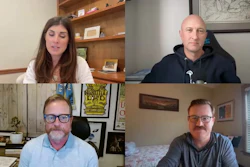
Sean Riley: Hello everybody, and welcome to End of the Line, our video podcast series where the editors of PMG get together on Fridays to talk about how their weeks went.
It is absolutely the dog days of August, so we're struggling a bit to find things that we haven't already covered in stories. But as always, I have Liz Cuneo from Healthcare Packaging, Matt Reynolds from Packaging World, and Derrick Teal from ProFood World.
No Casey this week. We had Casey sitting in with us for a couple of weeks, but he clearly took this week off.
Derrick, you're all branded up. You're Tillamook'd out. What's the scoop?
Derrick: Well, just because I'm wearing a T-shirt, I mean, come on.
Sean Riley:: What?
Derrick: I'm gonna make myself some cheese here.
But yeah, talking a little bit about Fairlife last week—or was it two weeks ago?—sent me down sort of a rabbit hole with dairy. I hadn't checked in on that much at all.
It was interesting because a couple of years ago, I think the dairy industry was sort of—at least liquid dairy was having—I don't want to call it a crisis exactly, but they were really up in arms about what should be defined as milk. Plant-based products: should those actually be called milk? I think we talked about something like that a few weeks ago as well.
So it got me looking into all that. In terms of production, liquid dairy has declined a little bit. A lot of the focus has shifted toward other dairy products like cheese, whey protein, cultured dairy, and other products that consumers are more interested in at the moment.
You see a lot of that with something like whey, which was traditionally considered a byproduct that's now getting rolled into a lot of different things.
Also along those lines, they're investing in ultra-high-temperature processing and aseptic processing. We've covered a few projects like this. The idea is to maintain the shelf life of those products. Costs are always going up, and if you're investing in something like that, you're able to keep your product on shelves longer, which helps justify the investment because you're not throwing away as much product.
At the same time, all the investment that was going into plant-based products has declined as well. It's gone from that huge investment-banker-type environment where they're throwing money at it to, "OK, now we've got to back off a little bit because we've saturated the market and it's matured."
In both cases, you're seeing some consolidation in terms of processing. It's been really interesting to see. There's so much to talk about and all sorts of numbers to go into.
For example, Hilmar opened a more than $600 million plant in Dodge City, Kansas, just for cheese and whey protein. And I'm sorry, I'm looking at stats, even though this cheese is right out here. It's very tempting. I'm gonna have a bit of it in a second.
And the aforementioned fairlife opened an ultrafiltered milk processing facility in Webster, New York, and they've announced a $650 million expansion of the facility here in Michigan.
So there are investments going on, but it's interesting how everything has sort of settled in terms of that—I don't want to call it a battle—but the discussion over whether plant-based products could be considered milk. Now it's shifted to, "OK, our liquid milk is high-value liquid milk production," or they're shifting into other value-added products such as cheese and, well, maybe even ice cream.
I don't have any ice cream out here. I do have cream cheese.
Sean: Nice. But I must be the person who doesn't know this. I'm sorry, but I didn't. So whey protein is just an accident?
Derrick: Yeah. In the past—it wasn't an accident. It's just a byproduct of the cheese-
Sean: But something they weren't using?
Derrick: Correct.
Sean: Oh, that's amazing.
Derrick: It had no value, and I think it's a good success story of reusing all of a product and completing a cycle. Everything gets reused. It's very similar to the beer-making process and the byproduct from that.
I'm blanking on the name of it right off the top of my head, but there are spent grains with beer, and they've been incorporated into a lot of bakery products as a high-fiber ingredient. Not a lot of nutrition, but there are reuse channels for it, which is always interesting.
Liz: Yeah, I just covered a protein powder, actually, Protein Powder Rise311, and they use upcycled barley from Anheuser-Busch because barley is high in protein. It's a plant-based protein, so they're finding it from other sources besides whey or casein and all that stuff.
But yeah, when you said whey, all I think about is a powder, like a protein powder.
Derrick: Right. And that's funny. So many things can be traced back to the pandemic. It was the dietary shift that we saw with consumers, where they're doing more at home. We saw a health kick prior to that, but since then it's really kicked into high gear.
I don't think there's any product in my household with two teenage boys that doesn't have some sort of protein in it. Waffles with protein—I mean, waffles with protein.
Matt: Do you think it has something to do with GLP-1 diets? Folks who are losing weight are expected or asked to—that's the route to nutrition, a lot of protein and high protein density?
Derrick: I would guess so. I'm not super familiar with the GLP-1 diet. Obviously, we cover manufacturing, not dietary requirements. But from what I recall, yeah, I think that is part of GLP-1.
Liz: That makes sense. Increased protein. But I thought it was even before that. Even before GLP-1 was more of a thing, in 2022 and 2023, you saw everything coming out with protein.
Matt: Yeah, I mean, it goes as far back as Atkins, right, when that was a big thing. There's been a push for protein, but I do think GLP-1 is part of it.
Liz: Food trends are fascinating to me. There's a Great Harvest Bread—you guys know that company? There's one that closed, I think, over a year ago. My mom is bread-obsessed, and she's like, "I wish it would reopen."
And I'm like, "It's not going to reopen. Bread isn't a thing anymore." I'm like, "No one eats bread, do they? Unless it's protein bread." Like the Ezekiel or Dave's Killer Bread. I've bought some, but I don't eat bread. I don't stop and get a loaf of bread.
I know that's so outdated to me. I'm like, "That's not reopening, Mom." Sorry to all the bread manufacturers, but bread is dead.
Matt: I disagree. A good sourdough, nicely toasted, goes a long way.
Liz: OK, but that's the other thing. People are making their own sourdough now.
Derrick: That takes a lot of work.
Matt: That was during the pandemic when everybody was stuck at home. Who's got time for that right now?
Derrick: But it's funny, talking about bread not being a thing. I went to buy some bread just the other day, and I was looking for sourdough. I could not find any sourdough. It was wild.
There were so many empty shelves on the bread aisle.
Liz: Where did you go? Just a grocery store?
Derrick: Yeah, right down the street from me. I think I can say Kroger. Maybe everybody in West Bloomfield is hoarding bread now. I don't know. But I couldn't find any sourdough.
Matt: I should tip my hand as an industry stooge here because I'm a former editor of Modern Baking and Baking Management magazines. So yeah, they're giving me a few bucks on the backside to make sure I boost Big Bread.
Derrick: So how do I get in on that?
Matt: It looks like you're already in Tillamook's pocket there, buddy.
Derrick: Well, hopefully they send stuff that goes in my pocketbook. I could use that instead of just shameless promotion.
Host: All four of us will happily shill your product on this podcast. We are open for business, hanging out a shingle. We just threw Kroger out there. I mean, that's a big one. They're probably gonna want to jump on board.
Matt: Small company like that.
Sean: Yeah, for sure. All right, Matt, what's been coming across the Wisconsin woods?
Matt: Yeah, the cheddar curtain.
Well, it's funny. It's nothing that's new, but it's something that's new because of the trends that are happening now.
Coca-Cola Consolidated—you know, Coca-Cola is the brand owner, but they operate with a whole lot of very large bottlers that actually do the packaging. They put the Coke or Sprite or whatever into the various formats: the 2-liter bottles, PET bottles, cans, all that type of thing.
All of those eventually have to go onto pallets, sometimes mixed pallets where you've got 2-liter bottles and cans and all sorts of formats. There's a lot that goes into making sure those pallets don't end up on the floor because any product that hits the floor is essentially not going to be sold.
There's a lot that goes into containment, especially for a mixed pallet where you've got multiple different weights and volumes. You can imagine any kind of beverage being packaged and shipped is heavy and has a lot of weight to it.
Meanwhile, Atlantic Packaging sells film. They do a lot of things, but they sell Coca-Cola Consolidated film. They have a system called MUST. There's an acronym for it: Monitoring Usage, Standardization, and Technology.
Essentially, it's something that's really simple and has been around for a decade. It's putting sensors on stretch wrappers, and it counts exactly how much film is going into every single pallet in real time.
Then that data goes via cellular, outbound only. So there's no big issue with IT worrying about somebody getting into a Coca-Cola facility and getting the recipe for Coca-Cola, which might be sensitive.
The data goes outbound via cellular to Atlantic's servers. Atlantic monitors it—it's like remote monitoring—and sets benchmarks by product type. For cans, they use this much stretch film; for 2-liter bottles, they use this much.
Honestly, I've been aware of it, and I almost didn't cover the story because it's like, "Well, what's new about that?"
What's new is the trend of AI. A company like Coca-Cola Consolidated is now sitting on 10 years of really good, clean data. It's a volume of data that is becoming actionable in ways that it wasn't before.
Even before AI, just the baseline process of monitoring stretch film for pallet wrap meant 20% lower film costs, 30% less material, and fewer film breaks. The industry average is around 5% film breaks on a pallet; they're only at 2%.
They've got 70 wrappers in 11 different facilities. I don't know if they're Wulftec or Lantech or Orion—all the usual wrappers. But for one installation of sensors on all 70 wrappers, they've seen a significant amount of savings over 10 years.
Now, 10 years in, they're able to use all that historical data and run it through AI. Atlantic is doing this. They didn't really tip their hand as to exactly how they're doing it. They're just starting to experiment with ways to do it.
But I think the bigger story is that AI is unlocking all sorts of things for companies that have been meticulously keeping good data for some time. It's retroactively unlocking trends and actionable pieces where they can make changes.
Essentially, for about what they're saving, Coca-Cola Consolidated is able to invest in slightly more expensive but also more sustainable stretch materials that use higher percentages—up to maybe 20%—of recycled material.
So optimization of stretch-wrap film on the front side, improved through a lot of data that you've had for 10 years and can now act on, is allowing and paying for further optimization on the sustainability side.
It's not new, but the advent of AI is unlocking things that weren't available to these big brand owners, big bottlers, or big contract packagers in the past. I thought it was interesting and something to keep an eye on for various other unlocks.
Liz: Yeah, we hear that people aren't so sure about AI and utilizing it in the plant and stuff like that. But I guess the big guys, the Cokes of the world, who have this clean data aren't as afraid to because they know what they're working with. Again, it's clean, pristine data that's going to help them in the long run. That's actually very interesting to hear.
Matt: Well, just to clarify, it's Atlantic that's doing all the monitoring and they're just reporting back. So it's on the Atlantic side. There probably is a certain amount of trial and error, and they aren't officially rolling out something called MUST AI at this point.
But it would be almost inconceivable for them not to be applying these tools to the data monitoring systems they've got set up.
So something as obvious and simple as optimizing your stretch wrap, through the lens of AI, opens all these other new possibilities. Again, it's Atlantic on the outside, not Coca-Cola Consolidated within its four walls. But Coca-Cola Consolidated is able to apply the learnings Atlantic sends back to improve its operations.
So I guess a little bit of risk-sharing is happening in that sense.
Derrick: It's interesting because, as you're both talking about that, a lot of the people I talk to say you have to be really focused on what data you're collecting because it can't all be actionable. You can't act on all of it.
But if you have AI that's able to process that data and tell you what you should be looking into, I think that could change people's outlook on AI in their plants, especially if it's enclosed and not able to go out into the wild and hack your systems. You're seeing rogue AI and system issues happening right now at one giant company recently.
Matt: Yeah, I think what it does is help prioritize. You can always improve every operation in your facility by 0.5% or 2%, but this sets it up in such a way where you can view what's going to be valuable, what the lowest-hanging fruit is, and where you can get the biggest wins early on.
AI is able to help focus on that instead of it being a crapshoot: "Am I going to improve throughput by 2% over here or reduce fall-downs by 1% over here?"
This lets you focus on where you'll get the highest value for the least amount of effort. AI is really bringing that into stark relief where it wasn't available before. It was a more muddled picture.
Sean: Love that. We've gone well into the episode without bringing up Liz. Usually Liz leads off because ladies first, but she doesn't like to always have to go first. So this time you're closing this for us. Last but certainly not least, what's going on in your world, Liz?
Liz: Well, I had an interesting interview with Melissa Carter. She's from Abbott, and she has an interesting title: principal director of service innovation. So I kind of dug into what that means.
I met her at an event at The Pack Out, and she spoke on what she's got going on over at Abbott. Basically, they do sample collection products that would go to homes and then to providers, and it's a whole ecosystem.
She really tracks how they get those sample kits out to providers, how providers or patients interact with them, and then how they eventually have to come back.
It's a whole circle, and there are a lot of different groups and people using these products. So it's pretty important to look at packaging that serves dual purposes throughout—not the supply chain, but the chain of use, if you will.
What was interesting about her is that she went to journalism school. So I thought that was interesting. What a path. She's had a very interesting career path that led her to where she is.
One of the things she brought up, thinking back to her journalism school days, is that she's really good at listening to users and customers and learning how to listen beyond what they're saying.
What someone says they need or want is not necessarily what they actually need. So she takes that into account when designing packaging. The ability to ask the right questions, hear what they're saying, pick up on small cues, and dig a little deeper has been a theme throughout her career.
Another interesting thing she brought up is designing this kind of packaging with as little friction as possible.
When you talk about user experience, you think about this big experience. She's like, "We want it to be really effortless, really seamless, with really little friction."
That's how they're designing it, and that's mostly on the hospital or provider side. We don't want them to overthink the packaging.
When you talk about people like us, one of Abbott's products is the Cologuard colon cancer screening kit that would come to a user like us. Then you really have to think about packaging a little bit differently.
It needs to come alongside them as they use it, ease fears or concerns, and help them understand how the package and the product work.
So she's designing packaging for different users and thinking about how it functions in different settings. She's pretty cool. Her presentation was great at The Pack Out, so I knew I wanted to talk to her.
That Prominent People in Packaging interview is online now at Healthcare Packaging. I'm looking forward to seeing if I can ping her again for something because she's got a lot of great insights.
Matt: It's always interesting when the package itself is the product, in the sense that what they're selling with Cologuard is ease, convenience, and transportability. The package is the product that does that.
In the same sense that a return pack for e-commerce is the product, that's always interesting—to see packaging in that role.
Liz: Yeah, and just think of who uses it, right? It comes to us, in theory, and we ship it back. Someone then has to use it to grab and test the product, and then, however the results get back.
It's multiple people touching and using it and having to understand it. The integrity of the package or product has to be maintained throughout. So it is interesting. The product and the package are kind of one in that sense.
Matt: Is it Prominent Packaging of People or Prominent People in Packaging?
Liz: Did I say—it's Prominent People in Packaging. Prominent People in Packaging. P-P-P.
Derrick: I should have known you'd bring up Cologuard since we talked about diarrhea last week. Oh, and I mispronounced it. It's cyclosporiasis, not cyclosporiasis.
Matt: And you had everybody believing that you knew what you were talking about, so we all just went along with it.
Sean: The confidence with which you were wrong is astounding. You never would have had to correct us.
Is that over? Are we still fighting lettuce?
Liz: It's still going on. In fact, there are more states reporting cases. I'm blanking off the top of my head on which states there are, but more states have reported cases.
It's continuing, and there's a whole other number of states reporting salmonella from jalapeños.
Sean: Oh no.
Liz: Oh yeah. They think they've traced it down to one restaurant—or one restaurant chain and its supplier—but who knows?
Sean: Interesting. Well, on that light note, stay away from lettuce and jalapeños and just eat ice cream and cheese.
Derrick: Cheese is good.
Sean: Yeah. On that note, it was a pleasure, as always, to catch up with everybody. Hopefully, for our listeners at home, it was also enjoyable.
Thanks again, Matt, Liz, and Derrick for taking the time to come on here, and everybody have a great weekend.
All: You too. Have a good weekend, everybody.