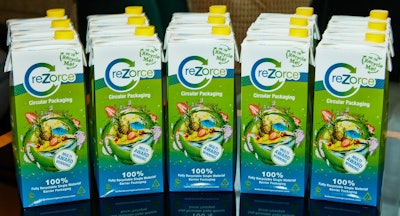
Packaging World editors were intrigued enough by this new tech to think it was worth a quick trip from Chicago to Amsterdam to see and understand. There, we caught up with Neil Court Johnston, president, Mucell Extrusion, a division of Zotefoam PLC, on a new multilayer but mono-material, food-contact HDPE and rHDPE structure called reZorce circular packaging.
PW: What is microcellular foaming tech, and what was its genesis? I believe an early, in-market example was the development of a lightweighted pack for Unilever brand Dove, correct?
Johnston: This really goes back to 2011 when Zotefoams acquired MuCell Extrusion. Microcellular foaming technology is where we inject atmospheric gasses into polymer, typically nitrogen and carbon dioxide, and we displace 10 to 15% of the weight, creating lighter, greener, cheaper packaging.
Fast forward to 2019. In the intervening years, you've been able to develop layers of this microcellular foam in HDPE specifically. And when laminated or otherwise stitched together, these layers can provide barrier properties. What are you doing to achieve this?
What we're doing is creating a mono-material, barrier, food-contact packaging with a layer structure. We can create up to nine layers within the gauge of a chip bag. We're able to include recycled material [HDPE PCR]. For mechanical recycling work streams, about 70% of the substrate would be rHDPE. With chemical recycling inputs, that's almost 100% recycled material.