Danone is prioritizing customer needs while pursuing aggressive sustainability goals by 2030, including reducing carbon emissions, halving virgin fossil-based packaging, and ensuring all packaging is reusable, recyclable, or compostable. The company emphasizes that sustainable packaging innovations must benefit consumers to succeed.
- Danone's 2030 strategy focuses on three pillars: CO2 reduction, halving virgin fossil-based packaging, and making all packaging reusable, recyclable, or compostable
- The company is switching International Delight creamer bottles to in-house PET bottles, reducing greenhouse gas emissions by 31%
- Danone shifted yogurt packaging from non-recyclable polypropylene with PETG sleeves to fully recyclable PP cups with PP labels for easier consumer recycling
- Scope 3 emissions from packaging are the hardest to decarbonize due to significantly higher costs compared to other supply chain areas
- Sustainability innovations must be benefit-led for consumers to drive adoption and justify pricing
For the second year in a row, Packaging World brought together all the stakeholders in the packaging recycling supply chain at its Packaging Recycling Summit, this year held in September in Anaheim, Calif.
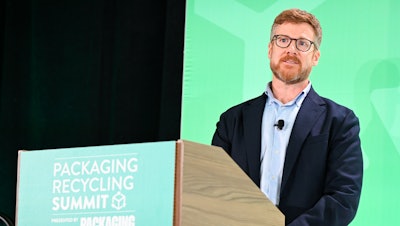
In his presentation at the conference, “Danone’s Packaging Portfolio Outlook for 2030,” company VP of Packaging Research & Innovation, Kory Nook, conveyed a clear message: The future of packaging lies in sustainability, and the stakes are high. “Our planet’s burning, and if we continue to do business the same way we have in years past, our planet’s going to keep burning, our business is going to keep eroding, and a lot of what we do ultimately will not suffice anymore,” he said.
Representing a company that ranks among the top global producers of plastic, Nook emphasized that Danone’s commitment to becoming more recyclable and sustainable by 2030 is not just a corporate goal but a necessity for survival.
 | Read this related article, “Live at PRS Day One: Insights from Coca-Cola and Danone, Plus EPR and Responsible Sourcing” |
Nook’s presentation was a blend of urgency and optimism, underscored by a reference to the “Nun Study” on cognition. This study, conducted at Notre Dame, revealed that despite having brain plaques and tangles typically associated with Alzheimer’s, the nuns remained mentally sharp due to their disciplined, community-focused lifestyle. Nook drew a parallel to the packaging industry, suggesting that a similar approach of discipline and community could help achieve sustainability goals. “My message today to everybody is essentially we need to start working that way,” he emphasized.
Danone’s 2030 strategy revolves around three main pillars: CO2 reduction, halving virgin fossil-based packaging, and ensuring all packaging is reusable, recyclable, or compostable. One of the significant challenges Danone faces is reducing Scope 3 emissions from packaging, which Nook said is the hardest to decarbonize. Scope 3 emissions are indirect greenhouse gas emissions (GHGs) that occur outside a company’s direct control but are still a result of its activities. For CPGs, Scope 3 emissions can include (upstream) GHGs from the sourcing, production, and transportation of ingredients and packaging, as well as (downstream) emissions from the logistics, use, and disposal of its products, including end-of-life treatment.
Explained Nook, the cost of reducing carbon in packaging is significantly higher than in other areas of the supply chain, making it a complex issue to tackle. However, he stressed, putting the consumer at the center of these efforts is crucial.
“If we’re changing a pack to be more recyclable, lower weight, whatever, we’ve got to make it better for the consumer,” he said. “It has to be benefit-led, otherwise the consumer is going to have a harder time paying for it, or they’re not going to understand it, and it’s going to be pointless.”
Nook then unveiled some recent and soon-to-be launched packaging innovations. Following three years of R&D, Danone will soon be switching from sourcing high-density polyethylene bottles for its International Delight creamer to in-house blow-and-fill PET bottles, resulting in a 31% decrease in GHGs and an easily recyclable package.
Another notable initiative was its recent shift from a non-recyclable polypropylene yogurt cup with a PETG sleeve to recyclable PP cups with PP labels. This change allows consumers to recycle the entire package easily, aligning with Danone’s goal of making packaging more consumer-friendly and sustainable. PW