Ask Kyle Hastings how fast Sterling Contract Packaging can turn around a customer request, and he doesn't reach for a metaphor. He reaches for his phone.
"I can call Michael Collins in 60 seconds or less, and we could be having a conversation about what's the next steps," says Hastings, VP of operations at the Moore, South Carolina, co-packer. "I can walk downstairs and get with my entire group and have a meeting in five minutes."
That responsiveness has become Sterling's calling card. Over the last 30 years, Sterling has grown from an idea of three colleagues into a 205,000-square-foot operation with roughly 100 permanent employees, expertise spanning medical device packaging, over-the-counter (OTC) manufacturing, and private label fulfillment.
But size was never really the point; Sterling maintains its edge by staying lean while delivering like a company many times its scale.
Seeing an opportunity
Sterling was founded on the search for flexibility.
In 1996, a customer decided it no longer wanted to handle its own packaging and pushed the work onto its manufacturing partners. Three senior managers at that facility saw an opportunity.
Michael Collins, Sterling's VP of sales and marketing, describes the pitch the founders made: "What if we opened a packaging facility locally and managed all your domestic and foreign supply chains? Everything would be packaged domestically and give you a lot more flexibility."
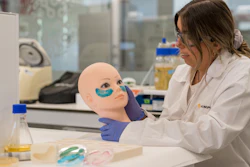
 Over-the-counter (OTC) drug manufacturing/packaging, and private label fulfillment make up a large piece of Sterling's contract mix.Sterling Contract Packaging
Much of that manufacturing growth traces back to a partnership with a large CPG brand, producing cold and flu products for a vaporizer line. At the height of the COVID-19 pandemic, Sterling churned out nearly 85 million single-use sachets and close to 4 million 8-ounce bottles of cold/flu products, more than double its typical annual volume.
The 'One PO' principle
If there's a single idea that defines Sterling's pitch to prospective customers, it's the promise to disappear into the background of a client's operation entirely.
"They just give us one PO for one price for one product," Collins says. "And we manage the entire supply chain until it goes out the door."
That means sourcing raw materials from Asia, Europe and elsewhere, managing supply agreements, and in most cases buying all the components to complete the finished product before it ever reaches Sterling's floor. Making that work requires every department in the building to move in step.
"It takes several areas of expertise to bring a successful turnkey package to market from engineering to procurement to production and shipping and receiving," Collins says in a video interview filmed for the public television series "All Access" (see sidebar). "All these groups must be in sync."
Some customers arrive already wanting that level of hand-holding. Others test the waters with a smaller SKU first.
"It evolves into the turnkey solution because they realize how quickly we can help them and take that burden off of them," Collins says.
Picking up work
Hastings sees the same pattern from the operations side, and traces it to a specific kind of customer frustration. Larger companies, he says, tend to hold onto their own supply chain management longer than makes sense, mostly out of institutional inertia. When they finally hand it over, the reaction is nearly universal.
 VP of Operations Kyle Hastings.
The Sterling team leans into that dynamic deliberately. Much of the staff, including Hastings himself, came from large corporations in chemical R&D, oil and gas and packaging engineering. That background gives them fluency in the language and expectations of big brands, paired with the flexibility of a much smaller organization.
"We are able to turn a project or turn a large quotation to a customer so that they can then communicate that to a large retailer," Hastings says, pointing to Costco and Walmart as examples of retailers that often demand a fast decision.
New business rarely comes from cold outreach. Collins credits strong relationships with material and equipment suppliers, built over his 25 years in the industry and his work as president of the CPA, The Association for Contract Packagers and Manufacturers. "A lot of it comes from word of mouth, quite honestly," he says.
Precision in the portfolio
Sterling's work with Devonshire, a Canadian supplier of iCloth cleaning wipes, shows what the turnkey model looks like when there is little margin for error. Airline pilots use iCloth to clean flight deck displays, tablets and flight-critical optical equipment, where touchscreen responsiveness and optical clarity directly affect performance.
 A roll of pouch wrapping material for iCloth wipes is ready for production.Sterling Contract Packaging
"As our customer base grew, it became important to find North American manufacturing partners that could consistently deliver products meeting very specific quality standards," says Peter Hartlen, president and CEO of Devonshire, in the same video.
For Hartlen, the requirement comes down to a single word: reliability.
"Each wipe must exactly match the one before it," says Hartlen. "Specific towel length, specific fill rates and seal integrity must be met for the product to work as intended."
Sterling packs each iCloth wipe in its own sachet for Devonshire, managing the entire supply chain.
Taking ownership
Consistency on the line is only part of the job. Whether the product is a cleaning wipe or a medical device, the package that carries it to market has to answer to more than one master.
 VP of Sales and Marketing Michael Collins.
Labeling, barcodes and safety requirements add yet another layer, he notes.
That work carries an unusual kind of responsibility, says Michael Hastings, one of Sterling's founders, president and CEO, and Kyle’s father. "We don't own any of these products, but we have to take ownership of that product in the development in making sure that it's always perceived as our customer wants it on the shelf," he says.
Weathering tariffs and labor shortages
Tariffs have hit contract packagers hard since early 2025, and Sterling has felt the whiplash directly. Collins calls these tariff swings "probably one of our biggest stumbling blocks." The volatility forced Sterling to track duties container by container as rates shifted dramatically.
Kyle Hastings recalls one shipment whose tariff rate fell in stages from 115% to zero after a Supreme Court ruling. Sterling passed most of the added costs on to customers, which Collins says was unavoidable for a company its size.
"There were some situations where people were abandoning full containers of product because the tariffs cost more than the value of the product inside the container," Collins says.
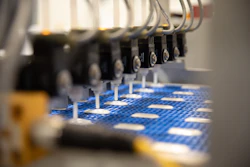
Labor presented a different kind of test. Labor costs have climbed sharply over the past decade, and hiring grew difficult in the years following the pandemic. Rather than lean harder on temporary staffing, Sterling invested in automation aimed at specific bottlenecks, not wholesale robotics.
Kyle Hastings says Sterling was forced to ask some tough questions.
"Can we design something that will remove a person, or is there a piece of equipment out there that will do the work of what's done manually by 16 people on a packaging line, but can be done with a piece of equipment that reduces it down to three?"
 A Sterling Contract Packaging worker assembles a kit. Sterling Contract Packaging
Nimble and focused
Collins and Kyle Hastings can both rattle off examples of that agility.
Collins recalls a procurement director at a large eye care CPG brand—someone who manages millions of dollars in sourcing relationships worldwide—telling him Sterling was the easiest supplier in her entire portfolio. In another instance, that same brand needed a tray former installed to build retail-ready trays for Costco and Sam's Club, but couldn't get the equipment in place fast enough internally. Sterling bought the machine itself and sold the output back on a per-piece basis.
"We did it, and it's done, and it's paid for, and it's just another success story," Collins says.
Kyle Hastings points to a similar dynamic with a large conglomerate CPG brand, a 20-year customer relationship. "The key thing for them… is that we continue to impress upon them that smaller companies like Sterling are more than capable of producing a result that is equal to or greater than something that a multibillion dollar company can do," he says.
That same appetite for moving quickly is shaping what comes next. Kyle Hastings says the company is exploring a move into niche, boutique cosmetics packaging, along with expanded manufacturing and development of single-use items. Collins adds that Sterling is building out manufacturing capability directly connected to its secondary packaging lines, allowing product to move from one side of the facility to the other without ever leaving the building.
It's a strategy built on the same idea that got Sterling started three decades ago: stay small enough to move fast, and let the results speak for themselves.