Speakers from P&G, Estée lauder, and WM offered insights on their own packaging recyclability strategies on Monday at the Packaging Recycling Summit in Rosemont, Ill. Here's what they had to say.
P&G strikes a cleaning and recycling balance
How are cleaning and recycling connected? For Teo Medellin, director, global corporate packaging sustainability at Procter & Gamble, innovation is the throughline. Teo Medellin, Director, Global Corporate Packaging Sustainability at Procter & GamblePackaging World
Technologies like LAZRmark, Flexloop, and dissolution apply P&G's core expertise in cleaning to the recycling stream. LAZRmark keeps contaminants out by eliminating inks and labels, while FlexLoop and dissolution pull contaminants back out through solvent.
"We create an idea. We draw from what we have learned from the world of cleaning. And then we find a partner that will help us develop it further," Medellin said. "From there, we participate in the scale-up, maybe sometimes as being one of the early adopters of the technology."
Estée Lauder Keeps Small Format, Swaps Materials
A major hurdle for companies like The Estée Lauder Companies in transitioning from small-format packaging is consumer expectations. (L to R) Matt Reynolds of Packaging World, Sarah Pamplona Santos of Closed Loop Partners, Scott DeFife of Glass Packaging Institute, Kenneth Laverdure of Estee Lauder CompaniesPackaging World
In a question that sums up how consumers want packaging that’s both practical and familiar, “Are we going to sell mascara in liter sized bottles?” asked Ken Laverdure, fellow, sustainability and material science at Estée Lauder, at the Summit Monday. Laverdure spoke alongside Sarah Pamplona Santos of Closed Loop Partners and Scott DeFife of the Glass Packaging Institute at the event.
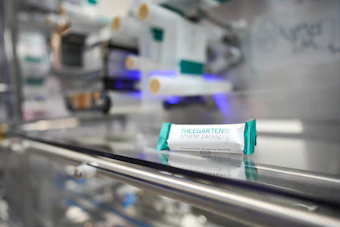
Laverdure pointed to Estée Lauder’s longstanding sample packs as an example of small-format packaging that’s difficult to redesign larger. Instead, the company swapped materials for a paper solution.
“We now have something that is flat, should move into the paper stream quite well, and meets the requirements of our paper recyclers," said Laverdure. "We’re meeting the APR guidelines, so as long as the equipment is playing well with us, that should get through the system."
WM invests in flexible film contamination solutions
Flexible plastic films can cause major problems for MRFs if they make it into the curbside recycling stream.  (L to R) Juliet Mathey of the Metropolitan Mayors Caucus, Jim Marcinko of WM, Christina Seibert of SWANCC, Walter Willis of SWALCOPackaging World
WM has spent $1.4 billion over the past four years to modernize its facilities, in part to more effectively separate films from other packaging to improve recycling rates, Marcinko said. The investment helps to instill confidence in brands that their packages are truly recycled.
"We’re able to design facilities to deal with some of the historical contamination we saw that was more problematic," Marcinko said. "Newer machinery does a lot more precision sorting using vision technologies and AI. That’s how we’re trying to capture more materials and have less contamination issues."