One of the longstanding assumptions in packaging sustainability circles is that consumers reward recyclable packaging with their purchasing decisions. After all, they often say that they prefer more sustainable packaging options, and brands have responded.
New research being presented for the first time at the Packaging Recycling Summit suggests the reality may be more complicated.
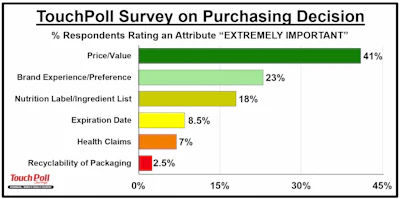
In a national consumer survey conducted by TouchPoll Surveys and Circular Ventures, respondents were asked to rank packaging recyclability alongside factors such as price, brand preference, nutrition information, health claims, and expiration dates when making a purchase decision. The findings suggest that while consumers continue to express support for recycling and sustainability initiatives, recyclability may rank lower than many industry stakeholders expect when shoppers are forced to prioritize among competing purchase drivers.
That doesn't mean recyclable packaging isn't important. Brands still face growing regulatory requirements, EPR obligations, retailer expectations, and corporate sustainability commitments. But the findings may offer valuable insight into how consumers balance sustainability considerations against factors such as price, value, and product information at the shelf.
At the Packaging Recycling Summit, Myles Cohen of Circular Ventures and Lanie Shapiro of TouchPoll Surveys will share the study's findings, demographic breakdowns, and recommendations for packaging communication and design. Whether the results confirm your assumptions or challenge them, they are likely to spark an important conversation about how sustainability, consumer behavior, and packaging strategy intersect.
What follows is an early snapshot of the findings, delivered to me via press release (below) to be presented in Chicago in a few weeks. I'm presenting this data as provided, for our Packaging World readers and Packaging Recycling Summit attendees to reference and consider. - Matt Reynolds, Packaging World magazine
For more info and to register to attend: https://www.packagingrecyclingsummit.com
Study: When Deciding Which Grocery Item to Purchase, Packaging Recyclability is Unimportant
National survey of 650 consumers finds price and nutrition dominate the choice of product purchased, recyclability trails by a mile.
By Myles Cohen, founder of Circular Ventures, LLC, and Lanie Shapiro, principal at TouchPoll Surveys
A new report from Circular Ventures and TouchPoll Surveys revealed an uncomfortable truth about how consumers value the recyclability of packaging: They don’t.
Across gender, political affiliation, education level, and income, consumers consistently ranked the recyclability of a package as the least important factor when standing in a store aisle and making a decision.
However, environmental sustainability in packaging is still important, for a myriad of other reasons, such as EPR compliance, so manufacturers of packaged goods need to carefully evaluate what outcome they are trying to achieve — and realize it should not be to gain market share.
The survey asked 650 consumers nationwide to rank six attributes of a purchasing decision in order of importance: Recyclability of package; price and value; nutrition label and ingredient list; brand.
- A mere 2.5% of survey respondents ranked “recyclability of package” as the most important factor in making a purchasing choice.
- 69% of consumers chose “price/value” as their first or second-most important factor when making a purchasing choice.
The data shows that the vast majority of consumers want the products they love at the best value and lowest price. Consumer confidence that packaging labeled "recyclable" actually gets recycled is mixed. Nearly half of respondents (47.9%) said they are unsure, while 27.0% are not at all confident and 25.1% are very confident, indicating considerable uncertainty about the effectiveness of the recycling system.Circular Ventures/TouchPoll
The Catalyst
Both of us are passionate about recycling, but we are also realists. We do NOT believe that recycling is a hoax, as it has often been portrayed by (Elon Musk,1 NPR,2 ABC,3 The Guardian4 and PBS.5) However, we also don't see it as a fail-proof solution that is going to build brand equity, grow revenue, and steal market share.
The Recycling Partnership’s 2024 State of Recycling Report found that of those households with automatic access to recycling collection service, only 59% use it,6 and of all U.S. households, only 43% participate in recycling.7 Overall, only about 21% of recyclables that could be collected curbside are collected.8 This survey gives TRP’s report a tremendous amount of credence.
A 2025 McKinsey report found that the importance of environmental impact to consumers has stagnated or declined since 2023. Environmental impact ranks among the bottom three characteristics across the 11 countries the report included, while price and quality were the most important.9
That only increased in McKinsey’s latest report, which noted: “price and quality are now the most important product characteristics that influence consumers’ purchasing decisions, with price even more important when compared with previous years.”10
A November 2025 report from WM, previously known as Waste Management, further explored the “say-do” gap, finding: “recycling action took place far less often than what was reported in survey data.”11
Another recent survey from York University found that of 617 households in Canada and the United States, the main challenge facing a circular economy is a “profound public deficit of trust and structural transparency,” and that less than 10% of those surveyed believe that consumer brands “genuinely care about waste reduction.”12
That tension over recyclability boiled over at the 2025 Packaging Recycling Summit in Irvine, Texas13 and at The Packaging Conference in February, when a speaker said sustainability tactics are “failing.”14
In response to the dismal curbside collection statistics, TouchPoll Surveys, a national, experienced, and unbiased firm, carried out independent market research to either confirm or dispel the other studies.
Survey Parses Consumer Intent and Behavior
Many studies ask respondents if they believe recyclability is important and if they believe in recycling, and the overwhelming majority says they do – but as The Recycling Partnership’s 2024 State of Recycling report15 proved out, belief and action are not aligned. We wanted to drill down into behavior versus intent.
Recyclability of packaging ranks lowest everywhere, even among those who recycle often or are confident in their recycling habits.
Price/value and nutrition label information consistently dominated purchasing decisions, regardless of demographics, lifestyle, or beliefs. Nearly 70% of consumers ranked price/value as extremely or very important to them.
Regardless of the trust and confidence level consumers have in the recycling system, which we detail in our full report, the recyclability of the packaging still comes in last in importance when consumers make a purchasing decision in front of the shelf.
While the recyclability of packaging is clearly not a main driver in the consumers’ decision to purchase a product, we obviously cannot abandon our packaging sustainability initiatives. However, we must rethink our priorities for sustainability in packaging. Our full report, which will be released at the end of June 2026, will provide recommendations for the ideal approach to communicate on package recyclability information.
To reserve a copy of the full report for the end of June release date, email [email protected]. There will be a nominal fee to download the full multi-page report, which you will have the option to approve in advance.
Footnotes
1“Is recycling worth it? Not according to the world’s richest man, Elon Musk.” The Independent Dec. 26, 2024
2“How Big Oil Misled The Public Into Believing Plastic Would Be Recycled” by Laura Sullivan. Published on NPR Sept. 11, 2020.
3“Greenpeace report finds plastics recycling is a dead-end street” published by ABC News Oct. 27, 2022.
4“Recycled plastic can be more toxic and is no fix for pollution, Greenpeace warns” by Damien Gayle. Published in The Guardian May 24, 2023.
5“The plastic industry knowingly pushed recycling myth for decades, new report finds” by Ali Rogin and Andrew Corkery. Published by PBS March 16, 2024.
6The Recycling Partnership’s 2024 State of Recycling Report. Page 17.
7The Recycling Partnership’s 2024 State of Recycling Report. Page 17.
8The Recycling Partnership’s 2024 State of Recycling Report. Page 23.
9McKinsey & Company report: Sustainability in packaging 2025: Inside the minds of global consumers. Published June 24, 2025.
10McKinsey & Company report: No ordinary disruption: State of the packaging and paper industry. Published April 8, 2026.
112025 WM Recycling Report. Page 3.
12Calvin Lakhan. “I don't trust you: Only one in four people believe that what we put in the bin gets recycled.” May 20, 2026
13“Policy tension over on-pack recyclability labeling ‘needs to get worked out’” by Katie Pyzyk. Published in Packaging Dive July 14, 2025.
14“Packaging sustainability is ‘failing.’ Or is it?” by Katie Pyzyk. Published in Packaging Dive February 12, 2026.
15The Recycling Partnership’s 2024 State of Recycling Report. Page 17.