The Plant Vitality Index, or PVI, is a proposed scoring system that measures plant condition and readiness alongside traditional ROI calculations, helping manufacturers justify automation investments by capturing benefits across multiple departments that standard payback periods often miss.
- Traditional 12-month payback periods often fail to capture shared benefits across operations, maintenance, HR, and sustainability teams
- The PVI scores plants on a 0-100 scale across six categories: asset health, automation and agility, digital integration, workforce readiness, sustainability, and maintenance maturity
- Proposed scoring ranges: below 50 (fragile), 50-69 (stable), 70-84 (strong), and 85-100 (best in class)
- Projects are prioritized when payback is under 24 months and vitality score improves by at least 10 points
- Schneider Electric's Christine Bush plans to develop the PVI into a standardized tool through A3, the Association for Advancing Automation
Automation proposals often begin with an obvious problem on the plant floor and end with a single number in a capital request. When approval depends on a 12-month payback, projects that could improve throughput, quality, safety, or flexibility may struggle to move forward.
Christine Bush believes manufacturers need a second measure alongside standard ROI. Her proposed Plant Vitality Index, or PVI, would score the condition and future readiness of a plant or production line, giving operations and finance a common way to evaluate automation investments.
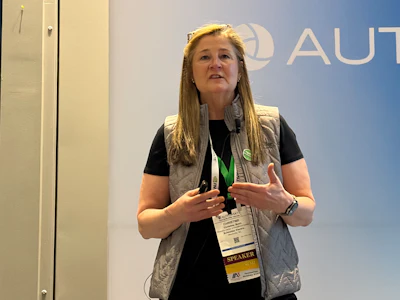
Bush, director of Schneider Electric’s Robotics Center of Excellence, introduced the working concept at Automate 2026 in Chicago in June. A3, the Association for Advancing Automation, produced the show, and Bush said she plans to bring the idea to A3’s Motion Control & Motors technical board for further development.
A 12-month payback can miss shared benefits
During her career, Bush said she’s watched manufacturers’ payback expectations shrink. A 36-month period eventually moved toward 24 months, and she now hears frequent demands for automation projects to pay for themselves in one year, a target she described as very aggressive.
The calculation becomes harder when one department funds the equipment while benefits appear elsewhere in the organization. Operations may gain throughput, maintenance may see less downtime, HR may experience lower turnover, and sustainability teams may reduce energy use or waste.
“A lot of the times one department is paying for it, while other departments are reaping the benefits of it,” Bush said.
Those divisions can leave the department funding the project with an unfavorable calculation, even when the company receives a substantial overall benefit. Bush urged teams to discuss how both project costs and benefits are distributed across operations, engineering, maintenance, finance, HR, and other affected groups.
Traditional calculations tend to capture labor savings and other direct financial gains. Bush said the business case should also consider scrap reduction, warranty claims, downtime, overall equipment effectiveness, energy consumption, safety, flexibility, data availability, predictive maintenance, sustainability, and digital transformation.
Some of those gains are difficult to convert immediately into dollars, but they may support corporate goals or improve the plant’s ability to respond to changing demand.
Flexibility can be particularly relevant for CPG operations. Bush pointed to smaller beverage cans and snack bags, changes in beauty product ingredients, and changeovers between bottle or bag sizes as examples of consumer-driven variation that production equipment must accommodate. Automation can help manufacturers make those changes with greater consistency and less disruption.
Build the case from operating data
Bush’s framework begins with finding processes that have high labor content, repetitive or difficult jobs, safety risks, quality variability, or high energy intensity. Teams can then quantify labor efficiency, throughput, quality, energy use, and risk reduction using operating data from the plant.
The next step is to compare current and future operating states. That analysis should account for changes in production volume, staffing, quality, costs, and other variables under both conservative and aggressive assumptions.
Consistency matters because the performance of one automation project can influence how executives judge the next proposal. A project considered unsuccessful can bring added scrutiny to later requests, even when they address a different process or need.
Bush also recommended sensitivity analysis to show how changes in labor rates, energy costs, and production volume affect projected results. Assumptions should be visible so finance and operations can understand how the model reached its conclusions rather than adjusting calculations simply to achieve a required payback period.
Add a vitality score
The proposed PVI would measure the current health and readiness of a plant or individual production line. Bush suggested scoring asset health and modernization, automation and agility, digital integration, workforce readiness, sustainability performance, and maintenance maturity.
A line-level assessment could include OEE and throughput, downtime and maintenance, energy and material waste, worker productivity and safety, connectivity and analytics, and changeover flexibility. Plants with several lines could score each one separately, helping leadership identify where modernization is most urgent.
Bush’s proposed scale runs from zero to 100. Scores below 50 fall into a fragile range, scores from 50 to 69 are stable, scores from 70 to 84 are strong, and scores from 85 to 100 are considered best in class.
In a hypothetical example shared by Bush, a line had a current vitality score of 54 and a target of 80. The 26-point gap showed how far the operation needed to move in areas such as reliability, sustainability, workforce readiness, digital capability, and agility.
Bush’s initial decision model classified a project as a high-priority candidate when its payback was under 24 months and it raised the vitality score by at least 10 points. The score could also support smaller modernization projects by showing how automating one machine improves a weak line, even when replacing the complete line isn’t feasible.
Turn the concept into a standardized tool
Audience questions focused on how to prevent the PVI from becoming a subjective score that varies from one company or evaluator to another. Bush agreed that the categories and scoring system will need measurable definitions before manufacturers can present the model confidently to executive management.
“We need to harden this,” she said. “We need to make it more tangible and objective so when we put it out on the website for you to use and for you to introduce to executive management, you’ll get that immediate buy-in.”
The audience suggested additional inputs, including maintenance labor and parts costs, cash flow, training and onboarding, and the competitive risk of delaying automation. Bush also proposed using data generated by the equipment to track energy consumed per unit, annual throughput, and changes in maintenance needs as a machine ages.
 Bush’s proposed dual-lens approach evaluates automation projects through both financial return and their contribution to plant modernization, business growth, and other corporate priorities.Christine Bush, Schneider Electric, recreated with AI
She wants A3 to help develop a standardized calculator rather than leaving each manufacturer to create its own scoring system. Bush said she planned to bring the concept to the A3 technical board in August and encourage the association to refine it into a tool that manufacturers, OEMs, systems integrators, and consultants could use consistently.
The financial calculation would remain part of the decision. The PVI would add a structured way to document plant conditions, modernization needs, and corporate priorities that may not appear in a conventional payback model.
Bush said that broader view could help plant teams explain why an automation project deserves consideration even when the immediate return doesn’t fit a narrow approval threshold. “I know I’ve been disappointed when the financial controller has said there’s not the return on investment, knowing at the plant floor we need to do something because we’re struggling,” she said. “This is a way to get there.” PW