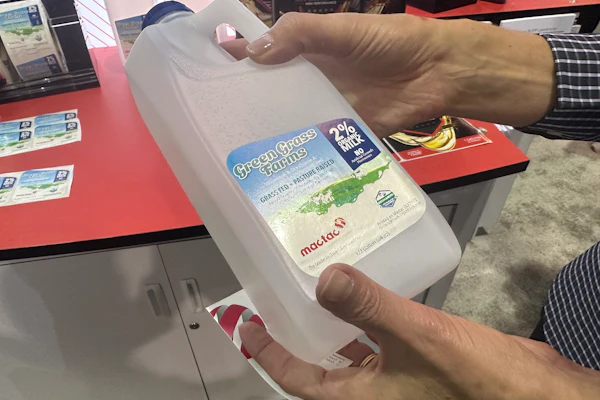
A new label film from Mactac, aimed at replacing paper on dairy packaging, points to a broader pattern showing up across multiple suppliers at Loupe Americas. With brands' being under the spectre of EPR fees, converters and their suppliers are engineering pressure-sensitive labels that they purport will stop interfering with the recycling of the rigid HDPE and PET containers they're applied to. The approaches split into two distinct camps.
Stay on and blend in
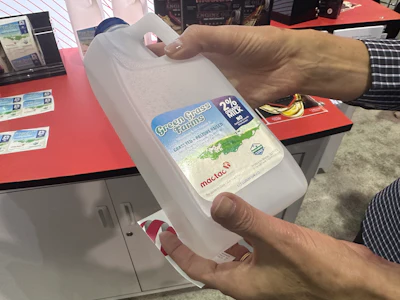
Mactac's new Vivid Edge film, debuted at the show, is a two-mil, semi-cavitated white polypropylene facestock. Specific to dairy, existing paper labels wick moisture from cold, condensation-covered milk jugs and can make the product look old or dirty on shelf to a browsing consumer, even when it isn't. According to Kim Hensley, senior marketing manager for Mactac's Prime Films/Roll Label business, the film resists wicking entirely while also addressing paper's incompatibility with HDPE recycling.
The film has earned Association of Plastic Recyclers (APR) recognition for compatibility with natural and pigmented HDPE containers. That recognition doesn't mean the label separates out and gets recycled on its own. Quite the opposite in fact. Polypropylene and HDPE are close enough in density that they wouldn't sort apart in a typical float/sink recycling step. Instead, the label and its hot-melt adhesive are designed to stay attached through grinding, blending directly into the reclaimed HDPE resin at a level APR's testing confirms won't degrade the recovered HDPE material's quality.
Though not a focus item at its booth, where advances in smart packaging via RFID inlays and 2D codes took the spotlight, it's worth noting that Avery Dennison has separately validated the same underlying mechanism. The company's clear and white BOPP and MDO film facestocks, paired with any of its hot-melt adhesives, received APR Critical Guidance recognition confirming the labels "remained in place without impacting the HDPE recycling process." This appears to be the same stay-on, blend-in approach as Mactac's dairy film, extended across Avery Dennison's broader HDPE-compatible film portfolio.
Mactac's dairy film is already in market in a private-label capacity, according to Hensley. Though no brand owner has been named publicly, that may change at PACK EXPO International this fall, where Mactac will be presenting with its converter partner.
Separate and wash off
UPM takes the opposite approach with its ProCycle portfolio, covering rigids in both PET and HDPE packaging across beverage, food, and home and personal care applications. According to UPM, ProCycle labels "separate cleanly during grinding and washing, supporting high-quality recyclate." That means the label is designed to physically detach from the container during processing rather than blend into it. Several ProCycle products carry "wash" directly in their names, and the line is externally recognized by RecyClass.
UPM also points to a second, earlier-stage sustainability claim for the same adhesive technology. Using its RW85C wash-off adhesive together with a PET liner made partly from post-consumer recycled content, rather than a virgin PET liner, the company's own lifecycle assessment shows meaningful reductions in primary energy demand, water consumption, and CO2e on a cradle-to-gate basis. So according to the company, the savings are counted through manufacturing, not across the label's full life in use and disposal. Regardless UPM's wash-off mechanism and its recycled-content manufacturing are two separate, stackable claims, not the same one restated.
Speaking of recycled content...
Recycled content, a separate story
Other material suppliers at Loupe Americas are pursuing a related but distinct sustainability claim by putting recycled content into the label materials themselves, rather than engineering the label to be compatible with the container's own recycling stream. Chiripal Poly Films is showing facestock and release liner products incorporating up to 40% PCR polypropylene and up to 90% PCR PET content. That means the recycled material shows up on both sides of the label construction, not just the printed facestock. Polyart Group's r-Polyart line uses 30% post-consumer recycled content in its facestock and, according to the company, prints and performs like virgin material.