At Loupe Americas today, label suppliers Innovia Films and Taghleef Industries are independently showing versions of the same idea a few aisles apart. It's a shrink sleeve engineered to float, solving several market needs at once.
The problems they're solving for start with a packaging trend already visible in any dairy aisle. Brands are moving light-sensitive products like milk, kefir, plant-based dairy, and nutritional drinks out of opaque HDPE bottles and into clear PET, which shows off the product and looks more premium on shelf. The trend isn't limited to light-sensitive products, of course, but by leaving opaque HDPE for clear PET, dairy and similar contents still need protection from light. So the bottle depends even more on nearly full-coverage opaque shrink sleeves to do the job the HDPE resin used to do on its own.
That creates a recycling problem. Conventional shrink sleeves are made from PET-G, which has close to the same density as the PET bottle itself. At the material recovery facility, PET bottles go through a sink/float step that separates plastics by density, but PET-G doesn't reliably separate from PET, so sleeve material and its printed ink end up contaminating the recycled PET stream. While PET-G is still PET, it's not desirable for blown PET bottles, so PET-G may contaminate a bale and disallow it for true 'bottle-to-bottle' circularity.  A demonstration at Innovia's booth shows shredded PET and label material separating by density in water — recycled bottle flakes sink, the lighter polyolefin sleeve material floats to the top. RayoFloat APO-HS (clear) and White (WAPO) sample bottles sit in front of the tank.
One approach
Innovia's RayoFloat line addresses this with a polyolefin-based sleeve engineered to be lighter than PET, so it floats away cleanly in that same sink/float step already running at essentially every PET reclaimer. It requires no new equipment, and importantly, no solvents. The line now comes in three variants--a clear film (APO), a white opaque film for light-blocking (WAPO), and a high-shrink version (APO-HS) for more complex bottle shapes.
Innovia's Marika Knorr framed the regulatory backdrop pushing this forward as producer-responsibility programs mature: fees for harder-to-recycle materials are already there in Europe, and are coming in the U.S. Colorado's own EPR fee structure took effect in January 2026 and does charge higher dues for less-recyclable material combinations, which gives that framing some real footing — though Innovia's own team acknowledged that the specific cost comparison between a clear-PET-plus-polyolefin setup and an HDPE-plus-PETG one still requires a brand's own case-by-case analysis, not a fixed number they could point to. Innovia's technology has been in the European market for roughly five years, driven by EU packaging rules; the company describes US adoption as real but early, dependent on which recyclers are equipped to handle it.
Another approach
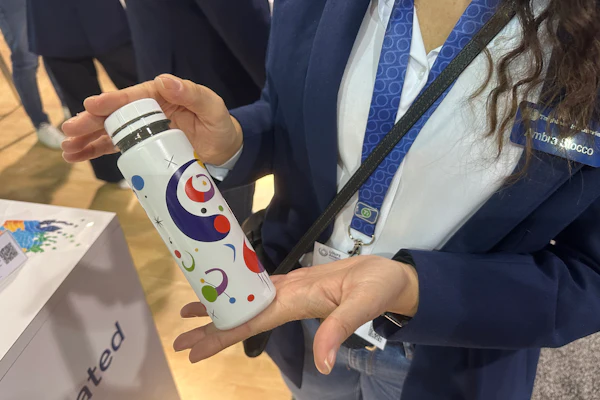
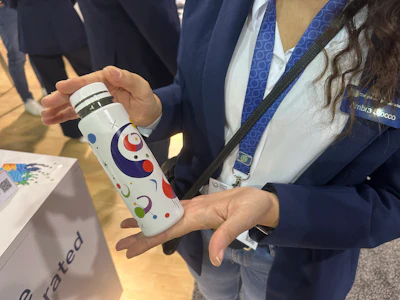
Taghleef's version, SHAPE360 TDSW, is a new white polyolefin shrink sleeve aimed at the same light-sensitive categories. Taghleef's Ambra Stocco confirmed the film is built for exactly the scenario driving this shift: dairy beverage brands moving from opaque HDPE to clear PET, which then need the sleeve to do the light-blocking work the old bottle resin used to do.
No U.S. brand owner has adopted the film yet, but it's in the mail. "We are starting," Stocco said. Anecdotally, she has seen white shrink sleeves on clear PET bottles of soy sauce in European retail, specifically Italy, suggesting the light-blocking need extends beyond dairy. Taghleef's SHAPE360 TDSW is a white shrink sleeve film designed to separate cleanly from clear PET bottles during recycling while providing light protection for dairy beverages and other perishable products.
A different angle: ink instead of film
A few booths away, Inx International is tackling the same contamination problem from the opposite direction. Its Genesis line is a washable, floatable ink system for shrink sleeves. Rather than changing the film itself, it's built so the printed ink separates cleanly during recycling even on a conventional sleeve. Film chemistry and ink chemistry, aimed at the same recycling-contamination problem from two different points in the material stack.