These innovations highlight new and different innovations that are hitting the market.
Learn more about ThePackHub's Innovation Zone here.
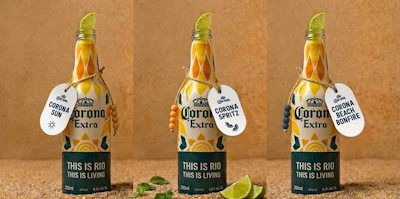
Corona's beach-inspired aluminum beer bottle returns for large-scale release
Corona, owned by Ambev and based in São Paulo, Brazil, is reintroducing its limited-edition aluminum beer bottle for a wider commercial release in Rio de Janeiro, Brazil. The reusable-style “alu bottle” was developed specifically for beach-side consumption, particularly in locations such as Copacabana where glass containers are prohibited for safety reasons. The packaging retains the familiar long-neck bottle shape associated with the brand while replacing glass with lightweight aluminum, allowing consumers to continue the ritual of inserting a lime wedge into the neck of the bottle. The design references Rio’s beachfront culture and is intended to function both as beverage packaging and as a collectible souvenir linked to the city. The aluminum bottle is now being distributed more broadly through kiosks and street vendors during major public gatherings in Rio. From a packaging perspective, the format combines portability and durability with reduced breakage risk in outdoor and high-traffic environments. Aluminum also provides rapid cooling properties and strong barrier protection against light and oxygen, which can support product preservation during outdoor consumption. The bottle’s structure appears to maintain compatibility with existing single-serve beverage handling and transport systems while offering an alternative premium packaging format to conventional cans and glass bottles.
 The construction consists of more than 50 individual components, developed across eight material systems and manufactured using eight distinct processes. ThePackHub
Jack Daniel's bottle packaging inspired by Formula 1 halo structure
Hunter Luxury, a packaging design company based in London, United Kingdom, has collaborated with Jack Daniel’s, and the McLaren Formula 1 Team to create the Halo MK1 packaging format. The design is based on the Halo cockpit safety device introduced in Formula 1 in 2018, translating its structural geometry into a display-oriented packaging concept. At the center of the structure, a 1 liter (1 L) bottle is suspended at its center of mass using a balanced engineering approach intended to create a floating effect while maintaining stability. The pack incorporates a concealed push-button mechanism positioned beneath branding elements, enabling controlled release of the bottle, with acoustic dampening included to regulate the motion and reduce noise during operation. The construction consists of more than 50 individual components, developed across eight material systems and manufactured using eight distinct processes. These include CNC-machined aluminum structural elements, die-cast aluminum subframes, injection-moulded high-performance polymers, and Alcantara-style internal linings, combined with electrophoretic coating to achieve a consistent matte aluminum surface finish. The exterior incorporates a carbon fiber-inspired texture alongside McLaren’s Papaya orange accents, reinforcing the motorsport design reference. The packaging is positioned primarily as a display and collector-focused format, with emphasis placed on material complexity, mechanical precision, and controlled user interaction rather than conventional distribution efficiency.
 The project was designed for larger bottle multipacks containing 20 or 24 units.ThePackHub
Carlsberg introduces rounded multipack design for beer bottles
Carlsberg, headquartered in Copenhagen, Denmark, has introduced a new cardboard multipack format with rounded corners for bottled beer products in Poland, developed in collaboration with DS Smith, based in London, United Kingdom, and KHS, headquartered in Dortmund, Germany. The packaging format, known as DS Smith Round Wrap, is based on SCA’s patented Arcwise technology and replaces conventional square-edged wrap-around cartons with curved edges. The project was designed for larger bottle multipacks containing 20 or 24 units, a common format in the Polish market for brands such as Carlsberg, Garage and Somersby. According to the companies, the rounded structure is intended to improve shelf visibility while also changing the visual appearance of the packaging. The development also focused on reducing material use and lowering the associated carbon footprint compared with traditional carton formats. The companies stated that the curved design may also reduce the likelihood of damage during transportation by distributing pressure differently across the pack structure. A key aspect of the project was ensuring compatibility with existing filling and packaging lines. KHS assessed Carlsberg’s current machinery and identified that the KHS Innopack Kisters WP Advanced system already installed at the production site could process the new format without significant modifications or additional capital investment.
Learn more about ThePackHub's Innovation Zone here.