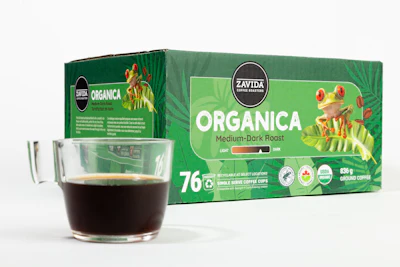
On the shelf at Costco, you may see a coffee box with a green tree frog printed on it, perched on a leaf so finely rendered it looks like it could be behind glass. It may seem like an odd amount of visual ambition for a corrugated shipper, but for Zavida Coffee Roasters, that's the point.
The Concord, Ontario-based brand chose that image deliberately not only to tell its story of its sustainable product but also to make a technical point about the packaging: that a plain corrugated shipper box, printed directly and without lamination, could hold color and detail as well as anything wrapped in glossy film.
That box also represents another bold move for the coffee roaster: its first entry into Keurig-compatible pods at Costco, a 76-count format built from the ground up. It's not a redesign or a new label on an old structure but an entirely new package, in format, size, and graphics, developed for a single limited-time run.
"This was an 'in-and-out' program, so timing was critical to capitalize on the opportunity," says Adi Montas, marketing commercialization manager at Zavida Coffee Roasters. "We needed a solution that allowed us to move quickly without compromising quality, visual impact, and brand equity."
Zavida Coffee Roasters had an established track record to build on. Coffee, in whole bean form, has anchored the family-run roaster's business for more than four decades, and its 2-lb whole bean bags of Organica coffee had already earned strong recognition at Costco for quality and sustainability.
 The 2-lb resealable stand-up pouch is where Zavida Coffee Roasters' Organica brand story started — and what the new box for coffee pods had to translate.Zavida Coffee Roasters
But whole beans and single-serve pods are different purchase decisions, made by different shoppers, often in a matter of seconds. Zavida Coffee Roasters had no packaging precedent to lean on, no legacy format to riff off of, and no time to spare.
Corrugated gets the job done
For established products, packaging often just needs to confirm what a shopper already expects. But for a brand-new format, the pack has to do most of the persuading itself.
"With whole beans, there's already familiarity: 'The coffee in the green bag,'" Montas says. "With pods, especially at Costco where decisions are made quickly, the packaging had to clearly communicate format, compatibility, quality, and brand values all at once, so now the consumer could say, 'the pods in the green box.'"
The shipper box needed to signal continuity with a trusted brand while introducing something the brand had never sold before. Green, in this case, does double duty: it reads as organic and sustainable, and it's the visual thread tying the new pod box back to the familiar whole bean bag on the shelf nearby.
Corrugated board turned out to be the material that could do all of the above. "Corrugated gave us the ability to combine functionality, sustainability, and brand storytelling in one structure," Montas says. "Instead of layering materials, we could simplify the package while still delivering strong visual impact."
The approach also matched what Costco wanted operationally: a dual-purpose structure built to move efficiently from pallet to floor and function as its own retail display without a secondary merchandising unit.
Betting on digital printing
As with any packaging decision, this one carried a real business calculation. For Zavida Coffee Roasters, this was less like a permanent line extension and more like a live market test, and that changed what kind of production process made sense.
"Traditional methods would have required longer lead times and higher upfront commitments," Montas says. "That would have reduced our flexibility and increased risk, especially for a new format and test launch."
For Zavida Coffee Roasters, the solution was digital printing, which removed the two variables that usually make new packaging formats expensive and slow: plates and tooling. "It changed everything," Montas says. "It reduced risk and allowed us to align production more closely with actual demand."
That flexibility came from Zavida Coffee Roasters' packaging partner, Atlantic Packaging Products — a privately owned, family-led Canadian packaging manufacturer that has grown since its 1945 founding as a small Toronto converting plant into a fully integrated producer of corrugated, flexible, and paper-based packaging, with more than a dozen facilities across Canada and the U.S.
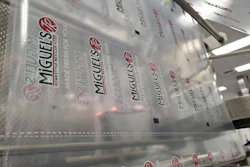
Atlantic produced this particular box at one of its Ontario plants, on a Koenig & Bauer Durst SPC 130, a single-pass digital press the plant installed in 2023. Anthony Memme, Atlantic's digital print manager, says Atlantic made the investment with exactly this kind of program in mind.
"This high-speed, single-pass press, powered by water-based inks, enables us to deliver high-quality, high-graphic corrugated packaging with unmatched efficiency and consistency," Memme says, "helping our customers bring products to market faster and smarter."
Without plates to produce, mount, and register, jobs can move from finished file to printed box in a fraction of the usual lead time. For a program built around a narrow retail window, that speed wasn't a nice-to-have; it was the reason the format was viable at all.
Solving for the frog
Here's where the tree frog earns its place on the box. Printing rich, photographic detail directly onto uncoated corrugated is a hard technical problem. The board is absorbent by nature, and ink tends to soak in unevenly, leading to dull colors and soft, mottled images instead of crisp ones.
"The challenge was achieving rich color, fine detail, and tonal depth on an uncoated surface that naturally absorbs ink, typically causing dullness and mottling," Memme says.
Durst's digital primer technology solved it, laying down a controlled surface ahead of printing so ink sits where it's meant to instead of spreading. The result, Memme says, is "color accuracy and clarity that rivals, and often surpasses, conventional print."
 The top panel of the Organic shipper case showcases the rich color, fine detail, and tonal depth Zavida and Atlantic achieved on an uncoated surface through digital printing.Zavida Coffee Roasters
From Memme's perspective, more brands are recognizing the potential of corrugated packaging as a primary branding surface.
"It's no longer just about protection and functionality; corrugated has become a powerful canvas for storytelling and brand differentiation," he says. "As corrugated packaging becomes increasingly consumer-facing at the point of purchase, especially in retail environments like Costco, Walmart, and other club stores, it is no longer viewed as just a shipping medium."
Choosing the material paid also off in a another way: the simple, mono-material structure, without extra labels or laminated layers, is also easier to recycle, which is important for a brand built on sustainability. "Direct digital print on corrugated has a positive impact on material usage, recyclability, and overall production waste," Memme says.
A test worth repeating
Montas says the program has already validated itself in the way club retail is best suited to validate anything: fast, visible, real-world feedback. "The package stands out on the floor and communicates the brand clearly. Retail partners appreciated the efficiency, and consumers responded well to the look and feel," she says.
The shipper with the little frog also caught the eye of others: the project went on to win Best in Class at the 2026 PAC Global awards in the Technical category for package innovation design. It's an external recognition of a packaging decision that started as an internal bet on timing and flexibility.
 Adi Montas, marketing commercialization manager at Zavida Coffee Roasters (left), accepts the Best in Class PAC Global Award in the Technical category for package innovation design at the 2026 PAC Global Awards.Atlantic Packaging Products
"It's changed how we think about packaging, not just as a cost, but as a strategic tool for innovation and growth," she says.
She's already thinking about where else the same playbook could apply. "There is definitely potential to expand," she says. "The combination of flexibility, speed, and sustainability makes this approach very attractive for other products and channels."
But none of the success, Montas says, happened in isolation. The format only worked because the packaging technology could keep pace with the business decision to move fast. "Partnering with both Atlantic and Costco to bring this to life. One cannot happen without the other," she says.