Commercial composting facilities collect organic waste from businesses and transform it into finished compost through a 30- to 45-day microbial breakdown process, creating valuable soil products for farmers and landscapers while diverting waste from landfills.
- Collection process: Food waste is mixed with wood material and placed in aerated piles that reach 150-180°F within 48 hours to accelerate decomposition
- Timeline: The breakdown process takes approximately 30 to 45 days from collection to finished compost
- Compostable packaging: Facilities designed to accept compostable serviceware reduce sorting complexity for commercial customers like restaurants and universities
- Scale: The Compost Company diverts 35,000 to 40,000 tons annually in the Nashville area, with potential for significant growth
- End products: Finished compost is sold in bulk to farmers, contractors, and landscapers, supporting soil health and circular economy systems
As part of the annual SPC Impact conference in Nashville this week, the Sustainable Packaging Coalition hosted a tour today of The Compost Company, a local business focused on keeping food waste out of landfills and turning it into compost, soil blends, and mulch.
The company has been operating in Middle Tennessee since 2012, collecting organic waste from commercial sources and processing it into products used by farmers, landscapers, and contractors. Its model is built around that circularity, with material coming in from businesses and leaving as finished compost. Collection is limited to commercial customers such as restaurants, universities, and venues. It’s not a curbside residential service, although residents can participate through drop-off or partner programs.
“Right now we are on track to probably do somewhere in the neighborhood of 35 or 40,000 tons this year, but that's a small drop in the bucket compared to what could be diverted just in the Nashville area alone,” said Clay Ezell, co-owner, collection and business development.
 Waste haulers unload collected food scraps and compostable materials at The Compost Company, where the material is then mixed with wood waste and prepared for grinding before entering the active composting process.Packaging World
On site, food waste is mixed with wood material to create the right balance for composting, then placed into aerated piles. The breakdown process takes about 30 to 45 days. During that time, microbial activity generates significant heat. Piles can reach between 150° and 180° F within the first 48 hours, which helps break down both food waste and compostable materials.
The business is structured to make composting workable for customers. The company runs route-based collection and tries to keep pricing close to standard waste hauling rates. “We want to make sure that we're not penalizing anybody for doing the right thing,” Ezell said. Revenue from selling finished compost helps offset those collection costs.
 Clay Ezell, co-owner of The Compost Company, speaks during a tour at SPC Impact in Nashville, where he emphasized the role of composting in waste diversion, noting, “Our reason for being is to keep material out of the landfill that otherwise could be composted.”Packaging World
One of the more notable aspects of the operation is its willingness to accept compostable packaging. Many composting facilities avoid these materials because they can introduce contamination or require additional processing. Here, the system is designed to take them.
That decision is closely tied to how its customers operate. Compostable serviceware makes it easier for businesses to divert food waste without requiring complex sorting systems. “A lot of our customers wouldn’t be composting at all if they couldn’t use compostable packaging,” Ezell said.
In practice, sorting still depends on how quickly people can recognize what goes where. Ezell emphasized the need for compostable packaging to be easily identifiable, noting that most people only spend a moment deciding where something goes, especially in busy environments. “If I had my druthers, everything would be bright green.” He also pointed to design cues like distinctive utensil shapes as a way to make compostable items easier to recognize at a glance.
That same focus on simplicity carries into how The Compost Company works with its customers. Businesses are trained to separate materials at the source, with guidance on signage, bin setup, and limiting the number of choices available to end users. In some cases, customers standardize materials so that everything in a given stream is compostable, removing the need for sorting decisions altogether.
Collection crews reinforce that process in the field. “Our first line of defense is our collection crews,” Ezell said. Drivers open and check bins during pickup, helping catch contamination early and providing feedback to customers when issues come up.
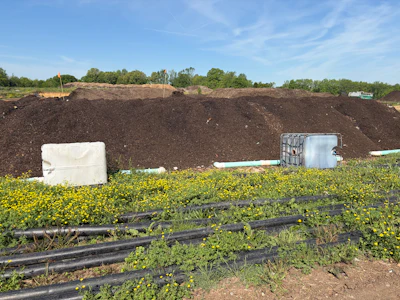
 Finished compost at The Compost Company is stored and blended into soil products before being sold in bulk to farmers, contractors, and landscapers, completing the cycle from food waste to usable soil.Packaging World
Even with that effort, some contamination is unavoidable, which makes processing an important backstop. All incoming material is pre-ground and composted under high heat. Most certified compostable items break down within the 30- to 45-day window, though some need to be screened out and run through the system again. “If we get the conditions right here, this breakdown will happen very well,” Ezell said.
There is also a practical view behind accepting compostable packaging in the first place. The expectation is not that single-use items will disappear quickly, so the focus is on providing an alternative to landfill disposal. “We don’t know that we’re going to get over our single use culture anytime soon, so we're trying to give people a better option and we want to be the outlet for that,” Ezell said.
At the end of the process, most of the material is sold in bulk to farmers, contractors, and landscapers, with some going to residential customers. The result is a system that takes local waste streams and turns them into products that support soil health. PW