Mobile robots are projected to overtake industrial robots as the largest robotics segment in packaging and processing by 2031, growing from 32% to 45% of market revenue, while the overall U.S. robotics market expands from $440 million in 2025 to $800 million by 2031 at an average annual growth rate of 10.3%.
- Mobile robots are forecast to account for 45% of total robotics revenue by 2031, up from 32% in 2025, overtaking industrial robots currently at 63%
- The U.S. robotics market in packaging and processing is projected to grow from $440 million in 2025 to $800 million by 2031, representing a 10.3% average annual growth rate
- 95% of end users are expected to adopt robotics by 2031, up from 72% currently using robotics in some capacity
- Mobile robots are expanding beyond warehouses onto plant floors, with 56% of OEMs offering raw material handling solutions despite only 9% of current users deploying them for this purpose
- High upfront costs and integration challenges remain the largest barriers, though reliability, uptime, and service support rank as top selection criteria for end users
Robotics use in packaging and processing is expected to expand considerably over the next five years, but one finding in PMMI’s new “Robotics in Packaging & Processing 2026” report stands out. Mobile robots, still a relatively new presence on many CPG plant floors, are forecast to overtake industrial robots and become the industry’s largest robotics segment by revenue by 2031.
The U.S. market overall is projected to grow from more than $440 million in 2025 to about $800 million in 2031, an average annual growth rate of 10.3%. Robotics adoption is expected to expand both in the number of users and in the level of deployment. Seventy-two percent of end users surveyed currently use robotics in some capacity, a figure expected to reach 95% by 2031, while 61% expect to increase robotics investment over the 12 months following the survey.
PMMI Business Intelligence, a part of PMMI, The Association for Packaging and Processing Technologies, produced the report with market intelligence firm Interact Analysis. The research included an online survey of 173 qualified professionals from U.S.-based CPGs, contract packaging and manufacturing companies, packaging and processing machinery OEMs, system integrators, and robotics suppliers, with end-user respondents having at least some involvement in robotics purchasing decisions.
Interact Analysis also conducted in-depth interviews with industry experts. The market-size figures cover revenue from robotics manufacturers and do not include robots built by packaging machine OEMs for their own equipment.
Mobile robots move toward the plant floor
For now, industrial robots still dominate, accounting for 63% of U.S. robotics revenue in packaging and processing in 2025. Mobile robots, which include Automated Guided Vehicles (AGVs) and Autonomous Mobile Robots (AMRs), account for 32%, cobots 5%, and humanoids just 0.1%.
 PMMI Business Intelligence
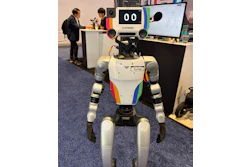
That mix is expected to change quickly. “Mobile robots are set to become the most popular robot type in packaging and processing by 2031,” the report says. They are projected to account for 45% of total robotics revenue by then, while humanoids reach 5% and cobots remain at approximately 5%.
Mobile robots have historically been used more heavily in warehouses, but their role is expanding onto the plant floor. Among end users currently deploying them, 52% use mobile robots for load-carrying material transport and 35% for load-pulling. Only 9% use them for raw material handling or production, even though 56% of OEMs and integrators offering mobile robots have solutions for that application.
Future interest runs in the other direction as well, with end users looking at mobile robots to bring raw materials and packaging supplies to production lines. Mobile robots equipped with cobot arms also drew interest in applications such as loading, unloading, replenishment, and material handling between workstations.
 PMMI Business Intelligence
Shared one CPG in the pharmaceuticals sector, “We’re starting to look more at… some projects that involve transport and material handling, whether it’s on a component level, bringing products to the line or taking the finished goods away from the line”
Plant footprint, navigation, manipulation, and safety requirements still complicate deployment, however.
Established robots still do much of the work
Articulated robots remain the most widely used robot type among current robotics users, at 81%, followed by delta robots at 49%. Industrial robot use is concentrated in established packaging applications, led by pick-and-place, palletizing, and case erecting and packing.
Cobots show a different pattern. Palletizing is their most common application, used by 69% of end users deploying cobots, followed by pick-and-place at 38% and case erecting and packing at 24%. The report links their use to lower-speed, space-constrained applications where ease of deployment and proximity to operators are important.
 PMMI Business Intelligence
“It comes down to what is the best tool for the job,” explained one integrator. “ …there’s different kinds of robots because there’s different things they need to do.”
Even as companies find uses for different types of robots, most have not yet deployed robotics broadly across their operations. Thirty-six percent of end users describe robotics deployment as limited, 21% report broad deployment, and only 5% say it’s extensive. By 2031, broad deployment is projected to reach 38% and extensive deployment 19%.
New applications move closer to the packaging machine
Several applications with limited use today drew particular interest during the interviews. One is using robotic arms to load cartons, cups, trays, sleeves, lids, labels, and other packaging materials directly into machinery.
Existing lines can make that difficult because human operators can move among workstations and compensate for layouts that were never designed for robotic replenishment. Greenfield projects offer more flexibility because lines can be designed around robotic loading from the start.
Robotics may also move further upstream into processing, including ingredient handling, container loading, cleaning support, and material transfer between processing steps. Hygiene requirements and more complex equipment interfaces continue to make these applications harder to automate.
Productivity edges out labor as the main driver
Labor shortages have long been associated with the business case for robotics, but end users put increasing throughput and productivity first among adoption drivers. Lowering costs follows closely, with improving quality and consistency next.
OEMs and integrators placed more emphasis on labor shortages than their customers did. “While OEMs/Integrators rated labor shortages/labor availability as the top factor influencing customer adoption, End Users placed equal or greater emphasis on productivity, ROI/cost reduction, and quality/consistency, suggesting that robotics adoption decisions are driven by a broader business case than labor availability alone,” the report says.
Once a company decides to pursue robotics, reliability takes precedence. Sixty-nine percent of end users rated reliability and uptime performance as very important when selecting an OEM or integrator. Service and support followed at 53%, while demonstrated ROI and payback and ease of integration each came in at 52%.
Cost can stop a project early
High upfront cost remains the largest barrier for end users evaluating or implementing robotics. Integration with existing equipment or systems ranks second, followed by maintenance and service support concerns.
Companies that aren’t considering robotics often give a more basic reason, saying the technology isn’t needed or there is no applicable use case. Capital expense can prevent a project from gaining approval, but once a compelling application has been identified, reliability, uptime, integration, and support become more important than purchase price.
Integration can be especially challenging in brownfield plants, particularly for mobile robots. Existing layouts may include narrow paths, fixed equipment, legacy controls, mixed-vendor machinery, and traffic patterns built around people and forklifts.
“Anybody can buy a robot, but there’s a lot that goes into the full integration that has to be understood and has to be done correctly,” said one CPG respondent.
Results are positive, but skills gaps remain
Companies that have installed robots report strong results in many of the areas that justified the investment. Eighty-eight percent said robotics had been somewhat or very successful at reducing repetitive tasks for employees, and more than 75% also reported success in productivity, process consistency, and waste or error reduction.
The harder part often comes after installation. Internal technical skills gaps ranked as the most significant operational challenge, followed by operator training and readiness. Uptime and reliability, maintenance support, and service response also remain concerns.
One integrator said weak maintenance knowledge can make it difficult for end users to keep robots running through changes or unexpected stops. That reliance on outside expertise is becoming more significant as deployments grow more complex. The report projects that use of system integrators for robotics integration will rise from 40% to 53% over the next 12 months.
End users are asking suppliers for better maintenance support, stronger training, easier integration with legacy systems, clearer ROI and lifecycle-cost information, and improved spare-parts availability. “I believe more thorough training of robotic operations would allow for confidence in operating, which would directly contribute to increased uptime,” said one end user.
The report puts much of the responsibility for closing those gaps on suppliers. “OEMs should treat customer training, documentation, service support, and post-installation knowledge transfer as core capabilities, rather than secondary support functions,” it says.
Integration and vision make robotics easier to deploy
Improved integration ranks first among the technologies end users and suppliers say have changed robotics most during the past five years, cited by 64% of end users and 65% of OEMs and integrators. Intelligent vision follows at 60% and 67%, respectively, while increased operating speed was cited by 59% of end users and 44% of suppliers.
Programming has become easier as well. Eighty-eight percent of OEM and integrator respondents said robotics programming continues to get easier, helped by more intuitive interfaces, drag-and-drop programming, simulation tools, and closer integration among robots, vision systems, and machine controls.
AI ranked below integration, vision, and speed when respondents looked back over the past five years. The report expects its influence to increase in programming, troubleshooting, analytics, vision, changeovers, and applications with less predictable product presentation. PW