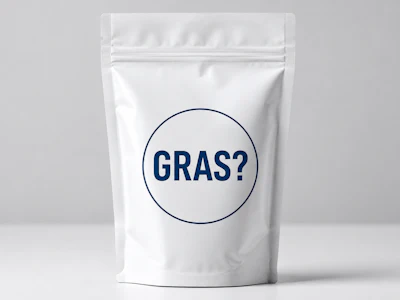
Proposed federal and state laws could eliminate the GRAS exemption that allows companies to use food-contact substances without FDA approval, requiring instead that companies submit their safety conclusions to the FDA for review.
- Federal legislation and state laws in New York, California, Pennsylvania, and New Jersey propose eliminating self-determined GRAS uses and requiring FDA submission
- New York's proposed law would require companies to report substances used under GRAS conclusions, including identity, manufacturing methods, and scientific safety basis
- Current GRAS exemption, in place since 1958, allows companies to use substances without FDA approval based solely on expert scientific opinion
- Food-contact substances typically expose consumers to parts per billion levels, significantly lower than food ingredients added in percentage amounts
- Changes could create compliance burdens including reformulation costs, FDA submission requirements, trade secret concerns, and conflicting state-level regulations
 Eric F. Greenberg
It’s impossible to predict precisely what these new proposed laws will require, but here are some of the key provisions being considered: The new federal law might eliminate self-determined GRAS uses of substances and instead require submission to FDA. The New York law, now on the governor’s desk, would require companies to report to the government on the substances they use on the basis of GRAS conclusions that aren’t FDA-submitted. Details in those reports might include the identity of the substance, how it’s made, relevant safety information about the use, and the scientific basis for the GRAS conclusion.
If a new law were to outlaw GRAS uses that aren’t submitted to FDA, there’d be a ton of new work for both companies—who might have to reformulate their packaging materials and submit a request for clearance by FDA—and for FDA who’d have to review them. And the suggested state reporting requirements would impose bureaucratic obligations on companies, too, and also raise concerns about maintaining companies’ trade secrets. And, of course, any state law requirement that differs from another state’s law’s requirements would create a burdensome scenario for packagers.
This is only the most recent chapter in a long story. Ever since 1958, the federal law that FDA administers, the Federal Food, Drug and Cosmetic Act, has said that a use of a substance that’s GRAS is not a food additive. And since it’s not a food additive, it doesn’t require FDA approval for its use before it goes into, or gets into, food.
For years, some folks have suggested this so-called “GRAS exemption” was intended only to exempt common, traditional food ingredients from having to get FDA approval as food additives, but the law is worded so broadly that it’s clear that it applies to more than that.
So for years, many companies have added ingredients to food, or used substances in their packaging that contacts food, on the strength of their conclusion that the use is GRAS.
And because the law makes no mention of any requirement for FDA involvement—all that matters for a use to be considered GRAS is the opinion of relevant scientists qualified by scientific training or experience to evaluate the safety of the exposure to the substance, based on publicly available information—companies commonly use substances and don’t notify FDA that they’re doing so.
Some consumer advocates and others have said they are uncomfortable with this set-up, saying there might be safety issues created by a program that leaves so much decision-making to companies and lacks public transparency. Among their arguments are that individual companies could not be trusted at all; that there weren’t enough agreed-upon standards for how to evaluate whether a use was GRAS; there weren’t protections against conflicts of interest when scientists were asked to opine about whether a company’s use of a substance was safe; and that FDA was left unaware of the full extent of the use of certain substances.
The various objections to the current system have always been essentially theoretical: There really isn’t any evidence that exposures to substances some companies consider GRAS in food are causing widespread health or safety issues. Nevertheless, these advocates’ concerns have been the subject of government study and consumer advocacy and lobbying, and even an unsuccessful federal lawsuit.
Those of us who watch the development of these legal and regulatory issues are always on the lookout whenever there’s a proposed change to anything having to do with “food,” as we then wonder if the change means food as such, or whether it also would include food-contact substances. So far, it appears that food-contact substances would be included the various suggested GRAS laws.
Probably the best argument against including food-contact substances in any program designed to regulate food ingredients is as follows. Since the levels of exposure to a substance are central to evaluating whether it’s safe or not, it seems obvious that food ingredients would be first in line, if not alone in line, for any changes in legal requirements. Very simply, exposures via diet to food-contact substances, which are often measured in parts per billion in the average diet, don’t present the same safety risks as exposures to food ingredients, which are often added to food formulations in percentage amounts.
Also, it’s not as if FDA involvement is necessary for food packaging oversight to occur. Food packaging makers, converters and users have a well-established safety program in place that assures that the correct materials are employed for each food-contact use and that the materials have the required legal clearance. Backing up any company’s promises of safety and legal compliance are the prospects of civil lawsuits and bad publicity if they get it wrong, in addition to any regulatory agency enforcement liability.
No doubt, packaging industry representatives are making these points repeatedly to state and federal legislators and regulators. And perhaps other stakeholders will echo their arguments, because after all, these changes will disrupt companies in the broader supply chain. Let’s all stay tuned.
Eric Greenberg can be reached at [email protected].
Or visit his firm’s Web site at www.ericfgreenbergpc.com.
INFORMATIONAL ONLY, NOT LEGAL ADVICE.