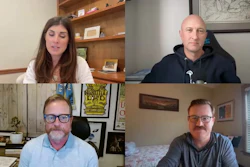
Derrick Teal: Hello, everyone, and welcome to the most recent episode—depending on when you watch it—of the End of the Line podcast, video, or whatever this is, where the editors of PMMI Media Group discuss things. That’s it. Things. We discuss things.
Joining me today, we have a slightly different group than usual. We have Matt Reynolds, editor-in-chief of Packaging World; Sean Riley, editor-in-chief of OEM; and Casey Flanagan, our jack-of-all-trades editor who works across nearly every brand here at PMMI Media Group.
I’m Derrick Teal, editor-in-chief of ProFood World.
Gentlemen, has it been a busy week or a slow week? What’s happening? Sean, you said there’s some activity in the exciting world of tariffs.
Sean Riley: Everything else seems slow, but yes. I guess the media had downplayed it, and we hadn’t heard much about tariffs lately. I thought we had put them in the rearview mirror and that I was off that beat.
But just when I thought I was out, they pulled me back in.
I did an UnPACKed podcast with Shawn Marie Jarosz. She is PMMI’s resident expert who they bring in to discuss trade issues and tariffs.
The long and short of what she has said all along is that, despite the Supreme Court striking down tariffs a couple of months ago and saying they were unconstitutional, tariffs were never going to go away. The administration was going to find some way to bring them back because the president loves tariffs, and he says as much.
Odds are that, when it’s all said and done, we’re going to have tariffs of 10% to 15% across the board.
The bigger development is the announcement of a 50% tariff on select Canadian imports. That includes some packaging and processing machinery, which would be a big deal.
That is supposed to go into effect in August. With these things, it always comes down to the last minute before we know whether they will actually happen the way they are planned.
These tariffs would apply whether or not the goods are compliant with the United States-Mexico-Canada Agreement, or USMCA.
The USMCA was the Trump administration’s replacement for NAFTA. For those old enough to remember NAFTA, the idea was that it would promote free trade.
The USMCA is a little different. According to the administration, goods were coming from Mexico and Canada and avoiding tariffs, including some Chinese goods.
The administration is unhappy about that because one of its main goals with the tariffs is to restrict Chinese goods.
These tariffs against Canada would apply regardless of whether products are USMCA-compliant. The administration considers that a loophole that Canadian and Mexican companies have taken advantage of, allowing them to avoid much of the impact of earlier tariffs.
There may be more of an impact now.
To put a button on all of this, the USMCA is also under fire from the administration. There was a deadline in July that would have extended the agreement for 16 years and avoided annual reviews, but that deadline passed.
Now, there will essentially be a negotiation every year among Mexico, Canada, and the U.S.
That is going to be a pain for everyone involved. These are supposed to be our trading partners in North America, and it could create bottlenecks in the supply chain.
Basically, the only certainty is uncertainty in tariff land. It remains a muddle until the deadlines arrive, something happens at the last minute, and everyone hopes for the best.
It is going to affect packaging and processing to some degree. We just don’t know when yet.
Matt Reynolds: Sorry, Derrick. I was just going to say that this can create such a chilling effect on innovation.
Whether you are building machinery or creating a new package to accomplish a different goal, companies have to ask, “Is now the time to do that? Is now the time to make that investment?”
You want to wait and see, but it feels as though the dust never settles. At some point, you almost have to plow through because you have to expect the unexpected.
The companies and brands that thrive in uncertainty seem to be the ones thriving in this uncertain environment.
Sean: That’s so true.
Shawn pointed out that companies had just reached the point where they had capital to spend and were willing to spend it again because things had calmed down.
Now, everything has ramped back up. As you said, it kills innovation and capital spending.
It’s a quagmire.
Derrick: Killing capital spending is the big question mark because I thought the whole point behind many of these tariffs was to generate more U.S.-based manufacturing.
We’re still seeing plants close in some places.
One item that came across my desk this week involved a bakery that ended operations around July 25, resulting in the loss of approximately 250 jobs.
On the other hand, companies such as Land O’Lakes are adding dairy protein capabilities at one of their California plants, including ultra-filtered milk production.
It feels as though investments are going toward specialized niches. That’s totally anecdotal at this point because I haven’t done enough research to support it yet.
We’ve seen similar activity at other plants, particularly involving milk and ultra-pasteurized products.
Casey, you recently came across what I thought was a plant expansion. Am I right?
Casey Flanagan: Not quite. It was more of an equipment installation that actually prevented the need for a move or expansion, which I thought was interesting.
I recently toured Glier’s Goetta in Covington, Kentucky.
Goetta is a Cincinnati specialty made with pork, beef, broth, and steel-cut oats. It is so locally beloved that Glier’s hosts an eight-day Goettafest, which draws between 200,000 and 250,000 people.
People in Cincinnati love this stuff.
The traditional production process at the plant was extremely manual. Workers cooked the meat in kettles, hydrated the oats in long tanks, and stirred each batch by hand with large paddles.
It was a three-and-a-half-hour process in a very hot room. There wasn’t cooking happening while I was there, but the room was still about 90 degrees.
It was extremely physically demanding work. It was strange to be in a shirt like this in that kind of room.
Matt: I bet it smelled great in there.
Casey: It did.
The plant also relied on its most experienced employees to handle the mixing because newer workers could not always achieve the same consistency or make sure the goetta was properly stirred.
It was a difficult manual process.
The company installed two Mepaco steam-jacketed mixers to automate the cooking and mixing process.
The process that had taken three and a half hours was reduced to about 30 minutes. It also created a more consistent product and reduced the plant’s dependence on physically demanding labor.
The equipment eliminated one of the plant’s hardest jobs and allowed the company to continue operating in its current facility.
The building dates back to around 1895, so it is definitely not a greenfield plant. The company had been concerned that it might need to move or expand.
By installing the mixer-cookers, it avoided having to make a much larger investment in a move or facility expansion.
The equipment dramatically changed the process while allowing the company to continue using the same recipe to make that Cincinnati favorite.
I thought it was pretty cool.
Matt: This is like scrapple, right?
Casey: Exactly.
It comes from a German, sausage-adjacent type of food. As German immigrants came to the U.S., different regions developed their own versions.
Depending on where you are in the country, you may find a similar food called scrapple, particularly in the Philadelphia and Pennsylvania areas. “Mush” is another name used in some places.
Goetta, however, is quintessentially Cincinnati.
Derrick: Even though one of our coworkers wanted you to bring back samples, right?
Casey: That’s right. I think she has some roots in Ohio, so she had a local connection to it.
It was interesting to hear about something I had never encountered before. I had heard of scrapple.
Sean: I’ve heard of scrapple, but not goetta.
Casey: It is very specific to that region, so it was cool.
Matt: I had to look it up because I’m now across the Cheddar Curtain in Wisconsin. I figured that, with such a large German population, there must be a local version.
Sure enough, it’s called grützwurst.
It is a peasant food brought by German immigrants to certain regions. It consists of boiled pork head meat and scraps mixed with steel-cut oats and barley, heavily spiced, packed into casings or loaves, and then sliced.
It sounds delicious. I think it’s part of every Wisconsinite’s breakfast of champions.
Casey: Yeah.
Derrick: In Germany, you have pork knuckle, so I guess they make use of every possible part.
Sean: They sure do.
Casey: That’s true.
David Glier at the plant described it similarly. He said, “This is basically medieval peasant food that we’ve turned into homestyle cooking.”
I don’t know whether that’s the most flattering description of your own product, but it makes sense in terms of the history.
Matt: Imagine those peasants getting a look at that new piece of equipment mixing it for them.
Casey: Right. Look how far we’ve come.
Sean: It sounded like peasant work based on how you described the old process.
Casey: It did. A 90-degree, steaming room did not sound like a very enjoyable environment.
They mentioned that older employees sometimes tease new hires about it. If a newer employee says, “This is hard work,” the longtime employees respond, “You don’t even know what it used to be like.”
It was pretty cool.
Derrick: A turn-of-the-century building, no less. It probably has brick walls that make it look like something out of a medieval horror tale.
Casey: It actually had dairy tile because the building previously housed dairy operations.
There were beige tiles covering the rooms, which was interesting.
Derrick: In other words, high-quality medieval torture.
Casey: Exactly.
Matt: Hygienic-design, washdown-ready medieval torture.
Casey: Yes, very innovative.
Derrick: Matt, I’ve completely forgotten what we were going to discuss, or what you were going to talk about.
I guess that’s always the risk of having me as the emcee. What do you have for us this week?
Matt: There are no big splash items, just the continued march of packaging-related legislation.
It feels like every time I sit down to write the piece that will explain everything happening, the goalposts move a little bit. But I think that’s just the nature of the beast.
Not too long ago, we talked about the National Association of Wholesaler-Distributors, or NAW, and its lawsuit challenging extended producer responsibility in Oregon.
NAW also has a lawsuit in California, and as of yesterday, it is moving forward with one in Colorado.
Those are three of the early-adopter EPR states and among the states that are farthest along in implementation.
In Oregon, the primary pillars of the lawsuit were based on due process. Those issues included fee setting, classification, dispute resolution with the Circular Action Alliance, or CAA, and questions around standards and oversight.
Related to that is the issue of CAA being a private entity that is effectively leveraging governmental power without public accountability. No one is voting CAA into that position, so the arrangement is somewhat murky.
The new Colorado lawsuit includes First Amendment arguments, such as compelled membership.
The argument is that businesses, brand owners, and producers are essentially forced to join CAA as a condition of doing business in the state, even if they do not necessarily agree with the organization.
The claim is that they are effectively bankrolling speech. That is the argument being presented, not my own argument. I’m simply trying to reflect it accurately.
While the Oregon case recently opened, Colorado is already at the compliance stage.
The motion for a preliminary injunction in Oregon has already been decided, while the Colorado motion was just filed. These cases are at different stages.
When I step back and look at this from a distance, what it tells me is that every EPR law is slightly different in every state.
Each law has its own features, which means each also has its own potential vulnerabilities.
Those seeking to dismantle or overturn EPR are approaching it from every possible angle. There is not a single playbook.
Wherever they identify a potential vulnerability, they are going to pursue it.
Each of the NAW lawsuits in Oregon, California, and now Colorado is slightly different. We didn’t see much of a First Amendment argument in Oregon, but we are seeing it in Colorado.
We always knew EPR would be scrutinized and would not simply sail through. These cases are some of the first early litmus tests, and we will see how they proceed.
We just have to continue covering it because it changes every week.
Derrick: Sounds like tariffs.
Sean: I was just thinking the same thing.
When they were drafting the Constitution, clearly they were thinking about EPR. The First Amendment was meant to include freedom from EPR.
It is an interesting way to challenge the law, though—the argument that you are being forced to join a group you do not want to join.
As you said, I would not have thought of it that way. I don’t necessarily agree with it, but it is a unique argument.
Matt: I think there is some of that argument in the California case as well.
The counterargument is that companies are not compelled to join CAA. They are compelled to pay into a producer responsibility organization, or PRO, but they can create their own PRO if they choose.
CAA happens to be the 800-pound gorilla in the EPR and producer responsibility organization space because it has done this multiple times and already has the infrastructure.
It is becoming a de facto standard, but there is nothing preventing a group of brand owners or distributors in Colorado from creating their own PRO and developing their own system.
They would still need to pay into a recycling and recovery system.
That is the basic principle behind EPR: If you are producing products that create waste, you help fund the collection and recycling of that waste.
That is the underpinning of the system.
It will be interesting to hear the arguments from both sides in the different states. As Sean said, each state is unique.
Derrick: Does anybody have anything else?
I know Casey has to get out of here because he wants to go watch The Odyssey again.
Casey: Yes. I need to get through my second viewing, and then I’ll be six hours deep into watching The Odyssey.
Derrick: Well, if there’s nothing else, for Casey, Sean, and Matt, I’m Derrick.
Thank you for watching or listening to the End of the Line podcast—or video, whatever it is—and we’ll see you next week.
Matt: I’m going to go find myself some grützwurst.
Casey: Awesome.
Matt: Thanks, everybody.
Derrick: Oh my God.
Sean: Bye.