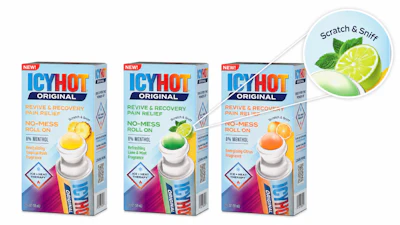
Icy Hot Revive & Recovery solved a key retail challenge by adding scratch-and-sniff technology to its cartons, allowing shoppers to sample the product's actual fragrances before purchase without damaging the packaging. This innovation reduces shelf shrink while helping consumers choose between three new scents that complement rather than mask the signature menthol formula.
- Icy Hot's new 2-oz roll-on comes in three fragrances designed to work with menthol, not mask it, addressing consumer concerns about medicinal odors in pain relief products.
- The scratch-and-sniff feature uses actual fragrance oils from the product encapsulated into a clear, matte varnish applied in a standard printing process.
- This is the first scratch-and-sniff technology used in OTC topical pain relief packaging, with no new tooling, equipment retrofitting, or substrate changes required.
- The innovation prevents carton damage and shrink by eliminating the need for shoppers to open sealed cartons to test fragrances before purchase.
- The cartons maintain full recyclability and scent durability of over one year, with no impact on existing distribution, embossing, or production processes.
Fragrance-forward products have a shelf problem when shoppers want to catch a whiff before they buy, but a sealed carton stands in the way. For brand owner Opella and its Icy Hot Revive & Recovery No-Mess Pain Relief, a new 2-oz, 8% menthol roll-on launched in three fragrances, an initial question for the packaging department was how shoppers might try to access the new smells.
Meanwhile, the topical analgesics category carries a scent problem of its own. Consumers tend to think such products have a medicinal odor. That’s why Icy Hot is “addressing user needs around fragrance, especially in the pain space, and consumer sensitivity around not smelling like a medicine cabinet,” says Heidi Graham, packaging innovation lead at Opella of the brief behind the launch. So three new fragrances were created to work alongside Icy Hot’s signature menthol, rather than to mask it. “It’s all about the formulation,” she says.
In this unique set of circumstances, secondary packaging in carton form became a problem. When a product’s entire premise is that it doesn’t smell medicinal, a shopper deciding between three new scents has every reason to want to open the carton.
“We have glued-end cartons, and so we wanted to avoid them destroying the carton to get at the product just to take a quick sniff and decide,” says Graham. “Our ambition is to help them with that decision without them having to tamper with the carton.”
Every carton opened by a consumer at the shelf is a unit that can no longer be sold. Opella’s answer was scratch-and-sniff, a technique most shoppers last met on 1980s stickers. In intervening years, the concept has moved into laundry and home fragrance, usually embedded in film. Getting it onto an OTC pharma/personal care product carton was a different proposition.
“We had to ask, ‘how do we integrate it into the carton in a seamless way?’” Graham says. “It was something we hadn’t done before, and it turns out it was new also for our converters.”
It also wasn’t a one-off. “We’ve been looking at ways to bring different sensory elements to our products,” Graham says. “And this one’s fun because it’s at shelf that we get to bring another dimension of interest.”
Real fragrance, standard varnish
 Spot gloss picks out the rollerball graphic against the matte carton face. The scented varnish that carries the fragrance is clear and sits on the same printed panel.
Opella brought in scent technology supplier Scentisphere and gave it an unusual starting point.
“We took our actual fragrance oil from our fragrance house for each of the three SKUs and sent it to this company so that they could encapsulate it for us,” Graham says. In other words, what the consumer samples on a carton at shelf is the product’s own fragrance, not just an approximation built to imitate it. And application doesn’t require unusual or difficult printing steps.
“They have this special technology that protects the oils so that you can then mix it into a standard varnish,” Graham says. “We were able to incorporate the three distinct fragrances in a standard carton printing process and just indicated the area where we wanted the scented varnish to go.”
The result is a spot varnish laid over the printed graphics in a defined area on the carton face, in what Graham says is a conventional flexo operation with no color-count constraints. The varnish is clear and matte, and nothing on the pack telegraphs the feature except a small fruit icon and the words “Scratch & Sniff” above the rollerball graphic. “Really you couldn’t tell otherwise,” Graham says, “so you have to look at it and go up and smell.”
Whether the scent survived the trip from fragrance house to encapsulation to varnish to carton was an open question until Opella put it in front of an internal focus group. “We did a scent test with folks in our Morristown office to see if they could marry up the product to the carton, and they did,” Graham says.
Opella did extensive consumer work on the three fragrances. It did none on the scratch-and-sniff feature itself. “Because we are using existing fragrance oils, we just wanted to make sure that it translated to the carton,” Graham says. “And we know that with just regular shelf engagement, if there is a fragrance-forward product, people want to smell it. So adding scratch and sniff was just a way for us to help them with their purchase decision.”
What they learned on press
The carton is printed, embossed, spot varnished (now with scent capsules), and die-cut at several converters in different regions across Icy Hot’s retail footprint. Asked whether the converters were skeptical of the new scratch and sniff process, Graham says they welcomed it with "very open arms... When they understood that they could just mix it in with the varnish, they quickly realized, 'Oh, we got this, no problem.'" Glued end cartons tear when opened. Shoppers wanting to sample the fragrance were destroying units that could no longer be sold.
Production was where it got more complicated. The Icy Hot carton carries spot gloss and embossing on the logo, on the "Original" tag color bar beneath it, on the rollerball graphic, and across the angled color treatment at the base.
"There were some things that we all had to learn as we ran it through actual production, because we didn't know what we didn't know," Graham says.
Sizing the scented area was one example of learning on the fly. Opella's starting point was something close to the size or footprint of a conventional scratch-and-sniff sticker.
"We had to learn how much scent area is important for it to really give the bloom that you want, and for it to last as long as you want it to," Graham says. "As people shop it, you may get a few people engaging with the carton, and you want to have enough encapsulated spheres left [for several different shoppers before it's ultimately purchased]."
A patch that reads as generous on a single sniff also has to survive weeks of new sniffs as consumers browse and move onto the next product. Opella leaned on Scentisphere for both the capsule loading and in deciding the appropriate coverage area, so the converters could adjust the varnish area in line.
Durability, recyclability, and shelf life
The questions Graham fielded internally were the ones any packaging engineer would ask, starting with distribution.
“That was a bit surprising, because you would anticipate with distribution testing that you would see some diminished fragrance because of breaking the capsules,” she says. “But it’s in a varnish that is very robust, and so the varnish helps to protect it, and you really do have to rub it to get the spheres to break.”
"We've looked at it at each phase from the cartoning first—well, even all the way through the printing process, because we learned that when you emboss, you have to be careful not to put so much pressure on that you crush [the spheres]," Graham says. Vibration testing turned up no issue either. And when asked if equipment needed retrofitting, Graham answered, "Nope, we run it as is." Three fragrances — Revitalizing Tropical Rush, Refreshing Lime & Mint, and Energizing Citrus — were developed to work alongside Icy Hot's menthol rather than mask it, addressing what Opella describes as consumer sensitivity to smelling like a medicine cabinet. Icy Hot
Mixed cases would be possible, but they are not the practice, and scent is not the reason. “We follow retailer preferences on inners, and so you’ll have a full ship case with an inner count that the retailer prefers, and then their distribution center is basically handling inner bundles, so they’re not really mixed,” Graham says. Shelf displays are the exception, and those are assembled in store.
Nor does the board carry a barrier coating to contain fragrance, an issue for some scent-forward products sold in paperboard. Here the primary package does that work. The roll-on is capped, and the only fragrance the shopper encounters in the aisle is the one they release themselves on the carton, via scratch and sniff.
Recyclability was the question her colleagues raised most, given Opella’s B Corp certification. “It’s just like any varnish, so it doesn’t affect recyclability in any way,” Graham says. The carton meets current Western Michigan University repulpability standards, a de facto recyclability test for board.
Scent longevity mattered for a less obvious reason. Cartons are printed well ahead of filling, so a coating with a short life would mean managing expiry dates on printed inventory. “We have some samples with one of our partners that are over a year old, and it’s just like they just printed them,” Graham says, calling it a “surprisingly long-enduring technology.” Opella targets a two-year minimum expiry on the product itself.
Regulatory review, on an OTC pack where every panel is spoken for, turned out to be the smallest hurdle. “It’s essentially a cosmetic claim, if you could call it that. It’s a fragrance being emitted,” Graham says. “It’s not covering up anything, because the varnish is clear. It didn’t impede us in any way in terms of regulations.”
An existing platform, a new reason to pick it up
 An inner fitment braces the roll-on stick inside the carton.
That leaves the carton doing the work in the retail aisle. And, if Opella’s read on the category is correct, it’s doing something no one else in topical pain relief is doing. Graham says store checks turned up no comparable examples outside laundry and fragrance. “Being first in category, for sure, was something that we were celebrating.”
The retailers’ case for avoiding shrink is as strong as the marketing one, and Graham says retail partners were on board for exactly that reason. A clear varnish that costs nothing extra to print, on a carton that runs on existing equipment, keeps saleable units on the shelf instead of in the damage bin.