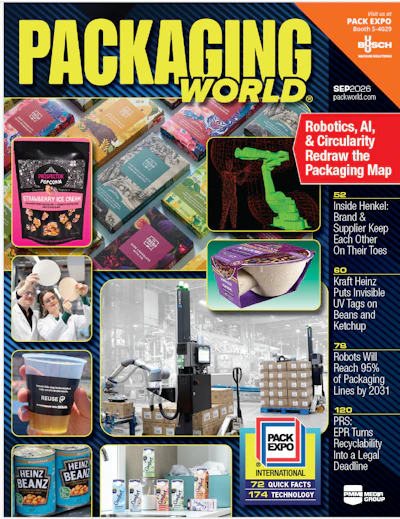
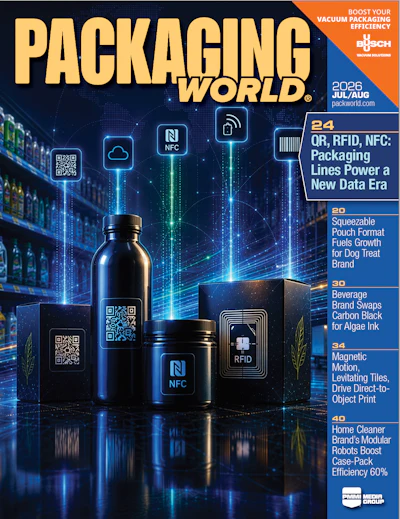
Download your copy of the Packaging World Annual Outlook Report 2026
Transcribed from AI, rev.com.
Sean Riley:
Hi, I'm Sean Riley, editor-in-chief of OEM Magazine. Here with my good friend and colleague, Casey Flanagan, associate editor for PMMI Media Group. Welcome to a quick sneak peek overview of the results of our Packaging World reader survey on workforce trends for 2026. Together as an editorial staff, we recently completed production of Packaging World's 2026 Annual Outlook Report, the second of its kind spanning the entire packaging universe. The subjects we look into include healthcare packaging, contract packaging, workforce, automation and robotics, digital transformation, e-commerce and direct-to-consumer packaging, and sustainable packaging. This video homes in on workforce issues as Casey led the way on our workforce survey.
The full report is available at the shorty link you'll see on your screen, it's pwgo.to/9052, and all the links to the full report should be available on whatever channel through which you're viewing this video, whether it's our website, LinkedIn, YouTube, et cetera. Give that link a click to access the full report. Now with all the business end out of the way, Casey, let's jump into your research on workforce. Welcome. How are we today?
Casey Flanagan:
Doing great. I'm excited to get started with this, so thanks for having me.
Sean Riley:
Oh, the pleasure is all mine. So let's start big picture. What would you say was the overarching takeaway for packaging workforce trends in 2026?
Casey Flanagan:
I'd say a major theme I saw was persistent challenges and adaptation to meet those challenges. So this being the second report, we got to look at the previous year and see what did or didn't change. Some of the big-picture trends have remained relatively stagnant since 2025, namely hiring difficulty and turnover rate, specifically across skill levels. To dig in just a little bit with that, hiring difficulty increases with skill level. That was a trend we saw last year and continued this year. And most respondents are having hiring challenges. As for turnover, about half of the respondents are seeing 0% to 19% turnover. The next largest group is about a fifth of respondents reporting about 20% to 29%. So one thing that I saw that was kind of interesting about this, though, was respondents’ outlooks for skilled operator hiring over the next year.
Those numbers I just shared are their current experience, and now, looking at what they think is going to happen, most are expecting no change in hiring difficulty this year, whereas in 2025, most expected hiring to become more difficult. So this isn't exactly ideal, given that most respondents are finding it very difficult already. So it seems like the expectation is that most respondents are at least thinking we're in a stable spot. So it seems like we've settled into a status quo in terms of what to expect in terms of hiring and retention trends. But now the question is how to respond to it. And as we'll get into here, companies are making some significant changes to meet that moment and figure out how to best handle hiring and retention.
Sean Riley:
And I guess that was the question I was thinking the entire time you were talking. I was paying attention, but while you were talking the whole time, I was thinking, what are we going to do to change? What are some of the things they can change? I guess we'll start with the recruitment aspect of it. What can they do differently to solve what is becoming almost an epidemic with this workforce issue?
Casey Flanagan:
Absolutely. So one of the more notable shifts I saw year over year was in recruitment, and it was a move away from what I saw as broad-reach recruitment strategies and toward more targeted and vetted recruitment options.
So hiring methods that cast a wide net, like online job portals and company and career pages. They were the most popular in 2025, but they dropped in 2026. Now, the strategy that is most popular, the types of strategies that I saw that were growing in popularity, I saw them as connected in that they involve some form of vetting, whether it's through personal networks, professional recruiters, or industry-specific channels. So rather than hoping someone qualified and interested in manufacturing comes forward from the general public, it seems that respondents are prioritizing strategies that have a level of interest or connection or commitment to manufacturing already built in, where the applicant is probably there because they are thinking this is a specific career path that they're interested in.
Sean Riley:
That makes sense.
Casey Flanagan:
Yeah, it does. It seems like it's probably a higher chance that you're going to get a really successful outcome in your job search. And that's not to say that the broad-reach recruitments are not popular. Online job portals and company career pages both went down, but they're still 43% and 29% saying that they use those, respectively. So now we have the other type, these vetted ones, kind of growing in popularity instead. And one thing that I specifically thought was interesting was employee referral incentive programs; they're now the most popular form of recruitment among our respondents. I did an in-depth interview with one of the respondents, an engineering director at a CPG company, and they had an interesting take on why that might be and why employee incentive is a decent option. They explained that it's a win-win for all involved.
The company gets a pre-vetted candidate because the employee decides, “Hey, my friend is qualified to be here and would be a great addition to the team.” The employee gets their monetary incentive if it all works out, and the candidate can ask their friend who is already an employee there, “Hey, be honest, what's it like working here?” And get an honest review, an honest answer from their friend about what it's like to be at that company before they come in. So it just adds that layer of everybody involved. It has a bit more awareness as they walk into the situation.
Sean Riley:
Again, this makes complete sense because you have so many people invested in when you're doing the employee incentive method: The person doing the hiring, the person who's suggesting them, and the person who's being suggested. It would make sense that they would be getting a vetted employee. That is interesting.
I looked at your data a little bit beforehand, prepping for this, and on the training side, it seems like there's been some changes, some of them kind of dramatic, in where companies are spending their money, where they're investing in training. Could you walk us through what you found there?
Casey Flanagan:
Absolutely. Yeah. So this year, we saw a pretty big shift in where respondents are placing their training investments.
Less money is going toward operator and maintenance technician training, and more is going toward leadership. To be more specific, notably more respondents are reporting low investment in operator and maintenance training, and fewer are reporting high investment in those areas. But the only category that I saw receiving more high investment in training is leadership, moving up 10% in a year. One explanation for this could be retention. If workers are consistently leaving and there's always just a lot of turnover happening at a place, especially at the operator and maintenance level, it might make sense to invest in leadership, where employees might stay a bit longer on average in this higher-up position, where it might be more of a career choice, and they might stay longer on average. They can also take that training that they got and pass it to the team. So if a new person comes in, they're the expert, and they can pass on that knowledge, and it creates a little bit more of a cycle of having the knowledge stay there. And then another explanation from a respondent I interviewed: this was a VP of operations at a frozen food manufacturer; they said it could be tied to increasing automation. So as things get more automated, you need more skilled techs, more programmers, electricians, et cetera. And the leadership team is the one making decisions on automation. If you invest in leadership, it could help prepare those people to have a stronger vision of what they're doing when they're adding in automation.
Sean Riley:
I had some thoughts on automation, so that's a good segue there because when speaking of increasing automation, one of the trends you highlighted was the difficulty training employees. When reporting for OEM Magazine, this comes up all the time. Basically, how difficult it is to get employees up to speed on the automated equipment. So what does your research show? What's going on there?
Casey Flanagan:
Yeah, so the skills gap is, of course, a pretty big issue when it comes to automation. And this was one of the bigger changes that we saw comparing this year's data to the previous year.
The number of respondents who find it very difficult to train employees on computerized automated equipment has more than doubled since 2025. It was 14% in 2025, and it's 29% this year. We offered write-in responses to questions in the survey. A place where respondents could basically say anything they wanted in terms of their outlook for the packaging workforce. If the multiple-choice answers we were throwing at them weren't quite what they wanted to say, they had their space to say what they felt the next year would look like. One of the more common responses was a predicted increase in automation, AI, and robotics, specifically to address labor challenges. So there seems to be a bit of a paradox here, where it's difficult to train workers on automated equipment, but if companies are using automation as a labor solution, they're going to have to figure it out. And the training, the more you add, the more skills gap there becomes in the plant, and the training challenge becomes more pronounced.
So that is kind of an interesting dynamic happening with automation and the workforce. And one other interesting point that the engineering director I interviewed mentioned, he said part of the challenge could come from mixing and matching several machines, sometimes sourced from different global suppliers, all in a single plan. So sometimes things might get lost in translation; they might make more sense in the native language where the machine was built. Each HMI probably has a different format, a totally different screen showing. You’ve got to figure out how to navigate through it, and it's going to take some learning before an operator really knows how to do the ins and outs of operating the entire line of machinery. It creates a bit of a puzzle for them to figure out. And I imagine if there's a ton of mixing and matching happening, it might be a bit more difficult to train.
Sean Riley:
I wonder if anecdotally, this has led to the growth of companies that offer full solutions. Their might be multiple companies under one umbrella that offer the entire line, and that is another plus because the line is all done by one company, same HMI, same controls, etc. It makes it easier for an operator to figure that out rather than kind of piecemealing, as you said.
Sean Riley:
Looking at everything that you put together, hiring challenges, the strategic changes, the automation complexities, what's the big picture? What does this mean for the packaging industry going forward in regards to workforce?
Casey Flanagan:
So what we're seeing here is an industry adapting to its realities. So we're seeing these persistent hiring challenges, and with that, we see a change in how companies are approaching hiring. And the same mindset carries over to training, where companies are reallocating their investments in a way that seems to meet their current needs. If it turns into, if there's turnover, they might put that investment into the leadership, where they might stay a bit longer. So some challenges are intensifying; we just talked about training on computerized equipment. The technology to address these labor shortages requires an increasingly skilled and difficult-to-hire workforce to operate. But based on how companies are adjusting, it seems that the best path forward, or at least what a lot of companies seem to be doing, is balancing short-term changes and long-term investments. So, something quick you can do is maybe adjust recruitment strategies. It's a relatively quick fix. You just decide, “Hey, I want to start working with a staffing firm instead of just waiting for stuff to come in from Indeed,” or maybe up that employee incentive. And that's a quick fix. It can offer immediate results, but it seems like it could be best paired with a long-term investment like developing a training program that remains effective despite turnover and keeps knowledge in the plan.
Sean Riley:
Okay. That's fantastic. We want people to read the whole report, and I feel like we might've given 'em too much information, but this was excellent. Thank you, Casey, for taking time to do this with me. But again, to our listeners or to our watchers out there, please take the opportunity to access the full report for each of the different segments that we have covered. It's the Packaging World Annual Outlook Survey 2026. Thanks again, Casey.
Casey Flanagan:
Thank you. And thanks everyone for listening.