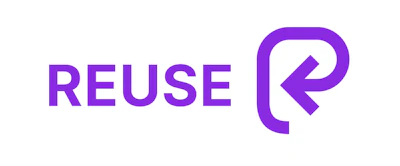
PR3, The Global Alliance to Advance Reuse, has unveiled a new global symbol designed to identify reusable packaging and reuse systems across markets. The alliance, which launched in 2019, develops standards to support reuse systems and is accredited as a standards developer by the American National Standards Institute.
The symbol was introduced by PR3 and an international coalition of businesses, governments, NGOs, designers, and reuse operators and is intended to help consumers recognize when packaging is part of a system in which items are returned, collected, washed, and reused.
It was developed through Rebrand Reuse, a global design initiative presented by the PR3 Global Standards Panel. The initiative received 236 submissions from 29 countries across every continent except Antarctica. The winning design was created by Nicole Ascanio Rodriguez and Juan Navarrete, designers and co-founders of Epigrama Studios, based in Bogotá, Colombia.
According to PR3, the design was selected after multiple rounds of jury review, global market testing involving 1,275 respondents across 17 countries, and a legal evaluation process. The jury included global leaders from sustainability, design, academia, business, and culture. The organization says the mark was reviewed for distinctiveness, memorability, actionability, cultural adaptability, and recognizability. PR3 also says it was evaluated to ensure it could be clearly distinguished from the existing recycling symbol and its chasing arrows Möbius loop.
Marco Cimatti, former design director, design innovation, PepsiCo, and a Rebrand Reuse juror, says the mark’s value lies in its consistency across reuse applications. “For reuse to succeed, people need clear, consistent cues that make participation feel intuitive and convenient,” he says. “The new mark creates a unifying visual language for reuse systems. Designed with bold simplicity in mind, it balances uniqueness with a strong visual signal to reuse.”
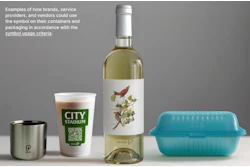
The symbol is being introduced on reusable packaging and reuse infrastructure, including cups, foodware, to-go containers, wine and beverage bottles, cleaning and homecare product containers, collection bins, logistics vehicles, marketing materials, signage, and citywide reuse systems.
That connection to an operating system is a key distinction, says Amy Larkin, co-founder and director of PR3. “Reuse systems keep a package in circulation, from 10 to up to 100 uses, before it is finally recycled and re-manufactured for another round of uses. This is our pathway to creating an un-throwaway world. The PR3 Global Standards for reuse and the new symbol give people a clear way to recognize reuse systems—and trust them,” Larkin says.
In the U.S., the symbol is being deployed or integrated by reuse organizations in multiple locations. Those include Bold Reuse in states such as Missouri, Arizona, Michigan, Oregon, and Washington, CupZero in Austin and New York City, Re-Dish in Boston, Seattle-based Reuse Seattle, Revino on the West Coast, and r.World in cities including Los Angeles, San Francisco, Denver, Cleveland, Washington, D.C., and St. Paul. The Hilo, Hawaii-based Ho’i Returnable Dish Program is also working with the symbol through Vytal US, Hawai’i County, Zero Waste Hawai’i Island, and Perpetual.
Outside the U.S., PR3 says organizations in Australia, Canada, Hong Kong, Singapore, Colombia, Egypt, Indonesia, the U.K., and the United Arab Emirates are also working with the symbol. PR3 says those organizations include reuse systems and operators working across foodservice, beverage, and other reusable packaging applications.
Unlike broad recyclability claims, PR3 says use of the symbol is tied to specific criteria in the PR3 Marking & Labeling Standard, which the organization says is soon to be published by ANSI. Per the standard, the symbol may only be used on packaging and infrastructure operating within systems that include collection, transport, sorting, washing, and reuse processes.
The symbol may also appear across collection points, wash facilities, digital interfaces, return systems, and reuse infrastructure. The organization says the goal is to connect the mark with the systems that make reuse possible, rather than with a package alone.
PR3’s global standards for reuse cover collection systems, container design, digital systems, labeling, operations, incentives, and washing infrastructure. The standards were developed through a consensus body representing more than 80 organizations across industry, government, environmental organizations, reuse operators, and civil society. PW