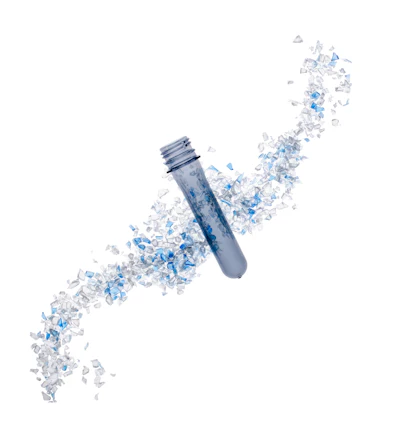
Suntory has modified its Flake-to-Preform recycling technology to produce 100% recycled PET bottles from inconsistent feedstock in Thailand, starting production in 2028 with 400 million preforms annually. The adapted method reverses the decontamination process to handle lower-quality collected bottles while maintaining food-grade safety standards and reducing CO₂ emissions by approximately 70%.
- Suntory's Flake-to-Preform (F-to-P) technology will produce 400 million rPET preforms yearly in Thailand beginning 2028, marking the first commercial F-to-P deployment in Southeast Asia.
- The modified process melts PET flake first, then decontaminates it—reversing Japan's approach—to accommodate the greater variability in Thailand's collected bottle quality.
- CO₂ emissions are reduced by approximately 70% compared to virgin fossil-based material, while maintaining food-grade quality and safety standards required for beverage packaging.
- A joint venture between Indorama Ventures PCL and Iwatani Corp will operate the facility, with Suntory PepsiCo Beverage (Thailand) as the dedicated offtake partner for all preforms.
- Suntory aims to achieve 100% sustainable materials across all PET bottles globally by 2030, having reached 42% as of 2025.
Suntory Group says it is committed to recycled or bio-based materials for all of its PET bottles globally by 2030, and it seems to be making progress.
"As of 2025, sustainable materials account for 42% of PET bottles used globally across the Group," says Kosuke Tamura, general manager of technical strategy planning and development at Suntory Holdings. "We continue to advance initiatives based on our 2R+B (Reduce, Recycle + Bio) strategy toward achieving our 2030 goal."
Closing the remaining gap means making recycled PET work in markets that don't collect bottles as neatly and efficiently as Japan. Thailand is going to be Suntory's first testing ground.
Beginning in 2028, Indovida (Thailand) Limited will produce roughly 400 million PET preforms per year using Suntory's patented Flake-to-Preform (F-to-P) Direct Recycling technology. Indovida is a joint venture formed in July 2026 by Indorama Ventures PCL and Japan's Iwatani Corp. Meanwhile, an end-market is already specified. Suntory PepsiCo Beverage (Thailand) will procure all of the preforms as a dedicated offtake partner, and blow and fill them for products sold in the Thai market. Indorama will supply most of the flake. According to stakeholders, this is the first commercial use of F-to-P for PET bottles in Southeast Asia.
"As of 2025, sustainable materials account for 42% of PET bottles used globally across the Group," says Kosuke Tamura.
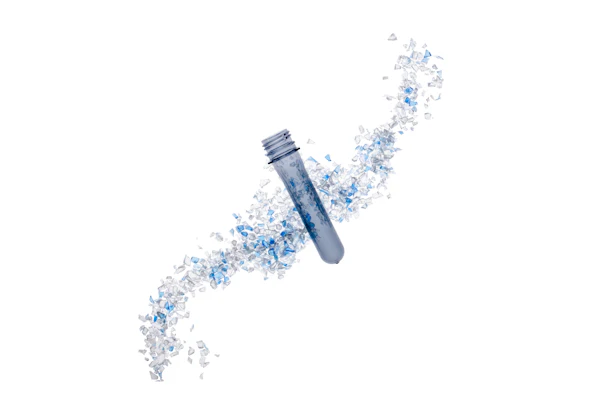
The F-to-P converts washed PET flake directly into preforms, eliminating steps that conventional bottle-to-bottle recycling requires, including crystallization and drying. Suntory developed the system with three partners, including Japanese recycler Kyoei Industry, and has used it for its soft drink bottles in Japan since 2018. The two F-to-P routes diverge only in the middle, where Japan decontaminates flake before melting and Thailand reverses the order to treat the melt instead. Indorama Ventures supplies the flake, Indovida (Thailand) Limited produces the preforms, and Suntory PepsiCo Beverage (Thailand) takes it from preform to filled bottle.Suntory Group
Rebuilding the process for Thai feedstock
The constraint on taking F-to-P out of Japan has always been input quality. Japanese collection delivers unusually clean bottles and the process was built around them.
In Japan, flake is decontaminated and then melted. In Thailand, it is melted and then decontaminated.
"Compared with Japan, the quality of collected PET bottles in Thailand generally shows greater variability," Tamura says. "To address this, the F-to-P technology introduced in Thailand has been optimized for local conditions, including selection criteria and the decontamination process. As a result, the system can accommodate a wider range of collected PET bottle quality while maintaining the same food-grade quality and safety standards achieved in Japan."
The adaptation is most recognizable in the process order. In Japan, flake is decontaminated and then melted. In Thailand, it is melted and then decontaminated.
"The technology was optimized for the characteristics of locally collected PET bottles in Thailand and was designed to suppress the formation of certain chemical substances that may occur during the melting process, while maintaining the required food-grade quality and safety standards," Tamura says.
Suntory wouldn't describe how, at least not yet. Tamura says that details of the decontamination mechanism and process conditions are proprietary and therefore cannot be disclosed.
Austria-based NGR (Next Generation Recyclingmaschinen GmbH) supplies the decontamination equipment and Husky Technologies supplies the injection molding system that produces the preforms. Both were brought in to adapt the process to Thai conditions. The Japanese F-to-P line that started up in 2018 used a different equipment pairing. In this rendering of the FtoP line planned for Thailand, washed PET flake enters at left and finished preforms exit the yellow Husky injection molding system at right. NGR’s decontamination equipment sits at the center, positioned after the melt rather than before it as the Japanese line is configured.Suntory Group
What it means
For packaging engineers weighing recycled content in their own portfolios, the question is what 100% rPET preforms do downstream.
Suntory says the processing window for blow molding is broadly comparable to that of conventional recycled PET. The comparison is worth reading closely, since conventional rPET already tends to require a tighter window than virgin resin. The company also says the technology has obtained approval for food-contact applications in Thailand and is designed to meet quality and safety requirements for beverage packaging. It did not identify the approving authority or say whether the clearance covers the direct flake-to-melt route specifically or recycled PET more broadly.
Suntory chose not to provide acetaldehyde, yellowness index, or haze figures, or to say whether Suntory PepsiCo Thailand's blow molding lines require modification to run the material.
On carbon, Suntory estimates F-to-P cuts CO₂ emissions by about 70% versus bottles made from virgin fossil-based material, a figure its announcement footnotes as calculated for Japan only.
"Suntory does not expect a significant difference for the technology introduced in Thailand, but will continue to verify the impact because manufacturing processes and the local electricity mix differ," Tamura says.
Leadership speaks on a work in progress
Several particulars remain unsettled in this continually evolving project. The facility site has not been finalized, though Tamura says a location owned by Indorama Ventures is under consideration. That leaves a 2028 production start with a stated capacity and a named offtake partner, but no confirmed address. The specific beverage brands and pack sizes to use the new blown rPET preforms are also undisclosed. Tamura says the preforms are expected to go into Suntory PepsiCo Beverage (Thailand)'s key beverage products, so the mainstream bottles, but specifics cannot be given this far ahead of production. Suntory will review commercialization in Thailand before considering expansion elsewhere in Southeast Asia. But leaders among the project's stakeholders believe innovation of this magnitude requires moving and collaborating before all the details are certain and locked into place.
“A truly circular economy can only be built through collaboration across the value chain,” says Aloke Lohia, group CEO of Indorama Ventures. “With Suntory Group and Iwatani Corporation, we are bringing together world-class innovation and expertise to make commercial-scale circular PET production a reality in Thailand. This partnership helps us position Thailand as a regional leader in circular packaging solutions while creating long-term value for the environment, our customers and the economy.”
Kenji Motoori, director, senior managing officer, and GM of Iwatani Corporation’s Materials Business Group, says the joint venture’s role is to ensure a stable supply of high-quality recycled PET preforms as F-to-P is commercialized in Thailand, and that Iwatani will keep working with its partners toward a circular economy.
“We see the introduction of this F-to-P technology in Thailand as a significant step forward in expanding the adoption of sustainable PET bottle, which is a key target of Suntory Group,” concludes Jun Asaki, chief sustainability officer of Suntory Holdings. “Through collaboration with a wider range of partners, we aim to promote PET bottles as a sustainable packaging solution in Thailand and across Southeast Asia, contributing to the realization of a circular society and environmental impact reduction.”