These innovations demonstrate the packaging industry's commitment to enhancing consumer experience while addressing inclusivity concerns.
Learn more about ThePackHub's Innovation Zone here.
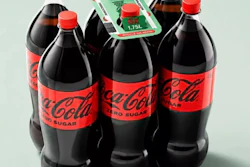
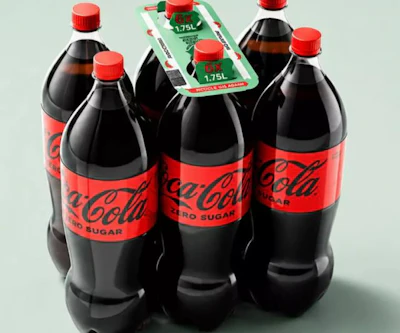
Coca-Cola uses adhesive dots to replace shrink film on PET multipacks
Coca-Cola and Coca-Cola Europacific Partners (CCEP) are conducting a limited retail trial in Germany and France of a secondary packaging format for PET bottle multipacks that removes the conventional plastic shrink film. The alternative format holds individual PET bottles together using strategically positioned adhesive dots, with a rigid cardboard carrying handle fitted to the assembled pack. The adhesive connections are designed to provide sufficient stability while the multipack moves through transport, distribution, retail handling and consumer carrying. Bottles can subsequently be separated from the pack by gently twisting or carefully pulling them apart, allowing each container to be removed without requiring an outer plastic film. As this opening method differs from conventional shrink-wrapped multipacks, graphic illustrations and point-of-sale instructions are being used to communicate the separation process to consumers. The trial is examining packaging stability, feasibility within the supply chain, retail handling and consumer acceptance. Once all bottles have been removed, the cardboard carrying component can be placed in the appropriate paper and cardboard recycling stream, while the PET bottles continue through established bottle collection and recycling systems. By eliminating shrink film from the format, the approach is intended to reduce the quantity of secondary plastic packaging required for multipacks and simplify the separation of different packaging materials after use.
 Lush says that one shampoo bar provides approximately 50 washes on average and is equivalent to three 8.8 oz bottles of liquid shampoo.ThePackHub
Lush expands packaging-free solid cosmetics removing primary packs
Lush, a cosmetics company based in Poole, Dorset, UK, has expanded its use of packaging-free formats across shampoo, shower gel, and other solid personal care products. The packaging approach removes conventional primary containers such as plastic bottles by formulating the contents as solid products that can be sold without an individual pack. The latest additions extend this approach across several solid formats, including shampoo bars and solid shower gels. From a packaging perspective, the format transfers some functions normally performed by the container to the formulation itself. Reducing water content enables ingredients that remain solid at room temperature, including cocoa butter, to be used within the formulation, while the products are designed to be self-preserving. The solid format also changes distribution requirements because concentrated products occupy less space and weigh less than comparable bottled liquids. Lush says that one shampoo bar provides approximately 50 washes on average and is equivalent to three 8.8 oz (250 g) bottles of liquid shampoo. The company also estimates that one truck carrying shampoo bars can transport the equivalent of 800,000 washes, compared with 15 trucks for the equivalent quantity of liquid shampoo.
 The aluminum can is reportedly 92% lighter than an equivalent glass bottle.ThePackHub
Domaine des Herbauges develops lightweight aluminum can for wine packaging
Domaine des Herbauges, based in Loire-Atlantique, France, has developed a lightweight aluminum wine can designed to reduce packaging weight, improve transport efficiency and provide an alternative to traditional glass wine bottles. The packaging innovation was developed over a five-year period with the objective of reducing container weight while offering a practical single-serve format. The aluminum can is reportedly 92% lighter than an equivalent glass bottle, contributing to lower transport weight throughout the supply chain. The company also reports an 88% reduction in the packaging carbon footprint compared with its glass alternative, based on its own assessment. Manufactured from aluminum, the container is designed to be recycled through established metal recycling systems, with aluminum capable of being recycled repeatedly without significant loss of its material properties. The packaging incorporates a full-opening lid, allowing the can to be used as a drinking vessel after opening, eliminating the need for separate disposable tasting cups in certain consumption settings. The compact format is intended for individual servings and is suitable for applications such as travel, hospitality, transport services and other on-the-go occasions.
Learn more about ThePackHub's Innovation Zone here.