SPC's Retailer Forum brings together major retailers like Amazon and Walmart to align on sustainable packaging priorities and guide suppliers toward scalable innovation solutions that meet regulatory demands.
- The SPC Retailer Forum launched in 2025 to address communication gaps between retailers and packaging suppliers on sustainable innovation priorities.
- The forum's first project focused on low-barrier flexible films, resulting in nine supplier submissions with solutions already at scale or nearing commercialization.
- The second project brief, launched at SPC Impact 2026, targets rigid packaging formats including beverage bottles and personal care containers with emphasis on source reduction and recyclability.
- Suppliers must meet regulatory compliance including California SB 343 and SB 54, plus recyclability validation through How2Recycle, APR, and third-party standards.
- Retailers like Walmart emphasize the need for unified alignment on packaging innovation priorities to provide clearer direction to their supply base.
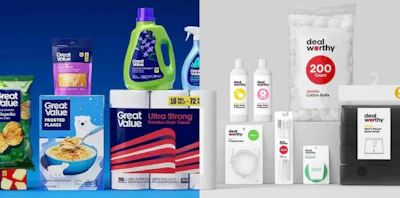
SPC’s Retailer Forum launched in 2025 as a way for major retailers with private label brands to work together on those packaging challenges they were struggling to solve individually. Retailers including Amazon, Walmart, Target, and CVS wanted to give packaging suppliers more direct guidance on where sustainable innovation was most urgently needed.
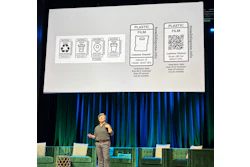
During the recent SPC Impact 2026 conference, Brandi Parker, founder and consultant at Parker Brands and Forum facilitator, shared that one of the earliest challenges was that retailers’ priorities were not clearly reaching suppliers. “Something we heard over and over again is, ‘I’m going to my suppliers, and I’m saying, “Guys, we really need to start innovating on X, Y, Z.” And the suppliers would be like, ‘Well, we’re not really hearing that,’” Parker said.
That communication gap became the foundation for the Forum’s first collaborative exercise. Retailers anonymously mapped their highest-priority packaging pain points, which helped shape the inaugural supplier brief. That process was designed to pool retailer demand, provide clearer supplier direction, and uncover solutions capable of moving beyond pilot programs.
That first brief centered on low-barrier flexible films, where retailers saw an opportunity to improve recyclability but needed stronger supplier innovation to bring scalable solutions to market. Nine supplier submissions followed, all representing solutions either already at scale or nearing commercialization.
 Cheryl Lam, Walmart, and Matt Swenson, AmazonPackaging World
For Amazon, one of the biggest surprises was the quality and originality of what came back. “My concern coming into it really was that this was just going to resurface the common solutions that we’re seeing with some known problems,” said Matt Swenson, senior sustainability specialist at Amazon. “But real, novel innovation was coming through.”
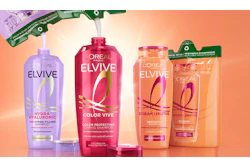
At the conference, the Forum launched its second project brief, this time shifting toward rigid packaging formats such as beverage bottles, personal care containers, pharmaceutical packaging, and home care bottles. The new challenge is focused on source reduction, seeking recyclable, reusable, or refillable container and bottle solutions that minimize or eliminate virgin plastic while remaining operationally viable in existing retail supply chains. Suppliers are also being asked to meet increasingly stringent regulatory demands, including California SB 343 and SB 54 compliance, along with recyclability validation through frameworks like How2Recycle, APR [Association for Plastic Recyclers], and third-party repulpability standards.
As the Forum moves into more complex packaging categories, Cheryl Lam, director of Walmart Brands sustainability initiatives, said the larger opportunity lies in giving suppliers clearer direction from retailers on where innovation is most needed. “I’m hoping we build on this momentum, and we start really aligning on what our needs are in a more unified way for clarity for our supply base.” PW