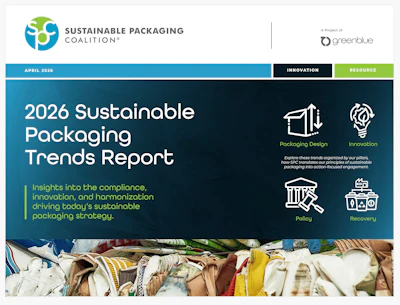
Olga Kachook, director of the Sustainable Packaging Coalition at GreenBlue, used SPC Impact 2026 to position the organization’s latest Sustainable Packaging Trends Report as a tool for companies trying to look beyond immediate regulatory pressure. “Mastering EPR compliance is an essential, inevitable part of today’s sustainable packaging landscape,” Kachook said. But, she added, “once we move beyond the complexity of implementation, we can begin to realize the benefits.”
That broader view shapes this year’s report, which outlines four major trends across packaging design, innovation, policy, and recovery. Kachook said sustainable packaging teams are under enormous pressure to manage reporting requirements, fee structures, and evolving legislation, but warned against treating compliance as a complete strategy. “The teams that treat compliance as a powerful tool within their broader strategies, as a foundation rather than a finish line, will move us meaningfully closer to realizing the promise of a circular packaging economy,” she explained.
 Cory Connors of Atlantic Packaging, and Olga Kachook, SPCPackaging World
For companies waiting for regulatory uncertainty to settle before making major packaging changes, Kachook urged a more proactive approach. Rather than delaying action, she encouraged brands to “set your own certainty” by designing packaging portfolios around the assumption that requirements are likely to remain strict or become more demanding over time.
“What if you decided we’re going to take an approach that assumes that yes, even the smallest, most annoying components that we are kind of hoping might not have to be reported on, what if we determined and set for ourselves the certainty that I think they are included,” Kachook said. Building strategies around tougher assumptions now, she argued, can help companies avoid scrambling later as regulations tighten and reporting expectations expand.
A major focus of the report is how recyclability rules are becoming more clearly defined across key global markets. Kachook pointed to Canada, the EU, and the U.K. as examples of markets moving toward more standardized recyclability definitions, creating stronger design signals for global packaging teams. “The greatest opportunity lies in global harmonization,” the report states, as more consistent definitions could help companies design packaging portfolios that can perform across markets rather than reacting region by region.
Kachook also highlighted healthcare and OTC packaging as an area where sustainability innovation is finally accelerating despite historically strict product safety requirements. “Prescription pill bottles are a massive, completely untapped opportunity that no one has touched,” she said, pointing to paper bottles, refill systems, and material substitution as signs that even heavily regulated categories are beginning to shift.
Across the report, Kachook’s larger point was that companies need to use this period of regulatory disruption to rethink packaging more fundamentally. “Companies that zoom out today to plan for the bigger picture will be better positioned to handle any turbulence tomorrow.” PW