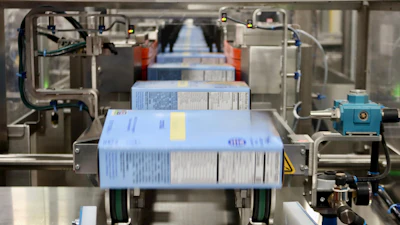
GreenSeed co-packer installed an R.A Jones CL-170 cartoner to automatically pack dry flaked products into bags and cartons, reducing waste from 3.5-4% to under 1% while meeting a major retailer's February launch deadline.
- The CL-170 cartoner runs 100 cartons per minute, fed by two vertical baggers each producing 50 pouches per minute
- Carton waste dropped from 3.5-4% to under 1% across 17 different SKUs after installation
- GreenSeed completed installation and startup in six months, meeting a tight February retail launch deadline
- The machine's adjustable bucket conveyor handles pouches and bags without significant retooling, enabling multiple customer projects on one piece of equipment
- GreenSeed already has a second project lined up for 2028, demonstrating long-term equipment utilization and ROI
When one of GreenSeed's biggest customers called with a new project, the Batavia, Ill., co-packer knew it had the capability to handle it — mostly. A major food CPG was switching its product line from a proprietary plastic canister it had used for almost 20 years to a bag-in-box format, driven by recyclability pressures that are reshaping packaging decisions across the industry.
The transition at the customer's own facilities would take roughly two years. In the meantime, they needed GreenSeed to run it, specifically filling dry flake product into metallized PET pouches on two vertical baggers and cartoning the finished bags for retail at volume, five days a week.
GreenSeed, a co-packer with two facilities, seven vertical pouch lines, and a deep specialization in dry products, had the baggers. What it didn't have was an automated cartoner capable of keeping pace with the output of two lines simultaneously.
The older unit on the floor could form and present cartons well enough for lower-volume work, but it relied on associates to manually load each pouch, and it was running 3.5 to 4 percent carton scrap in the process. For a project at this scale, with a hard February retail launch and a major retailer shelf date no one could afford to miss, that setup wasn't a serious option.
"We did not have a carton solution to pack that off automatically," says Scott Robison, GreenSeed's head of sales and business development. "That's the simplest way to put it."
The contract was awarded in June 2025. GreenSeed had six months.
Finding a solution
Jeff Sawyers, GreenSeed's president, had spent nearly 20 years at Power Packaging before joining the company, and R.A Jones cartoners had been part of the equipment mix throughout his career there. When GreenSeed started evaluating options, that history mattered, but so did the calendar.
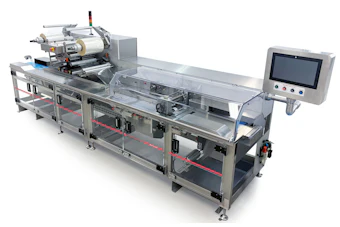
Many competing cartoner suppliers were quoting lead times of eight to twelve months, which ruled them out before the conversation got far. R.A Jones, it turned out, had a unit already built for PACK EXPO Las Vegas that fall. That was the Alterion CL-170, a new platform the company had developed specifically for the contract packaging and mid-sized regional brand owner market.
GreenSeed moved quickly. The purchase order was in place well before PACK EXPO opened, and when the show floor filled up in Las Vegas, the CL-170 was on display with a sign: “Sold to GreenSeed.” After the show, Jones added a few customer-specified options to the machine and shipped it by year's end, on schedule and with time to spare for installation and startup.
The CL-170 represented a deliberate step by R.A Jones into a segment of the market the company hadn't traditionally targeted. Known for high-speed, high-volume dedicated lines serving the largest food manufacturers in the country, Jones designed the CL-170 to bring that same reliability to a different kind of buyer.
"We wanted to bring that same value down to this contract packaging and regional brand owner market," says Rich Clifton, R.A Jones director of marketing and communications.
Pre-built sections keep lead times short. An adjustable bucket conveyor handles pouches, bags, or cracker slugs without significant retooling. Carton range runs from roughly five inches to eleven inches in product length, the kind of flexibility that lets a co-packer bid multiple projects against a single piece of capital equipment with some weight behind it.
 After installing its new CL-170 cartoner from R. A Jones, GreenSeed's dry product line is running much more efficiently and with less than 1 percent scrap.GreenSeed
Handling a curveball
The installation was progressing on schedule when, about a month before factory acceptance testing, the customer came back with a problem. Their packaging engineers had originally designed a carton footprint that turned out to be too small for the product. Retail was going to need more shelf space. The carton dimensions had to change, but that wasn't the only moving part.
Because the product had been formulated for decades to fill a rigid canister, this meant that bulk density was calibrated for a format that no longer existed. The metallized PET pouches, especially the 16-ounce size, were coming out too large to fit the revised carton. The product dosage itself needed to be reformulated for it to fit into the pouch.
"It was a very stressful time for everybody," Sawyers says. "You can't miss your launch to a major retailer"
What made the difference, Robison says, was the communication between R.A Jones' engineering team and the customer's packaging engineers. The teams worked through board thickness, flap taper, and other carton specs in real time as dimensions were still being finalized.
"The feedback that R.A Jones gave to the customer's engineers was something to think about when they were finalizing the design," Robison says, "and that was critical for the success of this project." GreenSeed started up in mid-December, just weeks before the February launch.
Inside the clean room
Running the dry food product also meant building a clean room, which GreenSeed did specifically for this project.
Robison says workers don full hygiene protection — hairnets, beard nets, gloves, and booties — before entering the production area, where two Hayssen vertical baggers run side by side. Dry product arrives in super sacks suspended overhead and gravity-feeds through a sub-hopper into augers that dose it into the flexible pouches. Filled pouches exiting the clean room are then manually loaded into the CL-170's bucket conveyor, the transition point between primary and secondary packaging.
The cartoner handles the rest: forming the carton, loading the pouch, sealing the end. Finished cartons move through a Mettler-Toledo x-ray unit and Domino laser date coding station before being manually packed four or five per case into corrugated shippers.
Numbers that tell the story
Robison says that since startup, the CL-170 hasn't stopped: GreenSeed has experienced very minimal operational downtime with it.
At full stride, the line runs 100 cartons per minute, fed by two vertical baggers each running 50 pouches per minute. The CL-170 is rated to 170 cartons per minute (the machine's namesake speed) which means GreenSeed is running it well within capacity. Any bottleneck, if there is one, would be on the pouch side. As the vertical lines ramp up, the cartoner has room to follow.
What’s more, carton waste is running under one percent across 17 SKUs— against the 3.5 to 4 percent baseline the previous machine had been posting. A horizontal pusher-arm design changed the equation, and the improvement shows up on the floor every shift.
GreenSeed already has a second project lined up for the machine in 2028, which is exactly the kind of long-term utilization the CL-170 was designed to support. "We already have a project we're lining up for this cartoner that we can retrofit very easily," Sawyers says. "Flexibility for a contract packager is critical."
As for the broader lesson, Sawyers keeps it simple. "You get what you pay for. It might be a little more costly initially, but the longevity, the uptime, the carton savings—it's all there."