Napco Brands automates its end-of-line palletizing across two packaging lines and extends its plant workforce while reducing turnover and safety risks by eliminating manual operations.
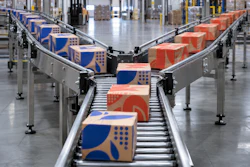
The palletizing solution receives boxes from a case sealer, and each line now moves 1,500 boxes daily to pallets.
Universal Robots
Private label brands are flexing their muscles. Over the last five years, private label sales have increased by more than 30%, or $64.8 billion, according to the 2026 Private Label Report from the Private Label Manufacturing Association. “Store brands have moved from just another item on the shelf to whole lines competing head to head with national brands and even setting the pace in some food and non-food categories and subcategories,” says Peggy Davies, PLMA President.
Unit sales growth is a good problem to have, but overall, the food industry isn’t meeting growth and margin targets. “Innovation is needed to tackle more since food companies are not launching fast enough and missing margin,” said Arnold Kogan, Managing Director and Partner with Boston Consulting Group (BCG), during the “The Connected Worker - Manufacturing Summit” in October 2025.
Napco Brands has been roasting and producing coffee since the early 1900s and has four in-house brands. Ali Papanicholas, Quality Assurance and Green Coffee Buyer at Napco Brands, tests multiple coffee samples.Napco BrandsCo-manufacturers and medium-sized food producers are searching for innovation with less capital. Many food producers have chosen to automate palletizing with collaborative robots to increase unit production, reduce changeover times, utilize capacity, and address workforce turnover.
Chicago-based Napco Brands recently implemented a collaborative robot solution for two packaging lines, resulting in higher volumes and increased plant utilization. The company roasts and packages four in-house coffee brands and produces coffee for private-label brands.
According to IBISWorld market reports, the number of businesses classified as coffee producers—roasters and manufacturers—has more than doubled in the last decade. Companies include micro-roasters, direct-to-consumer (DTC) startups, and nimble regional chains, and they have seen the U.S. coffee industry grow by 7.6% annually since 2016.
These companies need co-manufacturers with high-quality packaging and processing standards. “At Napco, we have a lot of capability to pack for private label,” says Eric Latsch, Sales Director, Napco Brands. “We have a lot of factory services we can offer, anywhere from roasting to packing it into a sealed container for retail sale, or for restaurant or food service businesses.”
To increase volume and margins, Napco Brands identified the need for more automation and robotics with palletizing. Napco has two production lines manufacturing single-serve coffee cups, but the processes were manual: An operator boxed the cups and brought the box to another operator who taped and palletized the boxes.
“Repeatable, repeated twisting and lifting overhead is a rough ergonomic application,” says Michael DeGrace, Key Account Manager at Teradyne Robotics. “It’s a high priority for food producers to find ways to deploy automation and reduce risk whenever possible.”
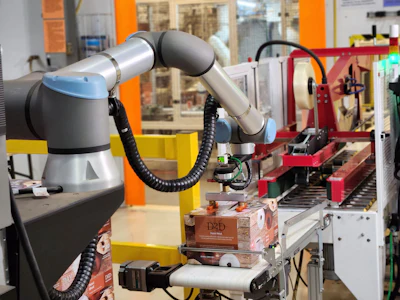
Napco Brands worked with FPE Automation, a supplier and distributor of automation components,and DesignHawk Innovations, a system integrator, to identify the right collaborative robot applications for two new production lines. Napco chose two AX10 automated palletizing solutions from Robotiq featuring the UR12e collaborative robots (cobots) from Universal Robots (UR). The high-load collaborative robots can handle a variety of pallet heights and can be customized to stack different-sized boxes in any pattern, such as turning boxes so that the box labels are visible on all sides of the pallet.
Napco changes pallet configurations after changeover using an online software tool that provides simulation for new layouts, including accurate cycle times for palletizing.Universal RobotsAutomation delivers ROI
Before the palletizing solution, Napco worked with DesignHawk to add robotics to an upstream picking application on a production line. “We learned many lessons from the robotics integration, including a lot about packaging, case erecting, programming, hardware selection, and control systems design,” says Jeff Benning, CEO of DesignHawk Innovations.
DesignHawk integrated two packaging lines for two robotic cobot palletizers that pick up boxes as they arrive on a conveyor, feed them through the automated box sealer, and place them on pallets.
The cobot palletizers have helped increase productivity at Napco Brands by approximately 15%. “Having automation and higher efficiency has made it possible for us to acquire new customers. We have several new private-label customers that we couldn’t have dreamed of two years ago,” says Latsch.
Latsch also notes that reliability in meeting customer orders is critical. “With our own brands, if you don’t get a product out, you only have to answer to yourself,” he adds. “If we’re making a product for another customer, we have a robotic solution that’s going to show up and perform.”
With the additions, the packaging lines and cobot palletizers are running two shifts, operating 18 to 20 hours per day, while each palletizing cell fills 1,500 boxes daily. The total volume reaches 180,000 single-serve coffee cups per day across the two cells.
“The automated palletizing solution reduces possible injuries and high turnover that results from repetitive tasks,” says Latsch.
Quick integration and training
DesignHawk implemented and configured the palletizing cells, and trained staff in one day. The company also provided two more days of initial training support for Napco operators. The coffee packaging line has a programmable logic controller (PLC), but built-in UR controllers for the cobot don’t require additional control logic, unlike traditional industrial robots.
Sensors detect boxes as they descend the conveyor and communicate with Robotiq software to send signals to the cobots. These UR10 cobots can move over 27.55 lbs of payload with a reach of 51.2 in. and a footprint of 190 mm.
For the palletizing setup, DesignHawk entered box sizes, pallet dimensions and formats into Robotiq’s online configurator software, which ran a simulation providing an accurate cycle time for palletizing. “That’s always one of the difficult parts of our job, determining exactly how the final system will run,” says Benning. “It was a huge benefit knowing that we’re going to meet the cycle time we need, and we’re going to put enough material in boxes at the right rate for the packaging line.”
The cobot solution at Napco offers up to 27.55 lbs of payload, with a reach of 51.2 in. and a custom pneumatic gripper from Piab.Universal RobotsDuring changeovers, trained operators at Napco reconfigure pallet stacks and layouts via the cobot’s touchscreen to change box sizes, boxes per pallet, or box direction. Eric Matthews, Production Floor Manager at Napco Brands, had no robotics experience before this implementation. “It did take a little bit of training, but it was a very easy course to go through, and it’s user friendly,” says Matthews. “After I was shown the system and took over, I was relieved. It was a pretty easy task to take over from there.”
With cobot palletizers for secondary packaging, food producers quickly understand the ROI and how they solve thorny workforce issues caused by manual palletizing. Napco cites 12 months for the ROI for the first two cobot palletizers and is evaluating other automation opportunities. “I think cobots would be helpful in almost any factory setting,” says Latsch. “It depends on the task, of course, but I could find a use anywhere for them.”
Discover How to Stay Ahead of the Competition at PACK EXPO International
See new solutions from 2,600 exhibitors. Gain insights from 150+ free educational sessions. From automation & robotics to real-time data insights, find the tech for your company’s future at North America’s largest packaging & processing event.
 Napco Brands has been roasting and producing coffee since the early 1900s and has four in-house brands. Ali Papanicholas, Quality Assurance and Green Coffee Buyer at Napco Brands, tests multiple coffee samples.Napco Brands
 Napco changes pallet configurations after changeover using an online software tool that provides simulation for new layouts, including accurate cycle times for palletizing.Universal Robots
 Napco changes pallet configurations after changeover using an online software tool that provides simulation for new layouts, including accurate cycle times for palletizing.Universal Robots
 The cobot solution at Napco offers up to 27.55 lbs of payload, with a reach of 51.2 in. and a custom pneumatic gripper from Piab.Universal Robots